
Weekend Sale - Special 75% Discount Offer - Ends in 0d 00h 00m 00s - Coupon code: 75onlydt

 Observability-Self-Hosted-Fundamentals Dumps with Practice Exam Questions Answers

Questions: 75 Questions and Answers With Step-by-Step Explanation

Last Update: Sep 13, 2026

Observability-Self-Hosted-Fundamentals Question Includes: Single Choice Questions: 43, Multiple Choice Questions: 32,

Observability-Self-Hosted-Fundamentals Questions and Answers

Question # 1

CPU utilization is being monitored on a critical Windows server and is set to notify when utilization exceeds 90%. Notification parameters are set to disregard those brief spikes over 90% and focus on sustained periods above 90%. What should be configured to accomplish the notification goal?

A.

change polling interval to match length of time for an alert to fire

B.

change polling method on the server from WMI to agent polling

C.

set node to change CPU status if threshold is met for multiple polling cycles

D.

set node to inherit CPU thresholds and alert to fire when threshold is met

Question # 2

A network discovery job was performed. The job was not correctly defined and not all devices were discovered within the network. What is the likely reason for the skipped devices?

A.

The missing devices were configured for SNPMvS.

B.

The missing devices were included in the discovery ignore list.

C.

The network discovery timeout was too short

D.

The preferred polling method in the discovery job was set to WML

Question # 3

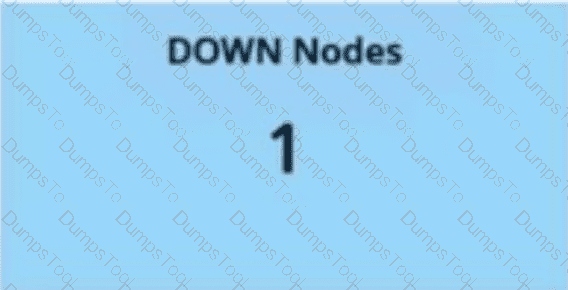
Which type of modern dashboard widget is represented?
A.

counter

B.

custom HTML

C.

KPI

D.

table

Question # 4

A group has been created to monitor a set of nodes. When additional nodes are added for monitoring, how can they be automatically placed in the group?

A.

create a custom property and add the nodes manually to a group

B.

create a custom property and add nodes to a static group

C.

create a custom property and dynamic query to add them to a group

D.

create a custom property and use an alert to add them

Question # 5

From which two of the following locations can CPU load be excluded from contributing to overall node status? (Choose two.)

A.

all nodes widget

B.

edit node properties

C.

mute node

D.

node child status

Observability-Self-Hosted-Fundamentals Exam Last Week Results!

20

Customers Passed
SolarWinds Observability-Self-Hosted-Fundamentals

90%

Average Score In Real
Exam At Testing Centre

95%

Questions came word by
word from this dump

An Innovative Pathway to Ensure Success in Observability-Self-Hosted-Fundamentals

DumpsTool Practice Questions provide you with the ultimate pathway to achieve your targeted SolarWinds Exam Observability-Self-Hosted-Fundamentals IT certification. The innovative questions with their interactive and to the point content make your learning of the syllabus far easier than you could ever imagine.

Intensive Individual support and Guidance for Observability-Self-Hosted-Fundamentals

DumpsTool Practice Questions are information-packed and prove to be the best supportive study material for all exam candidates. They have been designed especially keeping in view your actual exam requirements. Hence they prove to be the best individual support and guidance to ace exam in first go!

Observability-Self-Hosted-Fundamentals Downloadable on All Devices and Systems

SolarWinds SolarWinds Certified Professional Observability-Self-Hosted-Fundamentals PDF file of Practice Questions is easily downloadable on all devices and systems. This you can continue your studies as per your convenience and preferred schedule. Where as testing engine can be downloaded and install to any windows based machine.

Observability-Self-Hosted-Fundamentals Exam Success with Money Back Guarantee

DumpsTool Practice Questions ensure your exam success with 100% money back guarantee. There virtually no possibility of losing SolarWinds SolarWinds Certified Professional Observability-Self-Hosted-Fundamentals Exam, if you grasp the information contained in the questions.

24/7 Customer Support

DumpsTool professional guidance is always available to its worthy clients on all issues related to exam and DumpsTool products. Feel free to contact us at your own preferred time. Your queries will be responded with prompt response.

SolarWinds Observability-Self-Hosted-Fundamentals Exam Materials with Affordable Price!

DumpsTool tires its level best to entertain its clients with the most affordable products. They are never a burden on your budget. The prices are far less than the vendor tutorials, online coaching and study material. With their lower price, the advantage of DumpsTool Observability-Self-Hosted-Fundamentals SolarWinds Observability Self-Hosted Fundamentals Practice Questions is enormous and unmatched!

SolarWinds Observability-Self-Hosted-Fundamentals Practice Exam FAQs

1. What is the SolarWinds Observability-Self-Hosted-Fundamentals exam?


The SolarWinds Observability-Self-Hosted-Fundamentals exam is a certification test under the SolarWinds Certified Professional (SCP) program. It validates a candidate's foundational knowledge in deploying, managing, and troubleshooting hybrid and on-premises infrastructure, networks, applications, and logs using SolarWinds self-hosted observability platforms.

2. Who is the ideal target audience for this certification?


The target audience includes Network Administrators, System Engineers, Infrastructure Operations Specialists, DevOps/SRE professionals, and IT support teams responsible for monitoring on-premises and hybrid multi-vendor IT environments using SolarWinds tools.

3. What career and job opportunities open up after passing this exam?


Earning this credential qualifies professionals for high-demand IT roles such as SolarWinds Administrator, Network Monitoring Engineer, Systems Operations Specialist, IT Infrastructure Analyst, and Observability Engineer across enterprise IT environments.

4. What is the official cost and format of the exam?


The official SolarWinds exam fee is $200 USD (or 60,000 THWACK points). The test consists of 75 multiple-choice and scenario-based questions to be completed within a 90-minute limit, with an online proctored delivery.

5. What prerequisites are recommended before taking the exam?


While there are no formal prerequisites, SolarWinds recommends roughly six months of hands-on operational experience with SolarWinds self-hosted monitoring platforms and at least one year of general IT systems/network administration background.

6. Why should I use Dumpstool for my exam preparation?


Dumpstool provides verified Observability-Self-Hosted-Fundamentals real questions paired with comprehensive, concept-clearing explanations. Our materials reflect the exact current syllabus, allowing candidates to master core observability mechanisms rather than relying on rote memorization.

7. Are there any discount offers available on Dumpstool?


Yes. Dumpstool regularly runs seasonal and promotional discounts across all SolarWinds study packages, making high-quality Observability-Self-Hosted-Fundamentals study guides and test engines accessible at competitive pricing.

8. How regularly are the PDF questions and practice sets updated?


Dumpstool's team of monitoring and IT operations specialists updates the question bank immediately whenever SolarWinds modifies the exam blueprint, ensuring you always practice with current, valid material.

9. What is the Dumpstool success guarantee?


Dumpstool backs its preparation products with a success guarantee. We are confident in the accuracy of our Observability-Self-Hosted-Fundamentals exam questions, promising that thorough study with our materials will enable you to pass your certification on your first attempt.

Our Satisfied Customers Observability-Self-Hosted-Fundamentals