dumpstool logo

Which situation is considered an imminent health hazard and requires the restaurant to be closed?
A guest slips and falls on gravel in the parking lot, breaks a hip, and requires emergency transport.
An employee is rushed to the emergency room unconscious with an unidentified illness.
A fire starts in the kitchen and spreads to other areas of the operation.
The sanitizer dispensers in the restrooms are empty and delivery of more is expected in the next half hour.
Animminent health hazardis a significant threat or danger to health that is considered to exist when there is evidence sufficient to show that a product, practice, circumstance, or event creates a situation that requires immediate correction or cessation of operation to prevent injury. According to1the FDA Food Code and ServSafe2, afire in the kitchenthat spreads to other areas is a classic example of an imminent health hazard. Fire compromises the safety of the food through smoke damage, chemical contamination from fire extinguishers, and the loss of temperature control (electricity or gas).34
Other common imminent healt5h hazards include an extended power outage, a failur6e of the public water supply, a sewage backup, or a significant pest infestation. In these cases, the Person in Charge (PIC) must immediately stop all operations and notify the regulatory authority. The restaurant cannot reopen until the hazard is eliminated and the authority gives approval. While a guest injury (Option A) or a sick employee (Option B) are serious incidents, they do not necessarily compromise the safety of the entire food supply in the way a fire or flood does. Empty sanitizer dispensers (Option D) are a sanitation violation but can be corrected immediately without closing the facility. Managing imminent health hazards is a high-level responsibility that requires the PIC to prioritize public safety over business continuity.
Customers experiencing allergic reactions often show which symptom?
Fever
Jaundice
Hives
Sneezing
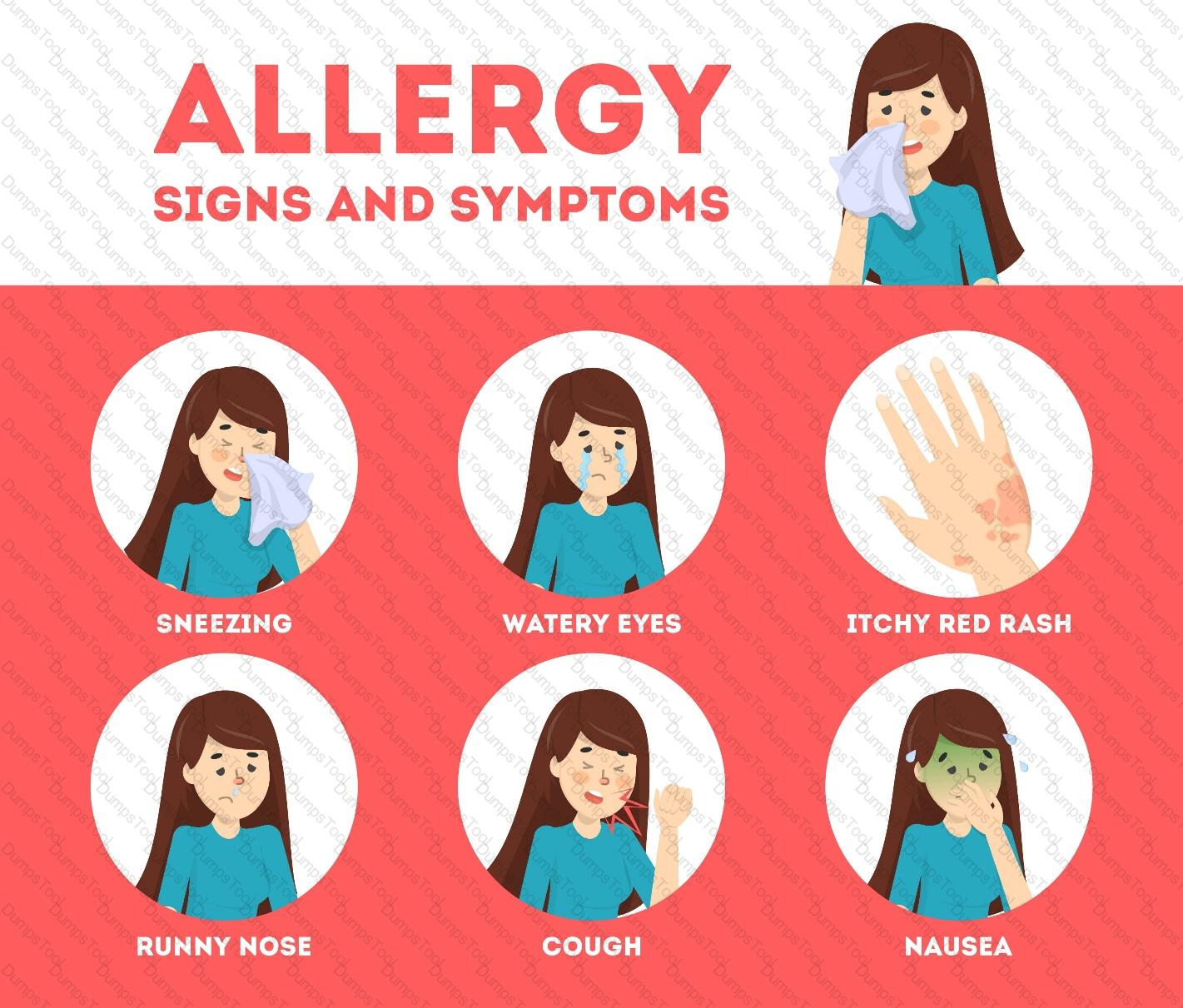 Image of allergic reaction symptoms
Shutterstock
Food allergies are an immune system response to specific proteins in food. While symptoms can vary significantly between individuals,hives(urticaria)—which are itchy, raised red welts on the skin—are one of the most common and recognizable signs of an allergic reaction. Other typical symptoms include swelling of the face, lips, or tongue (angioedema), abdominal cramps, vomiting, and shortness of breath. In the most severe cases, a customer may experience anaphylaxis, a life-threatening condition that can cause the throat to close and blood pressure to drop.
It is crucial for food handlers to distinguish allergy symptoms from foodborne illness symptoms. Fever (Option A) is usually a sign of an infection (biological contamination). Jaundice (Option B), a yellowing of the skin and eyes, is a specific symptom ofHepatitis A, which requires the exclusion of the employee from the facility. Sneezing (Option D) is generally associated with respiratory issues or seasonal allergies, rather than food allergies. When a guest notifies staff of an allergy, the manager must ensure that "cross-contact" is prevented by using clean and sanitized equipment and preparing the meal separately. If a guest begins showing symptoms like hives shortly after eating, the manager should call emergency services immediately, as the reaction can escalate rapidly. Training staff to recognize these signs is a key component of the "Providing Safe Food" domain.
A label on foods prepared and packaged onsite for retail sales must list which information?
A copy of the recipe used to prep the product
A list of all ingredients used in descending order by weight
Inspection score of the prep facility
Use-by dates that are 5 days after product prep
When a food establishment packages food for retail sale (such as a "grab-and-go" cooler), it must comply with strict labeling requirements mandated by the FDA Food Code. The label must include the common name of the food, the quantity (weight), the name and place of business of the manufacturer, and, crucially, alist of all ingredients in descending order by weight. This transparency is vital for consumer safety, particularly regarding food allergies.
The label must also clearly identify any of theBig 9 major allergenscontained in the food. If an ingredient (like bread) contains other sub-ingredients, those must also be listed. Option A is incorrect because the specific recipe is proprietary and not required for a safety label. Option C is incorrect as inspection scores are public record but not required on food labels. Option D is incorrect because the standard shelf life for TCS food is 7 days, not 5, and the specific date must be calculated based on the earliest expiring ingredient. Proper labeling allows guests to make informed decisions and protects the establishment from liability in the event of an allergic reaction. Managers must verify that every packaged item is accurately labeled before it is placed in the retail area to ensure compliance with both federal and local health laws.
Before which activity should a food handler apply gloves?
Taking out the trash
Opening the cooler
Receiving a delivery
Handling raw carrots
Single-use gloves serve as a critical barrier between the food handler’s hands andready-to-eat (RTE) food. According to the FDA Food Code, gloves must be worn whenever a food handler is touching RTE food with their bare hands. While carrots may eventually be cooked, "raw carrots" are often served as sticks or in salads without further cooking. Even if they are to be cooked later, the standard practice in a professional kitchen is to use gloves when preparing fresh produce to minimize the introduction of pathogens.
The other activities listed—taking out trash (Option A), opening a cooler (Option B), and receiving a delivery (Option C)—do not involve direct contact with exposed RTE food. In fact, wearing gloves for these tasks can lead to a false sense of security and actually increase the risk of cross-contamination if the handler then touches food without changing them. The correct sequence for applying gloves is: (1) Wash hands thoroughly, (2) Select the correct glove size, (3) Pull them on, and (4) Check for rips or tears. Gloves must be changed at least every four hours, when switching tasks, or if they become soiled or torn. By applying gloves specifically for "handling raw carrots," the food handler ensures that no pathogens from their skin or environment are transferred to a product that a guest may consume raw.
There has been a recall of chicken tenders due to intentional tampering. The Person in Charge (PIC) has determined that the operation serves the type of chicken tenders recalled. What should the PIC do?
Tell food handlers to cook the tenders longer.
Continue serving, since the probability of having received tainted food is slim.
Immediately locate and isolate all of the chicken tenders and call the regulatory authority.
Donate all of the chicken tenders to a local food bank.
Intentional tampering is a "food defense" issue and represents a critical threat to public safety. Unlike accidental biological contamination, intentional tampering may involve chemical, physical, or biological agents that are not necessarily destroyed by heat. Therefore, telling staff to cook the food longer (Option A) is an ineffective and dangerous response. According to ServSafe guidelines for managing recalls, especially those involving a security threat, the PIC must immediately take t1he product out of service by locating and isolating it.
The isolated food must be clearly labeled with "Do Not Use" and "Do Not Discard" signs to prevent any accidental preparation. It should be stored in a separate area from all other food and equipment. Furthermore, because this recall involves "intentional tampering," the PIC must notify the local regulatory authority (health department) and potentially law enforcement. This ensures that the incident is tracked and that the source of the tampering can be investigated. Continuing to serve the food (Option B) is gross negligence. Donating the food (Option D) is unethical and illegal, as it passes a known hazard to another population. This procedure is a key part of theA.L.E.R.T.food defense program, specifically the "Report" and "Threat" components, which emphasize transparency and cooperation with health officials during a crisis.
==========
Which of the following is evidence of deliberate tampering of food?
Labels are missing from food containers.
Sulfites are added to prevent browning of lettuce.
Protective seal or wrapper is missing from a food container.
Food employees are handling ready-to-eat foods with bare hands.
Food defense is the protection of food products from intentional contamination by biological, chemical, physical, or radiological agents. While "accidental" contamination (like a hair in a soup) is common, "deliberate tampering" is an act of sabotage. According to the ServSafe Manager guidelines and the FDA’sA.L.E.R.T.program, one of the most visible signs of tampering is amissing or broken protective seal or wrapperon a food container. These seals are designed to guarantee the integrity of the product from the manufacturer to the end-user. If a seal is broken, it suggests that an unauthorized individual may have had access to the contents.
Managers must train receiving staff to inspect all incoming deliveries specifically for signs of tampering. This includes checking for punctured packaging, leaking containers, or boxes that appear to have been resealed with non-factory tape. While missing labels (Option A) are a regulatory violation and bare-hand contact (Option D) is a hygiene failure, they do not necessarily indicate a malicious attempt to harm the public. Adding sulfites (Option B) is actually a prohibited practice for fresh produce in many jurisdictions, but it is a chemical additive issue rather than tampering. To mitigate the risk of deliberate contamination, the A.L.E.R.T. system suggests that managers:Assure products are from safe sources,Look and monitor the security of the facility,Employees (know who is in the building),Report and keep records, andThreat (know what to do if a threat occurs). Isolating and reporting any products with suspicious packaging is a mandatory step in protecting the business and its customers from intentional harm.
What is one approved way to preset utensils?
Wrap them in a napkin.
Preset indoors only.
Remove them at the end of the day.
Use only clear plastic utensils.
In the "Flow of Food," the service stage involves protecting utensils from contamination before they are used by the guest. According to the ServSafe Manager curriculum and the FDA Food Code, if a table is preset with silverware, the utensils must be protected from contamination.Wrapping them in a napkinis a primary approved method because it provides a physical barrier against dust, droplets from coughs or sneezes, and accidental contact by other guests or staff.
The regulation states that if utensils are preset and not wrapped, they must be removed and replaced when a new customer is seated, regardless of whether they appear to have been used. However, if the utensils are wrapped—such as in a "roll-up" where the napkin completely covers the items—they do not need to be swapped out if the previous guest did not use them. This is because the wrapping ensures the "sanitary status" of the items remains intact. Other approved methods include using a dispenser that only allows the user to touch the handle of the utensil. Options such as "presetting indoors only" (Option B) or "removing at the end of the day" (Option C) do not provide specific protection against contamination during the hours of operation. Proper handling of utensils is a critical part of the service phase to prevent the transmission of pathogens likeStaphylococcus aureusfrom human contact or environmental debris. Managers must ensure that staff who prepare these roll-ups wash their hands thoroughly before touching the clean silverware.
A server finds a full napkin-lined basket of dinner rolls on a table after a customer has left the establishment. According to the FDA Food Code, what should the server do with the rolls and napkin?
Remove the napkin and discard the rolls.
Reuse the napkin but replace the rolls with fresh ones.
Replace the napkin and donate the unused rolls to charity.
Replace the napkin and give the unused rolls to employees for staff meal.
The FDA Food Code is very clear regarding the re-service of food. Once food has been served to a guest, it is considered "potentially contaminated" and cannot be served to another guest, donated, or given to staff. Therefore, the server mustdiscard the rolls. Even if the rolls appear untouched, they have been exposed to the guest's environment, where they may have been coughed on, sneezed on, or touched with unwashed hands.
The only exceptions to this "no re-service" rule are foods that are packaged and in good condition, such as unopened cracker packets, individual condiment packets (like ketchup or mustard), or wrapped "saltine" crackers. Rolls in an open basket do not meet this criteria. Regarding the napkin, if it is a cloth napkin, it must be sent to the laundry. If it is a paper napkin, it must be discarded. Reusing any part of the service (Option B) or donating contaminated food (Option C) poses a significant risk of spreading foodborne illness, specificallyStovirusorStaphylococcus aureus. Managers must train front-of-house staff to never "recycle" bread, butter, or garnishes that have been placed on a customer's table. This protocol ensures that every guest receives food that is fresh and has not been subjected to previous human contact.
A consumer advisory must be given when an operation serves
steamed mussels.
raw oysters.
poached salmon.
roasted pork.
According to the FDA Food Code and ServSafe standards, any establishment that serves raw or undercooked Time/Temperature Control for Safety (TCS) foods must provide aconsumer advisory. This advisory is a formal notice to guests that consuming raw or undercooked meats, poultry, seafood, shellfish, or eggs increases the risk of foodborne illness, especially for those with certain medical conditions.Raw oystersfall directly into this category because they are a raw shellfish product frequently associated with pathogens likeVibrio vulnificusandNorovirus.
The advisory consists of two parts: adisclosureand areminder. The disclosure usually involves marking the specific menu item with an asterisk (*) to indicate that it is raw or undercooked. The reminder is a written statement, usually located at the bottom of the menu, that explains the health risks associated with those items. Steamed mussels (Option A), poached salmon (Option C), and roasted pork (Option D) are typically cooked to their required minimum internal temperatures, which eliminates the need for an advisory. For raw oysters specifically, many jurisdictions also require a "Hepatitis A" warning or specific shellfish tags to be maintained. Managers must ensure that the advisory is clearly visible and legible to all guests before they place their order. This protocol is an essential component of "Active Managerial Control," shifting some of the risk assessment to the consumer while ensuring they are fully informed of the biological hazards inherent in raw animal proteins.
A food handler is assigned to monitor self-service food bars because customers may:
need help in selecting food.
attempt to steal food from the line.
place too much food on their plates.
contaminate food while moving through the line.
Self-service areas, such as buffets and salad bars, present a significant challenge to food safety because the food is exposed to the public. ServSafe Manager guidelines require that these areas be monitored by trained employees primarily to preventaccidental or intentional contaminationby customers. Unlike a controlled kitchen environment, customers in a self-service line may not be aware of food safety protocols. Common risks include customers using the wrong utensil for a dish (cross-contamination of allergens), returning to the line with a "dirty" plate for seconds (introducing saliva or bacteria from their previous meal), or children touching the food or sneeze guards.
The presence of a food handler acting as a monitor is a critical "Active Managerial Control" measure. This employee’s role is to ensure that sneeze guards remain in place, that utensils are kept in the food with handles pointing out, and that customers follow proper hygiene practices. If a customer is seen contaminating food—for example, by using their hands or sneezing near the display—the monitor must immediately remove the contaminated product and sanitize the area. While helping customers select food or preventing "food theft" may be secondary tasks, the primary safety objective is to protect the integrity of the food from biological, physical, and chemical hazards. The FDA Food Code specifically mandates that "effective measures" must be taken to protect food in self-service areas, and dedicated monitoring is often the most effective method. Furthermore, the monitor ensures that the food remains at proper temperatures (135°F or higher for hot food, 41°F or lower for cold food) and that the "First In, First Out" (FIFO) method is used when replenishing items.
If a customer with a food allergy accidentally receives a dish with the allergen in it, what should the food handler do?
Quickly heat the dish to $165^{\circ}F$ ($74^{\circ}C$).
Throw out the dish and prepare it again.
Serve the dish if the customer's allergy is not severe.
Warn the customer that cross contact may have occurred.
Food allergies are a major public health concern, and "cross-contact" occurs when an allergen is accidentally transferred from a food or surface containing an allergen to a food that does not contain it. According to the ServSafe Manager 2026 standards, which now includesesameas the ninth major allergen, the only safe response when a mistake occurs is tothrow out the dish and prepare it againusing cleaned and sanitized equipment and fresh ingredients.
Heating the dish to $165^{\circ}F$ (Option A) is ineffective because allergens are proteins, not bacteria; heat does not "kill" or neutralize an allergen. In fact, most allergens are heat-stable and remain dangerous even after cooking. Serving the dish based on the perceived severity of the allergy (Option C) is extremely dangerous, as an individual's reaction can change over time and may result in life-threatening anaphylaxis. Simply "warning" the customer (Option D) is insufficient once the contamination has already happened. To prevent these errors, managers must implement strict communication protocols between the front-of-house and back-of-house staff. This includes using separate "allergen-friendly" utensils and purple-coded equipment, if available. If a mistake happens, the "discard and restart" policy is the only way to guarantee guest safety. This process falls under the "Flow of Food" because it involves the careful management of ingredients from preparation to service.
Which is an example of "cleaning"?
Checking the final rinse temperature in the dishwasher
Spraying a solution of bleach on a cutting board
Removing food bits from a slicer with a wiping cloth
Using a dry towel to remove spots from wine glasses
In a professional foodservice environment, ServSafe makes a critical distinction between "cleaning" and "sanitizing." Cleaning is the physical process of removing food, dirt, and other visible soil from a surface. Removing food bits from a slicer with a wiping cloth is a direct example of cleaning. This step is the essential first phase in the five-step process for cleaning and sanitizing: (1) Scrape or remove food bits, (2) Wash the surface, (3) Rinse the surface, (4) Sanitize the surface, and (5) Allow the surface to air-dry.
Without the initial cleaning step, the subsequent sanitizing step will be ineffective. Soil and food particles can neutralize chemical sanitizers like chlorine or quaternary ammonium, or they can act as a physical shield that prevents the sanitizer from reaching and killing microorganisms. Options A and B describe monitoring and the act of sanitizing, respectively. Option D is a cosmetic action(polishing) that does not necessarily meet the hygienic definition of cleaning in a food-safety context. Effective cleaning requires the use of a detergent and physical labor (scrubbing or wiping) to break the surface tension of the soil. For equipment like meat slicers, this process is high-risk and must be performed at least every four hours if the equipment is in constant use. Managers must verify that staff are not skipping the "wash and rinse" phases before applying sanitizer. By removing the visible "bits" and "grease," the food handler ensures that the environment is prepared for the reduction of pathogens to safe levels.
Which is an example of possible chemical contamination?
Sauerkraut stored in a glass jar
Tomato juice stored in a plastic jar
Orange juice stored in a copper pitcher
Grapefruit juice stored in a china pitcher
Chemical contamination occurs when toxic substances are introduced into food, often through improper storage or the use of non-food-grade materials. A classic and frequently tested example in the ServSafe Manager curriculum is the storage ofacidic food or beverages in copper containers. Orange juice is highly acidic. When an acidic liquid comes into contact with copper, it causes a chemical reaction known as "leaching," where copper ions dissolve into the liquid. If consumed, this can lead to heavy metal poisoning, resulting in symptoms like nausea, vomiting, and diarrhea, often occurring within minutes.
The FDA Food Code strictly prohibits the use of "reactive metals"—including copper, brass, lead, pewter, and galvanized zinc—for the storage or preparation of acidic foods. Other examples include storing tomato sauce in a copper pot or lemonade in a galvanized bucket. In contrast, glass, food-grade plastic, and most modern china are considered "non-reactive" and safe for acidic items. Managers must ensure that all equipment used in the kitchen is labeled as "food-grade" or bears the NSF/ANSI certification. This also extends to the use of chemicals like cleaners, sanitizers, and polishes, which must be stored away from food-prep areas in their original containers or clearly labeled secondary containers. This specific hazard (toxic metal leaching) highlights the importance of understanding the chemical properties of both the food and the equipment being used. By ensuring that acidic foods never touch reactive metals, a manager eliminates a significant and preventable chemical hazard from the operation.
A detergent must be able to
kill bacteria.
remove food residue.
strip heavy grease.
eliminate the need for scrubbing.
According to the ServSafe Manager curriculum, it is vital to distinguish between cleaning and sanitizing. A detergent is a cleaning agent designed specifically toremove food residue, dirt, and other soils from surfaces. Detergents contain surfactants that reduce surface tension between the soil and the surface being cleaned, allowing the residue to be lifted and rinsed away. While some specialized detergents (degreasers) are designed to strip heavy grease (Option C), the fundamental requirement for a general detergent used in a kitchen is the removal of organic matter.
It is a common misconception that detergents "kill bacteria" (Option A); that is the function of a sanitizer. In fact, if food residue is not completely removed by the detergent first, the sanitizer will not work effectively because the organic matter can neutralize the chemical or physically protect the microorganisms. Furthermore, most detergents do not eliminate the need for scrubbing (Option D); mechanical action is almost always required to break up biofilms and stuck-on food. In the three-compartment sink method, the first sink uses a detergent solution to remove the "bulk" of the waste. Managers must ensure that the correct type of detergent is used for the task—such as heavy-duty detergents for baked-on grease or multipurpose detergents for floors and walls—and that staff understand that cleaning with a detergent is the mandatory prerequisite to the sanitization step.
What is the second compartment in a three-compartment sink used for?
Rinsing
Washing
Sanitizing
Sterilizing
The three-compartment sink is the standard for manual warewashing in a professional kitchen, and its effectiveness depends on following the correct sequence of steps. According to ServSafe and the FDA Food Code, the five-step process is: (1) Scrape/Pre-rinse, (2) Wash, (3)Rinse, (4) Sanitize, and (5) Air-dry. Thesecond compartmentis dedicated exclusively torinsing. After items are washed in the first compartment with detergent and hot water ($110^{\circ}F$), they must be moved to the second sink to remove all traces of food particles and, more importantly, detergent residue.
Rinsing is a critical "bridge" step. If detergent is not completely rinsed off, it can neutralize the chemical sanitizer in the third compartment, rendering the sanitizing step ineffective. The water in the rinse sink should be clean and changed frequently to prevent the buildup of "suds" or cloudiness. The FDA Food Code requires the rinse water to be at least $110^{\circ}F$ ($43^{\circ}C$) if used for hot-water sanitizing systems, though clean warm water is the general standard. Sterilizing (Option D) is a higher level of pathogen destruction typically used in medical settings and is not a standard kitchen procedure. By strictly separating the wash, rinse, and sanitize functions into three distinct basins, the operation ensures that each chemical and physical process can function at its maximum effectiveness, protecting the health of the customers.
Who is required to wear a hair restraint while working?
Greeters
Cashiers
Dishwashers
Hosts
Personal hygiene is a cornerstone of food safety, and hair restraints are a mandatory requirement for any staff member working in food-preparation areas or areas where equipment and utensils are cleaned. According to the ServSafe Manager curriculum and the FDA Food Code, hair restraints—such as hats, hairnets, or beard restraints—are designed to prevent hair from falling into food and onto food-contact surfaces. Hair is a physical contaminant and can also carry pathogens likeStaphylococcus aureus.
The requirement specifically targets "food handlers," which the FDA defines as anyone working with exposed food, clean equipment, utensils, linens, or unwrapped single-service items. In this question,Dishwashersare the only group listed who directly interact with clean equipment and utensils. While they may not be preparing food, their proximity to clean plates, silverware, and the "clean end" of the dish machine makes hair restraint mandatory to prevent contamination of surfaces that will later touch food or a customer’s mouth. Conversely, Greeters, Cashiers, and Hosts typically work in the "front of house" or at the entrance. Because these roles generally do not involve handling open food or cleaning kitchen equipment, they are usually exempt from the hair-restraint requirement, though they must still maintain high standards of personal neatness. For those in the kitchen, the restraint must effectively keep hair away from the face and shoulders. Managers must strictly enforce this rule for all back-of-house staff, including prep cooks, line cooks, and dishwashers, as a single strand of hair found in a meal or on a "clean" utensil can lead to both customer dissatisfaction and regulatory citations.
When the water supply has been disrupted due to a natural disaster, an acceptable alternative is
buying commercially bottled drinking water.
sanitizing water with a 50-50 mixture of bleach.
securing water from a private well tested every 2 years.
using clean water from the air conditioning system.
A disruption in the water supply is considered animminent health hazard. Because water is essential for handwashing, cooking, and sanitizing, an establishment cannot operate safely without a potable (drinkable) source. According to the ServSafe Manager curriculum, if the municipal supply fails, the only acceptable short-term alternative5for drinking and food preparation iscommercially bottled drinking waterfrom an approved source.
Other options are highly unsafe: a 50-50 bleach mixture (Option B) is toxic and would cause chemical poisoning. Private wells (Option C) must be tested at least annually, not every two years, and may not be sufficient during a disaster. Water from an air conditioning system (Option D) is non-potable and potentially contaminated with mold and chemicals. If an establishment uses bottled water, it must also address other needs, such as using single-service (disposable) plates and utensils to avoid the need for dishwashing and providing portable handwashing stations or hand sanitizer (though the latter is only a temporary measure). If safe water cannot be secured for all essential tasks, including restroom use and handwashing, the manager must close the operation until the water supply is restored and cleared by the regulatory authority.
A food establishment must have specific procedures for employees to follow when cleaning up which of the following substances?
Mold and mildew
Vomit and diarrhea
Food spills and beverage machine leaks
Rodent droppings and dead cockroaches
According to the FDA Food Code and the ServSafe Manager curriculum, every food establishment is required to have a formal, written plan for the cleanup ofvomit and diarrhea. This requirement ex1ists because these substan2ces are primary vehicles3for the transmission ofNorovirus, which is highly contagious and the leading cause of foodborne illness in the United States. Norovirus can be aerosolized (spread through the air) when a person vomits, and it can survive on surfaces for weeks if not properly disinfected.
The written procedures must detail how employees will minimize the spread of contamination to food, surfaces, and other people. This typically involves using a "Body Fluid Cleanup Kit" that includes personal protective equipment (PPE) such as disposable gloves, a gown, and a face mask. The cleanup process requires the use of a high-concentration disinfectant (such as a 1,000–5,000 ppm chlorine solution) rather than standard kitchen sanitizers, which are often too weak to kill Norovirus. The plan must also specify how to dispose of contaminated materials and how to handle the "exclusion" of the sick individual. While cleaning mold (Option A), spills (Option C), or pest evidence (Option D) is important for general sanitation, the legal mandate for aspecific written procedureis focused on Norovirus containment to prevent massive outbreaks. Managers are responsible for training all staff on these protocols before an incident occurs.
Which plant food must be transported to the serving site at $41^{\circ}F$ ($5^{\circ}C$) or below?
Chopped celery
Diced tomatoes
Sliced cucumbers
The FDA Food Code identifies certain produce items as TCS (Time/Temperature Control for Safety) foods once they have been "processed" or cut.Diced tomatoesare specifically classified as a TCS food. While a whole tomato is shelf-stable, slicing or dicing it breaks the protective outer skin and allows pathogens that may have been on the surface to enter the nutrient-rich, moist interior. Tomatoes also have a neutral pH that supports the rapid growth of bacteria likeSalmonella. Therefore, they must be maintained and transported at$41^{\circ}F$ ($5^{\circ}C$) or lower.
Chopped celery (Option A) and sliced cucumbers (Option C) are currently not classified as TCS foods by the FDA, although they should still be handled with good hygiene and refrigerated for quality. Other plant foods that require $41^{\circ}F$ control include cut leafy greens, cut melons, and sprouts. When transporting diced tomatoes, the manager must use refrigerated trucks or insulated containers with ice packs to ensure the temperature does not rise into the Danger Zone. This is a critical point for salad bars and catering operations where pre-cut produce is common. Failure to maintain temperature control for cut tomatoes has been linked to numerous large-scale foodborne illness outbreaks.
Lighting fixtures in a cooler must have bulbs that are
easily removable.
100 watts.
fluorescent.
plastic shielded.
Proper lighting is required in all areas of a food service operation to ensure that staff can clean effectively and monitor food quality. However, light bulbs are a significantphysical hazardbecause they are made of glass. According to ServSafe and the FDA Food Code, lighting fixtures in food-prep, food-storage, and service areas—including walk-in coolers and freezers—must beplastic shieldedor otherwise shatter-resistant.
The purpose of the plastic shield (Option D) or a "shatter-resistant" coating is to contain the glass fragments if the bulb should break. Without this protection, shards of glass could fall into open food containers, onto clean utensils, or onto prep surfaces, where they are nearly impossible to detect. In a cooler, where food is often stored in open or loosely covered bins, this risk is especially high. Managers must ensure that all lighting meets these safety standards during facility inspections. Beyond the physical protection, the Food Code also specifies minimum lighting intensity for different areas: for example, 10 foot-candles (108 lux) in walk-in units and dry-storage, and 50 foot-candles (540 lux) in high-intensity food-prep areas. Ensuring that bulbs are shielded and providing adequate brightness is a dual-purpose strategy that protects the physical integrity of the food while allowing for better overall sanitation and safety monitoring.
A food handler must wear single-use gloves when
washing vegetables for use on a salad bar.
pouring a beverage from a pitcher into a glass.
serving a plate of food to a customer.
making a cold sandwich with ready-to-eat deli meat.
The use of single-use gloves is a fundamental requirement when handlingready-to-eat (RTE) food. Deli meat is classified as an RTE food because it has already been cooked or processed and requires no further heating to be safe for consumption. According to the ServSafe Manager curriculum and the FDA Food Code, bare-hand contact with RTE food is strictly prohibited (with very few exceptions) because the hands can easily transmit pathogens likeNorovirus,Hepatitis A, orSalmonella Typhi.
When making a cold sandwich, the deli meat is handled directly before being served to the guest. Wearing gloves provides a critical barrier that prevents the transfer of microorganisms from the skin to the food. Washing vegetables (Option A) is a preparation step where gloves are often not required because the water and mechanical action assist in cleaning, and the vegetables may be further processed. Pouring beverages (Option B) and serving plates (Option C) are service tasks where the hands do not typically make direct contact with the food itself. It is vital to remember that gloves are not a substitute for handwashing; a food handler must wash their hands thoroughly before putting on a new pair of gloves. Furthermore, gloves must be changed if they become torn, dirty, or when switching between different tasks (such as moving from raw meat to deli meat). Managers must ensure that staff understand that the primary purpose of gloves in this context is to protect the consumer from "hand-to-food" contamination.
What information must be on the label of a sandwich to be held in a self-service unit?
Preparer's name
Preparation time
Ingredient list
Retail price
Food that is packaged in the operation and sold to customers for off-site consumption or held in self-service units must meet specific labeling requirements mandated by the FDA Food Code. One of the most critical components of this label is acomplete list of ingredients in descending order by weight. This is essential for consumer transparency and, most importantly, for the safety of individuals with food allergies. If the sandwich contains any of the "Big 9" allergens (milk, eggs, fish, crustacean shellfish, tree nuts, peanuts, wheat, soy, or sesame), they must be clearly identified on the label.
In addition to the ingredient list, the label must include the common name of the food, the quantity of the food (weight or volume), and the name and place of business of the manufacturer, packer, or distributor. While preparation time (Option B) and the preparer's name (Option A) are useful for internal quality control, they are not regulatory requirements for a retail label. The retail price (Option D) is a business requirement but not a food safety requirement. Proper labeling ensures that a guest can make an informed decision and avoids the risk of "hidden" allergens causing a life-threatening reaction. Managers must verify that any item packaged "on-site" for retail sale is labeled correctly before it is placed in the grab-and-go cooler or self-service display.

TESTED 08 Oct 2026
Copyright © 2014-2026 DumpsTool. All Rights Reserved