dumpstool logo

Note: This section contains one or more sets of questions with the same scenario and problem. Each question presents a unique solution to the problem. You must determine whether the solution meets the stated goals. More than one solution in the set might solve the problem. It is also possible that none of the solutions in the set solve the problem.
After you answer a question in this section, you will NOT be able to return. As a result, these questions do not appear on the Review Screen.
You have a Microsoft Sentinel workspace
You have a multi-tier Security Operations Center (SOC) team.
You need to ensure that all new security incidents are assigned immediately to the Tier 1 analysts group and flagged for triage.
Solution: You create an analytics rule.
Does this meet the goal?
You need to implement the planned change for SQLdb1
Which two actions should you perform? Each correct answer presents part of the solution.
NOTE: Each correct selection is worth one point
Note: This section contains one or more sets of questions with the same scenario and problem. Each question presents a unique solution to the problem. You must determine whether the solution meets the stated goals. More than one solution in the set might solve the problem. It is also possible that none of the solutions in the set solve the problem.
After you answer a question in this section, you will NOT be able to return. As a result, these questions do not appear on the Review Screen.
You have an Azure subscription that contains two virtual machines named VM1 and VM2. Each virtual machine has system-assigned managed identity enabled.
You have an Azure Storage account named storage1. Public access from all networks is enabled for storage1.
You need to ensure that VM1 and VM2 can access storage1.
Solution: You add each virtual machine to a role on storage1.
Does this meet the goal?
You need to delegate a user to implement the planned change for Defender for Cloud. The solution must follow the principle of least privilege.
Which user should you choose?
Note: This section contains one or more sets of questions with the same scenario and problem. Each question presents a unique solution to the problem. You must determine whether the solution meets the stated goals. More than one solution in the set might solve the problem. It is also possible that none of the solutions in the set solve the problem.
After you answer a question in this section, you will NOT be able to return. As a result, these questions do not appear on the Review Screen.
You have a Microsoft Sentinel workspace
You have a multi-tier Security Operations Center (SOC) team.
You need to ensure that all new security incidents are assigned immediately to the Tier 1 analysts group and flagged for triage.
Solution: You create a playbook
Does this meet the goal?
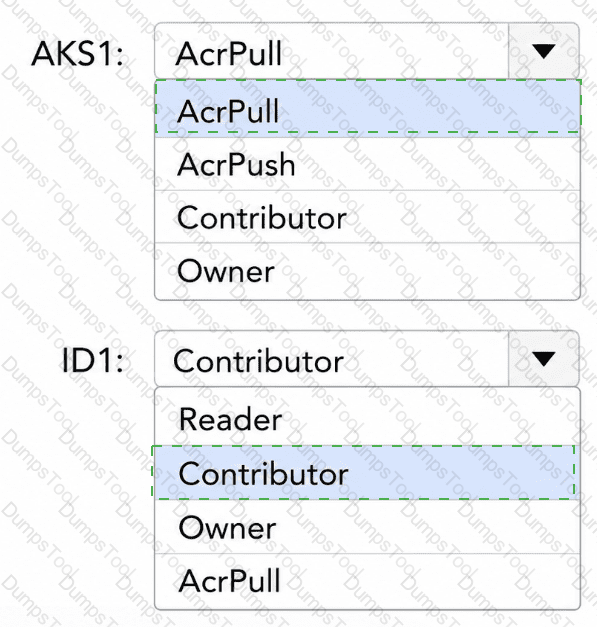
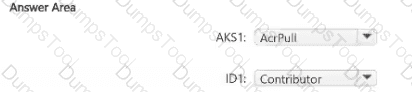
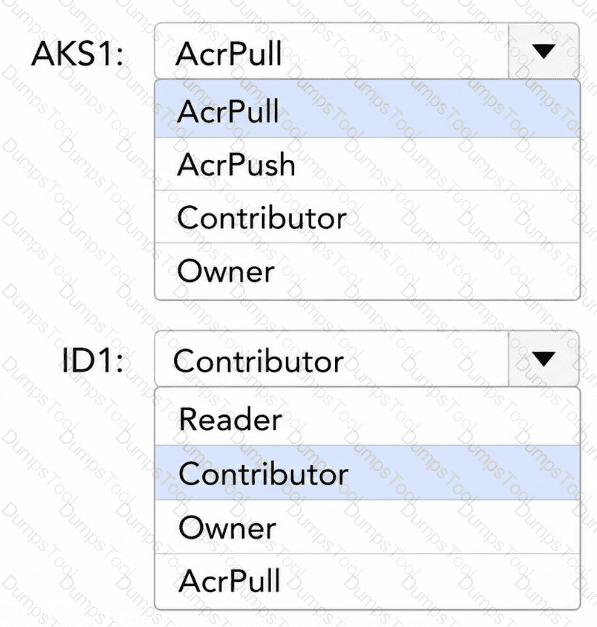
You need to configure the AKS1 and ID 1 managed identities to meet the technical requirements. The solution must follow the principle of least privilege.
Which role should you assign to each identity? To answer, select the appropriate options in the answer area.
NOTE: Each correct selection is worth one point.
Note: This section contains one or more sets of questions with the same scenario and problem. Each question presents a unique solution to the problem. You must determine whether the solution meets the stated goals. More than one solution in the set might solve the problem. It is also possible that none of the solutions in the set solve the problem.
After you answer a question in this section, you will NOT be able to return. As a result, these questions do not appear on the Review Screen.
You have an Azure subscription that contains two virtual machines named VM1 and VM2. Each virtual machine has system-assigned managed identity enabled.
You have an Azure Storage account named storage1. Public access from all networks is enabled for storage1.
You need to ensure that VM1 and VM2 can access storage1.
Solution: You create a user-assigned managed identity, assign the identity to each virtual machine, and then add each managed identity to a role on storage1.
Does this meet the goal?
You have an Azure Storage account named storage1 that hosts a blob container named container1.
You have an Azure Functions app named app1 that uses a managed identity.
You need to configure app1 to read, write, and delete blobs in container1. The solution must follow the principle of least privilege.
What should you do?
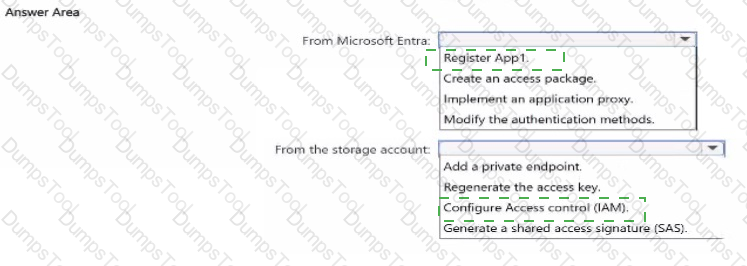
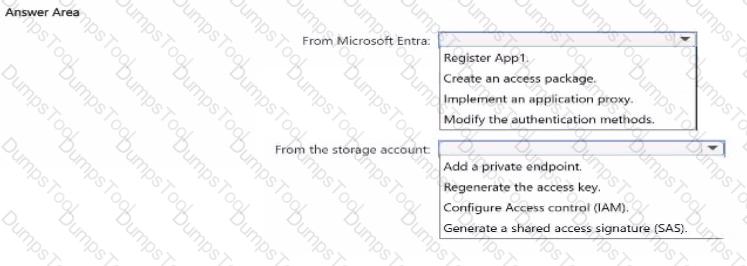
You have an Azure Storage account that contains a blob container named container 1 and a client application named App1. You need to enable App1 access to container1 by using Microsoft Entra authentication. What should you do ' To answer, select the appropriate options in the answer area. NOTE: Each correct selection is worth one point.
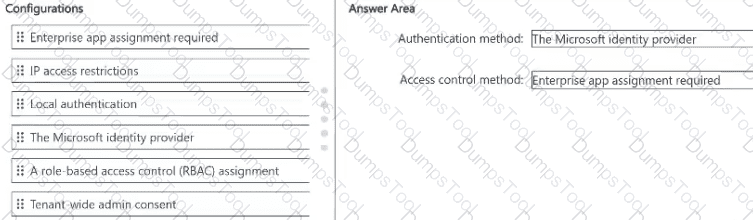
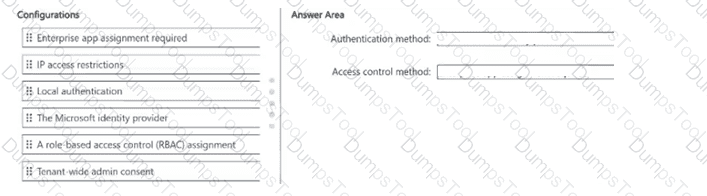
You have three internet-facing Azure App Service web apps named App1, App2, and App1 Each app uses built-in authentication.
App2 hosts a backend API.
Some corporate users can sign in to App2, even though they should NOT be able to use the API.
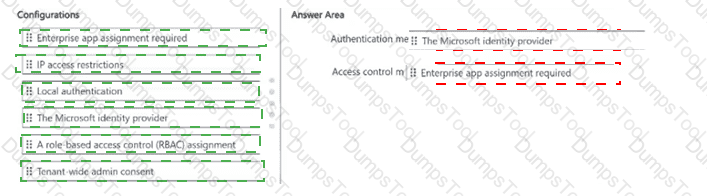
You need to restrict App2 access to assigned Microsoft Entra users and groups.
What should you configure for App2? To answer, drag the appropriate configurations to the correct methods. Each configuration may be used once, more than once, or not at all. You may need to drag the split bar between panes or scroll to view content.
NOTE: Each correct selection is worth one point.
You have an Azure subscription that contains a user named User1 and an Azure Container Registry named ContReg1.
You enable content trust for ContReg1.
You need to ensure that User1 can create trusted images in ContReg1 The solution must use the principle of least privilege.
Which two roles should you assign to User1? Each correct answer presents part of the solution.
NOTE: Each correct selection is worth one point.
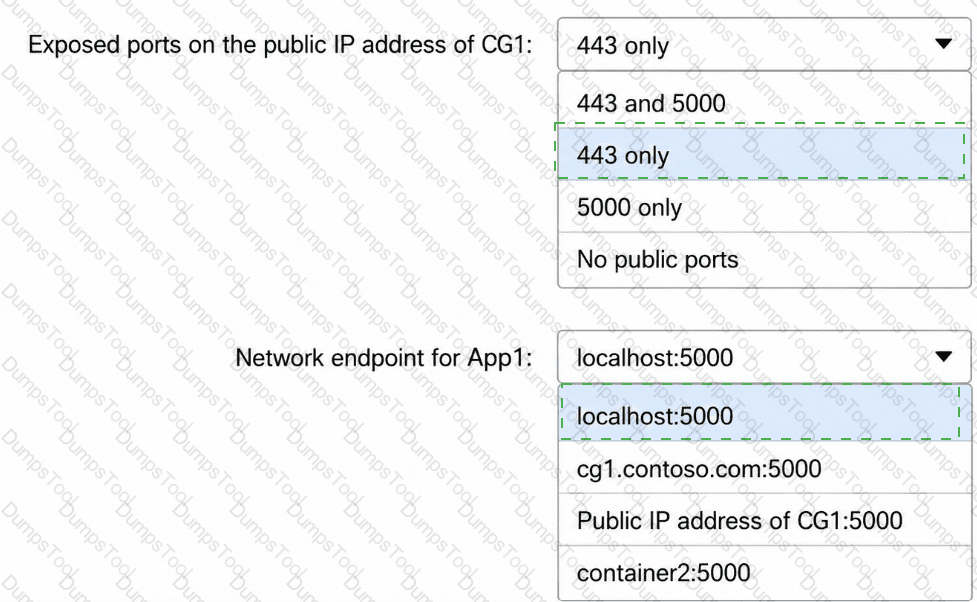
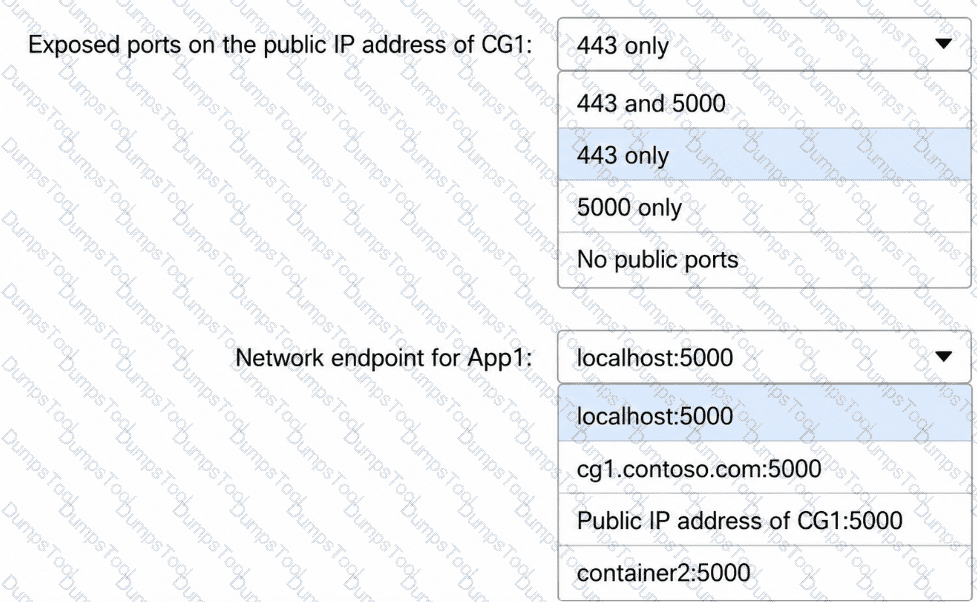
You have an Azure Container Instances container group named CG1 that has a DNS name of cg1.contoso.com. CG1 has the following configurations:
•A Linux container named container1 that serves HTTPS over TCP port 443 and hosts an application named App1
•A Linux container named container2 that listens on TCP port 5000 and is accessed only by App1
•A public IP address
A security review finds that external clients can reach TCP port 5000 by using the public IP address of CG1.
You need to meet the following requirements:
•Ensure that the external clients can access container1 only by using TCP port 443.
•Ensure that container1 can continue to access container2
What should you configure? To answer, select the appropriate options in the answer area.
NOTE: Each correct selection is worth one point.
You have an Azure environment.
You need to identity any Azure configurations and workloads that are non-compliant with ISO 27001:2013 standards. What should you use?
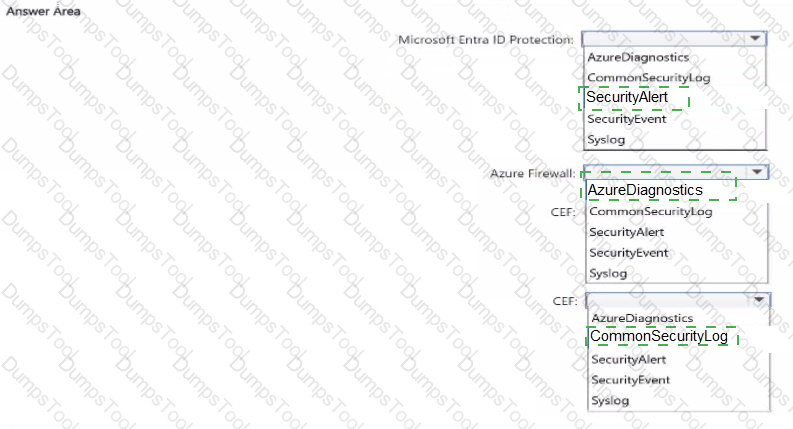
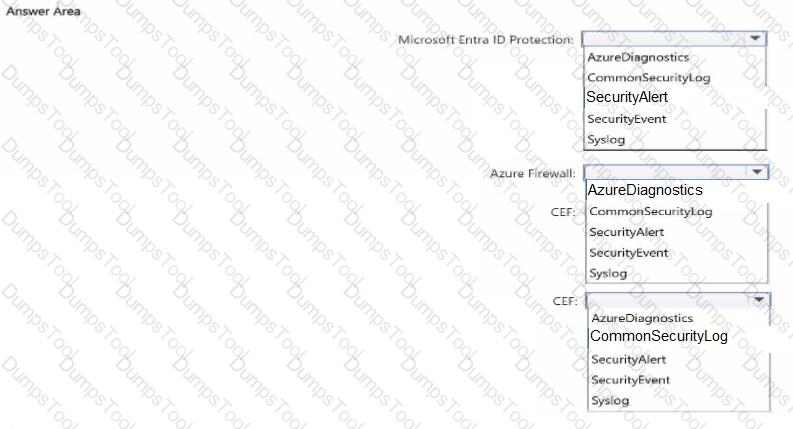
You have a Microsoft Sentinel workspace that has the following data connectors:
• Microsoft Entra ID Protection
• Azure Firewall
• Common Event Formal (CEF)
You need to ensure that data is being ingested from each connector.
From the Logs query window, which table should you query for each connector? To answer, select the appropriate options in the answer area.
You have a Microsoft Entra tenant that contains a user named User1.
You have an Azure Arc-enabled server named SRV1 that runs Windows Server. SRV1 is configured for Microsoft Entra sign-in.
User1 reports that when they use their Microsoft Entra credentials to sign in to SRV1 over RDP, they receive the following message:
“Your account is configured to prevent you from using this device.”
You need to ensure that User1 can sign in to SRV1 over RDP. The solution must follow the principle of least privilege.
What should you do?
You have an Azure Functions app named App1 that uses an HTTP trigger, runs on an Elastic Premium plan, and uses virtual network integration.
A partner application sends requests to App1 from a public IP address of xxx.xxx.xxx.xx.
You need to ensure that the requests are accepted from only xxx.xxx.xxx.xx.
What should you do?
You have an Azure API Management instance named APIM1.
You have a partner company that accesses an API in APIM1 by using subscription keys.
A backend API key is stored in a named value in APIM1.
Microsoft Defender for Cloud generates the following recommendation: “API Management secret named values should be stored in Azure Key Vault.”
You need to address the recommendation.
What should you do first?
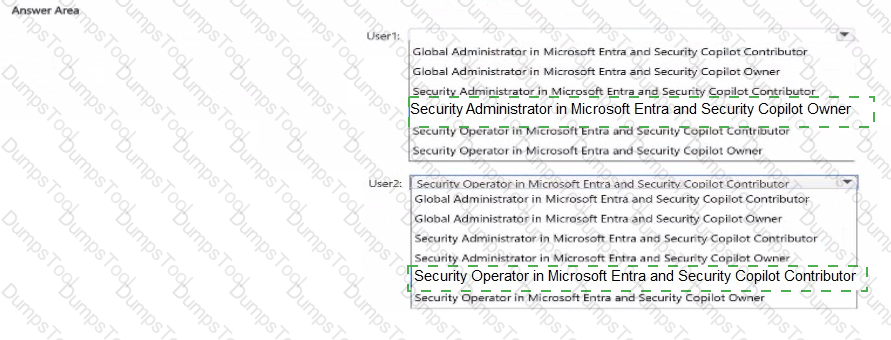
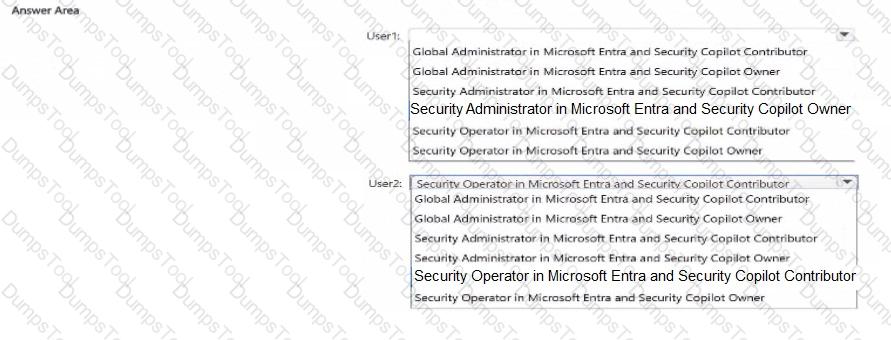
You have a Microsoft 365 tenant that uses Microsoft Security Copilot and Microsoft Defender XDR.
Access to Microsoft Defender XDR is managed by using Microsoft entra global roles.
The Phishing triage Agent is available in Microsoft Defender. The required agent prerequisites and approvals are complete
Two users will perform the following tasks:
• User1 will enable and manage the Phishing Triage Agent settings.
• User2 will use Security Copilot in Microsoft Defender XDR to manage phishing incidents identified by the agent.
You need to assign the least-privileged built in Microsoft Entra role and Security Copilot role combination to each us Which roles should you assign to each user? To answer, select the appropriate options in the answer area.
You have a Microsoft Entra tenant that has the following configurations:
•User consent for applications is disabled.
•Only administrators can grant permissions to applications.
You register an application named App1 that uses delegated Microsoft Graph permissions.
You need to configure App1 to meet the following requirements:
•Enable user sign-ins without interactive consent prompts.
•Enable App1 to access Microsoft Graph on behalf of the signed-in user.
What should you do?
You have an Azure subscription that contains a resource group named RG1. RG1 contains a storage account named storage1. You have two custom Azure roles named Role1 and Role2 that are scoped to RG1. The permissions for Role1 are shown in the following JSON code.


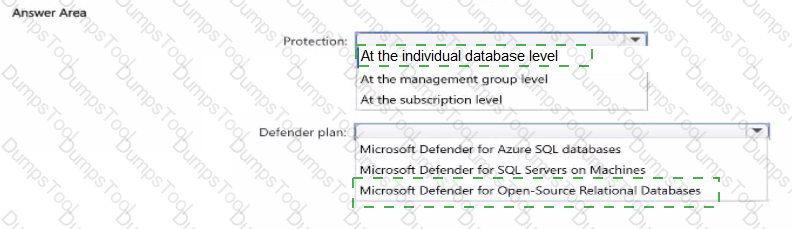
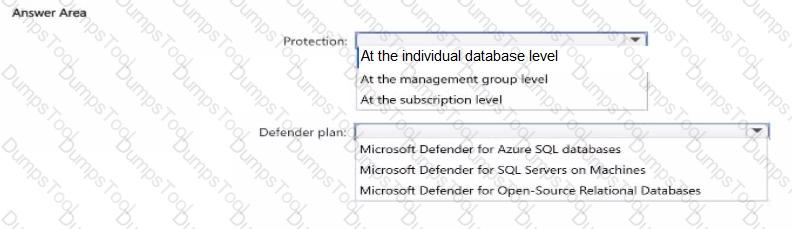
You have an Azure subscription that contains an Azure Database for PostgreSQL instance named 081.
You plan to protect OBI by using Microsoft Defender for Cloud.
You need to configure Defender for Cloud to detect anomalous activities and database exploitations for 061. The solution must NOT affect any other databases.
What should you enable? To answer, select the appropriate options in the answer area.
NOTE: Each correct selection is worth one point.
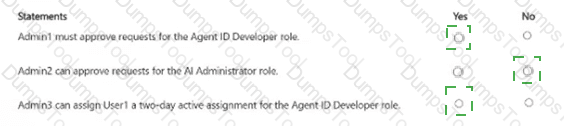
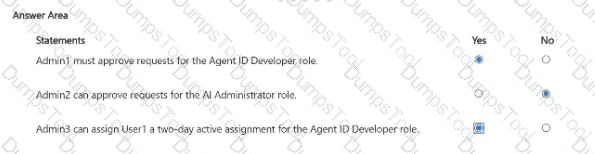
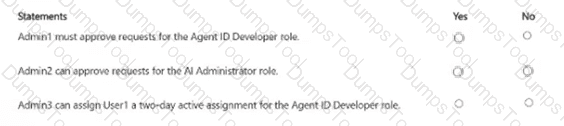
You have a Microsoft Entra tenant that uses Privileged Identity Management (PIM).
You need to modify the AI Administrator role settings to meet the following requirements:
•Elevated access must be evaluated by another administrator before it is granted
•Privileged access must be removed automatically after a fixed period.
Which two settings should you configure? Each correct answer presents part of the solution.
NOTE: Each correct selection is worth one point.
You use Microsoft Security Copilot.
Security Copilot contributors currently create custom plugins for their own sessions and manage organization-wide custom plugins.
You need to prevent the contributors from managing the organization-wide custom plugins. The solution must NOT affect the contributors ' ability to create custom plugins for their own sessions.
What should you select in the Plugin settings?
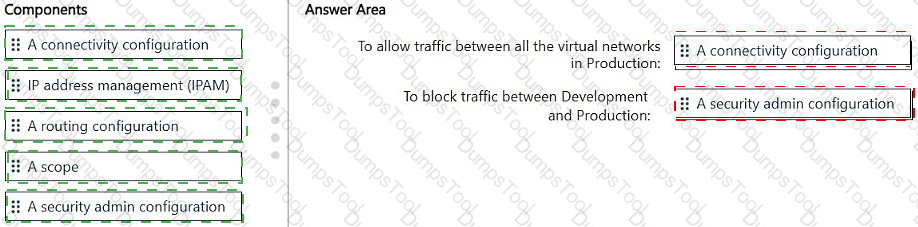
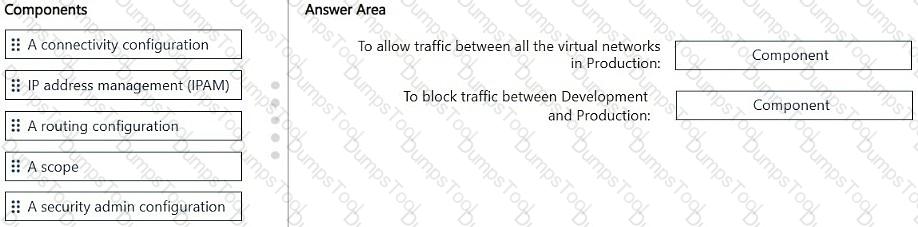
You use Azure Virtual Network Manager to manage multiple virtual networks organized into two network groups named Production and Development.
You need to configure Virtual Network Manager to meet the following requirements:
Allow traffic between all the virtual networks in Production.
Block traffic between Development and Production.
What should you use for each requirement? To answer, drag the components to the correct requirements. Each component may be used once, more than once, or not at all. You may need to drag the split bar between panes or scroll to view content.
NOTE: Each correct selection is worth one point.
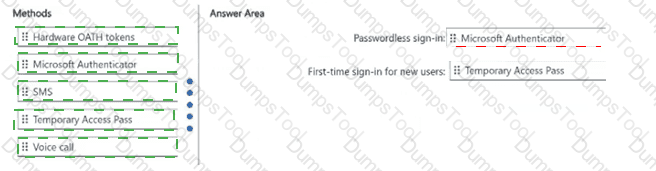
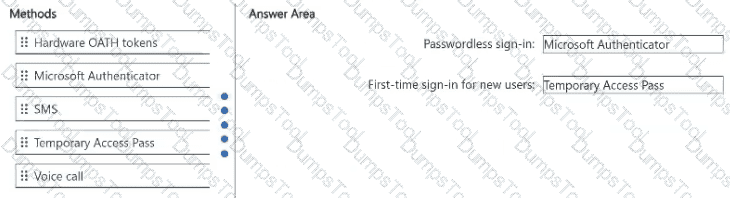
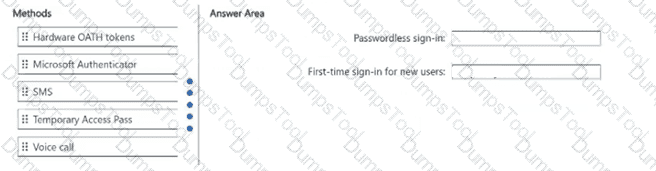
You have a Microsoft Entra tenant.
You need to implement password less authentication. The solution must meet the following requirements:
•Users can sign in without a password by using a mobile device.
•New users that sign in for the first time must use a helpdesk issued sign in method that expires.
Which authentication method should you enable for each requirement? To answer, drag the appropriate methods to the correct requirements. Each method may be used once, more than once, or not at all. You may need to drag the split bar between panes or scroll to view content.
NOTE: Each correct selection is worth one point.
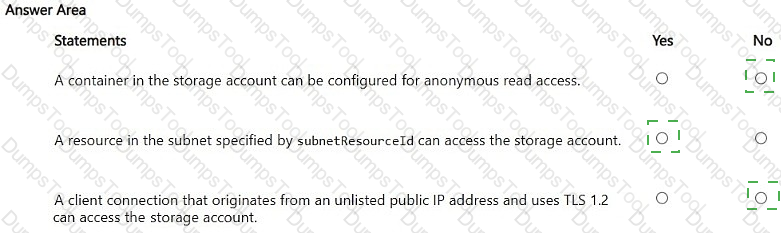
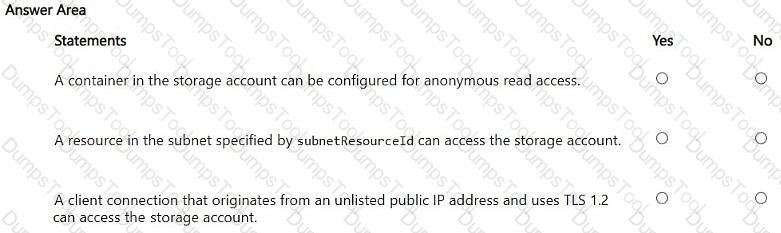
You are implementing security controls for an Azure Storage account by using infrastructure as code (IaC).
You deploy the following Bicep code.
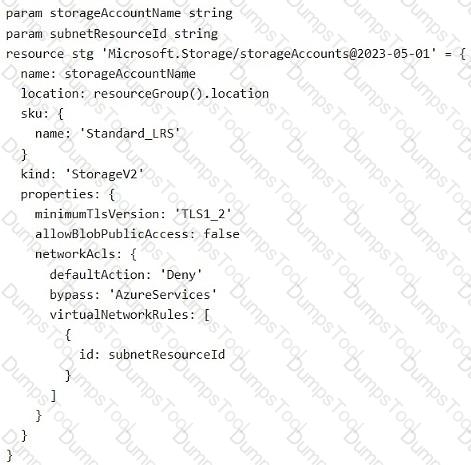
For each of the following statements, select Yes if the statement is true. Otherwise, select No.
NOTE: Each correct selection is worth one point.
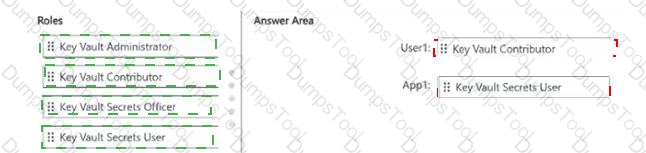
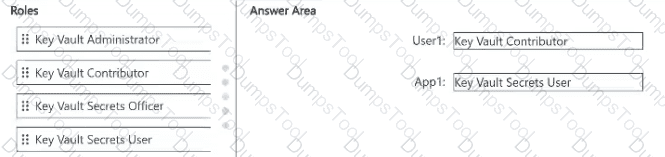
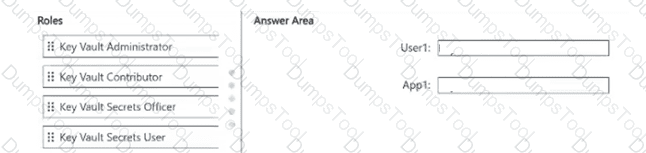
You have an Azure key vault named KV1 that uses role-based access control (RBAC) for data plane authorization.
You have a user named User1 and an Azure App Service web app named App1 that has a system-assigned managed identity.
You need to configure authorization to meet the following requirements:
•App1 must be able to retrieve secrets from KV1.
•User1 must manage the KV1 settings without accessing secret values.
The solution must follow the principle of least privilege.
Which role should you assign to each identity for KV1? To answer, drag the appropriate roles to the correct identities. Each role may be used once, more than once, or not at all. You may need to drag the split bar between panes or scroll to view content.
NOTE: Each correct selection is worth one point.
For each of the following statements, select Yes if the statement is true Otherwise, select No.
Note: This section contains one or more sets of questions with the same scenario and problem. Each question presents a unique solution to the problem. You must determine whether the solution meets the stated goals. More than one solution in the set might solve the problem. It is also possible that none of the solutions in the set solve the problem.
After you answer a question in this section, you will NOT be able to return. As a result, these questions do not appear on the Review Screen.
You have an Azure subscription that contains two virtual machines named VM1 and VM2. Each virtual machine has system-assigned managed identity enabled.
You have an Azure Storage account named storage. Public access from all networks is enabled for storage1.
You need to ensure that VM1 and VM2 can access storage1.
Solution: You create a private endpoint on storage1.
Does this meet the goal?
Note. This section contains one or more sets of questions with the same scenario and problem. Each question presents a unique solution to the problem You must determine whether the solution meets the stated goals. More than one solution in the set might solve the problem. It is also possible that none of the solutions in the set solve the problem
After you answer a question in this section, you will NOT be able to return. As a result these questions do not appear on the Review Screen.
You have a Microsoft Sentinel workspace
You have a multi-tier Security Operations Center (SOC) team.
You need to ensure that all new security incidents are assigned immediately to the Tier 1 analysts group and flagged for triage.
Solution You create a hunting query.
Does this meet the goal’
You need to implement the planned change for the AKS1 integration.
What should you configure for AKS1?
For which storage accounts can you implement the planned changes for storage?
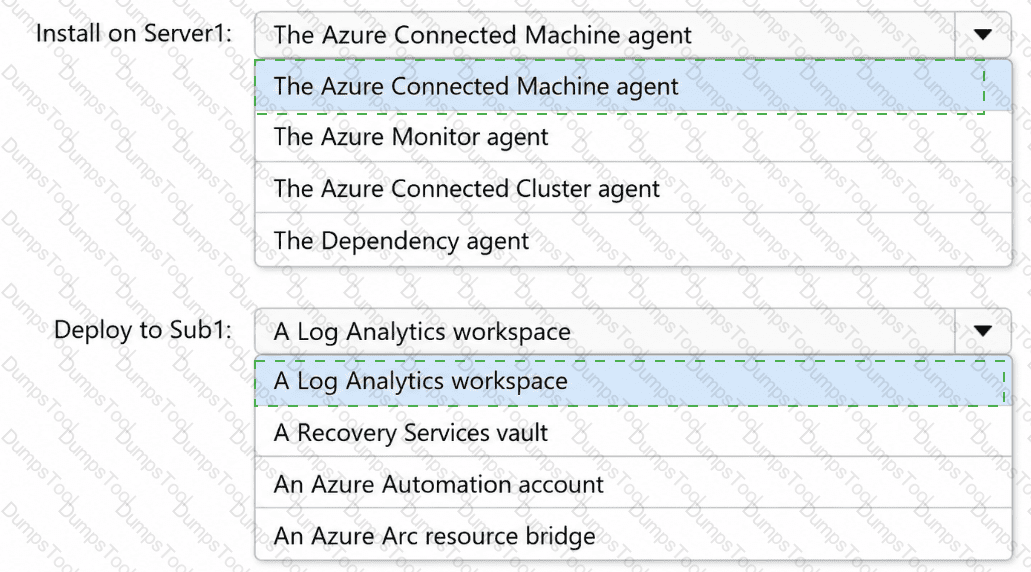
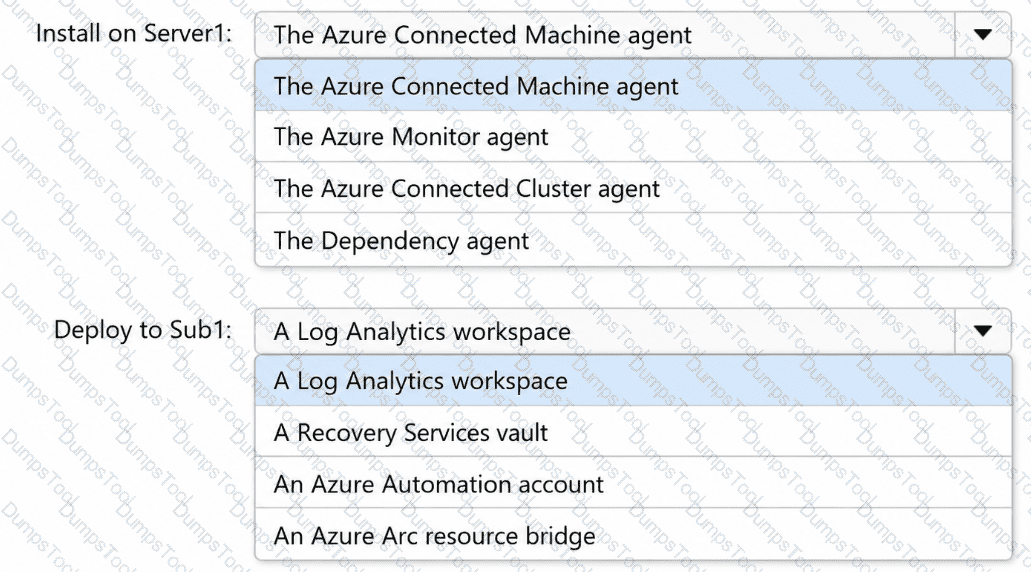
You need to configure Server1 to meet the technical requirements.
What should you do? To answer, select the appropriate options in the answer area.
NOTE: Each correct selection is worth one point.
You need to implement the function apps to meet the technical requirements.
Which apps should you include in the implementation?
Note: This section contains one or more sets of questions with the same scenario and problem. Each question presents a unique solution to the problem. You must determine whether the solution meets the stated goals. More than one solution in the set might solve the problem. It is also possible that none of the solutions in the set solve the problem.
After you answer a question in this section, you will NOT be able to return. As a result, these questions do not appear on the Review Screen.
You have an Azure subscription that contains two virtual machines named VM1 and VM2. Each virtual machine has system-assigned managed identity enabled.
You have an Azure Storage account named storage1. Public access from all networks is enabled for storage1.
You need to ensure that VM1 and VM2 can access storage1.
Solution: You add each virtual machine to a security group, and then add the security group to a role on storage1.
Does this meet the goal?

TESTED 19 Sep 2026