Big Cyber Monday Sale - Special 70% Discount Offer - Ends in 0d 00h 00m 00s - Coupon code: 70dumps

HPE7-A02 Questions and Answers

Question # 6

A company has HPE Aruba Networking APs running AOS-10 and managed by HPE Aruba Networking Central. The company also has AOS-CX switches. The security team wants you to capture traffic from a particular wireless client. You should capture this client’s traffic over a 15-minute time period and then send the traffic to them in a PCAP file. What should you do?

A.

Access the CLI for the client’s AP. Set up a mirroring session between its radio and a management station running Wireshark.

B.

Go to the client’s AP in HPE Aruba Networking Central. Use the "Security" page to run a packet capture.

C.

Go to that client in HPE Aruba Networking Central. Use the "Live Events" page to run a packet capture.

D.

Access the CLI for the client’s AP's switch. Set up a mirroring session between the AP’s port and a management station running Wireshark.

Full Access
Question # 7

You have configured an AOS-CX switch to implement 802.1X on edge ports. Assume ports operate in the default auth-mode. VolP phones are assigned to the

"voice" role and need to send traffic that is tagged for VLAN 12.

Where should you configure VLAN 12?

A.

As the trunk native VLAN on edge ports and the trunk native VLAN on the "voice" role

B.

As a trunk allowed VLAN on edge ports and the trunk native VLAN in the "voice" role

C.

As the trunk native VLAN in the "voice" role (and not in the edge port settings)

D.

As the allowed trunk VLAN in the "voice" role (and not in the edge port settings)

Full Access
Question # 8

A company needs you to integrate HPE Aruba Networking ClearPass Policy Manager (CPPM) with HPE Aruba Networking ClearPass Device Insight (CPDI).

What is one task you should do to prepare?

A.

Install the root CA for CPPM's HTTPS certificate as trusted in the CPDI application.

B.

Configure WMI, SSH, and SNMP external accounts for device scanning on CPPM.

C.

Enable Insight in the CPPM server configuration settings.

D.

Collect a Data Collector token from HPE Aruba Networking Central.

Full Access
Question # 9

A company already uses HPE Aruba Networking ClearPass Policy Manager (CPPM) as the RADIUS server for authenticating wireless clients with 802.1X. Now you are setting up 802.1X on AOS-CX switches to authenticate many of those same clients on wired connections. You decide to copy CPPM's wireless 802.1X service and then edit it with a new name and enforcement policy. What else must you change for authentication to work properly?

A.

Role mapping policy

B.

Authentication methods

C.

Authentication source

D.

Service rules

Full Access
Question # 10

You have installed an HPE Aruba Networking Network Analytic Engine (NAE) script on an AOS-CX switch to monitor a particular function.

Which additional step must you complete to start the monitoring?

A.

Reboot the switch.

B.

Enable NAE, which is disabled by default.

C.

Edit the script to define monitor parameters.

D.

Create an agent from the script.

Full Access
Question # 11

A company uses both HPE Aruba Networking ClearPass Policy Manager (CPPM) and HPE Aruba Networking ClearPass Device Insight (CPDI).

What is one way integrating the two solutions can help the company implement Zero Trust Security?

A.

CPPM can provide CPDI with custom device fingerprint definitions in order to enhance the company's total visibility.

B.

CPDI can provide CPPM with extra information about users' identity; CPPM can then use that information to apply the correct identity-based enforcement.

C.

CPPM can inform CPDI that it has assigned a particular Aruba-User-Role to a client; CPDI can then use that information to reclassify the client.

D.

CPDI can use tags to inform CPPM that clients are using prohibited applications; CPPM can then tell the network infrastructure to quarantine those clients.

Full Access
Question # 12

A company has a variety of HPE Aruba Networking solutions, including an HPE Aruba Networking infrastructure and HPE Aruba Networking ClearPass Policy

Manager (CPPM). The company passes traffic from the corporate LAN destined to the data center through a third-party SRX firewall. The company would like to

further protect itself from internal threats.

What is one solution that you can recommend?

A.

Have the third-party firewall send Syslogs to CPPM, which can work with network devices to lock internal attackers out of the network.

B.

Use tunnel mode SSIDs and user-based tunneling (UBT) on AOS-CX switches to pass all internal traffic directly through the third-party firewall.

C.

Add ClearPass Device Insight (CPDI) to the solution; integrate it with the third-party firewall to develop more complete device profiles.

D.

Configure CPPM to poll the third-party firewall for a broad array of information about internal clients, such as profile and posture.

Full Access
Question # 13

You are setting up HPE Aruba Networking SSE to prohibit users from uploading and downloading files from Dropbox. What is part of the process?

A.

Adding a web category that includes Dropbox

B.

Installing the HPE Aruba Networking SSE root certificate on clients

C.

Deploying a connector that can reach the remote users

D.

Deploying a connector that can reach Dropbox

Full Access
Question # 14

A company wants to turn on Wireless IDS/IPS infrastructure and client detection at the high level on HPE Aruba Networking APs. The company does not want to

enable any prevention settings.

What should you explain about HPE Aruba Networking recommendations?

A.

HPE Aruba Networking recommends turning on both wired and wireless prevention whenever you enable detection at high.

B.

HPE Aruba Networking recommends using hybrid AP mode, as opposed to Air Monitors (AMs), when implementing detection without prevention.

C.

HPE Aruba Networking recommends disabling client detection when you configure infrastructure detection at high, as infrastructure detection includes all the client checks and more.

D.

HPE Aruba Networking recommends configuring infrastructure and client detection at a custom level and disabling or tuning some of the settings that are likely to produce false positives.

Full Access
Question # 15

Refer to the exhibit:

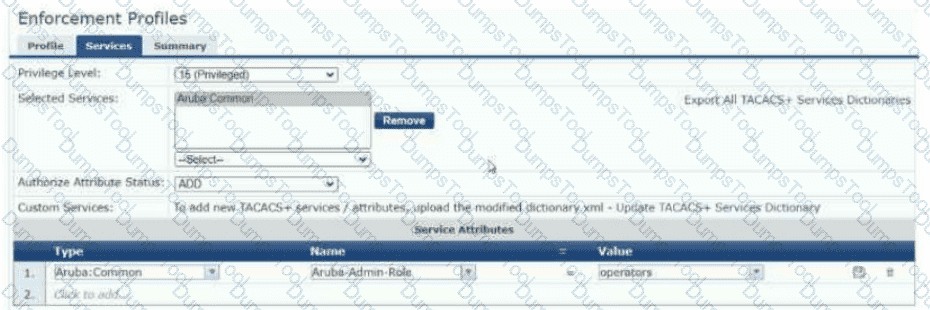
The exhibit shows the TACACS+ enforcement profile that HPE Aruba Networking ClearPass Policy Manager (CPPM) assigns to a manager. When this manager logs into an AOS-CX switch, what does the switch do?

A.

Assigns the manager operator-level privileges

B.

Assigns the manager administrator-level privileges

C.

Rejects the manager with an error message

D.

Assigns the manager auditor-level privileges

Full Access
Question # 16

You need to create a rule in an HPE Aruba Networking ClearPass Policy Manager (CPPM) role mapping policy that references a ClearPass Device Insight Tag.

Which Type (namespace) should you specify for the rule?

A.

Application

B.

Tips

C.

Device

D.

Endpoint

Full Access
Question # 17

You have set up a mirroring session between an AOS-CX switch and a management station, running Wireshark. You want to capture just the traffic sent in the

mirroring session, not the management station's other traffic.

What should you do?

A.

Apply this capture filter: ip proto 47

B.

Edit protocol preferences and enable ARUBA_ERM.

C.

Edit protocol preferences and enable HPE_ERM.

D.

Apply this capture filter: udp port 5555

Full Access
Question # 18

A company has HPE Aruba Networking APs and AOS-CX switches, as well as HPE Aruba Networking ClearPass. The company wants CPPM to have HTTP User-

Agent strings to use in profiling devices.

What can you do to support these requirements?

A.

Add the CPPM server's IP address to the IP helper list in all client VLANs on routing switches.

B.

Schedule periodic subnet scans of all client subnets on CPPM.

C.

Configure mirror sessions on the APs and switches to copy client HTTP traffic to CPPM.

D.

On the APs and switches, configure a redirect to ClearPass Guest in the role for devices being profiled.

Full Access
Question # 19

Refer to the Exhibit:

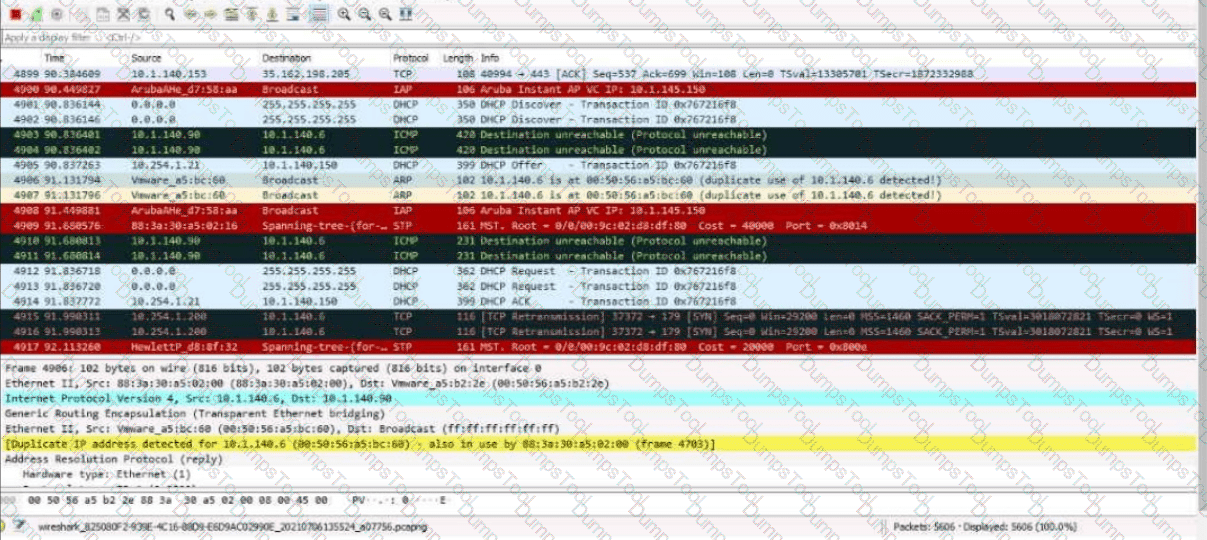
These packets have been captured from VLAN 10. which supports clients that receive their IP addresses with DHCP.

What can you interpret from the packets that you see here?

These packets have been captured from VLAN 10, which supports clients that receive their IP addresses with DHCP. What can you interpret from the packets that you see here?

A.

Someone is possibly implementing a MAC spoofing attack to gain unauthorized access.

B.

The mirroring session that captured the packets was likely misconfigured and captured duplicate traffic.

C.

An admin has likely misconfigured two clients to use the same DHCP settings.

D.

Someone is possibly implementing an ARP poisoning and MITM attack.

Full Access
Question # 20

A company has AOS-CX switches and HPE Aruba Networking APs, which run AOS-10 and bridge their SSIDs. Company security policies require 802.1X on all edge ports, some of which connect to APs. How should you configure the auth-mode on AOS-CX switches?

A.

Leave all edge ports in client auth-mode and configure device auth-mode in the AP role.

B.

Configure all edge ports in client auth-mode.

C.

Configure all edge ports in device auth-mode.

D.

Leave all edge ports in device auth-mode and configure client auth-mode in the AP role.

Full Access
Question # 21

A company wants HPE Aruba Networking ClearPass Policy Manager (CPPM) to respond to Syslog messages from its Palo Alto Next Generation Firewall (NGFW)

by quarantining clients involved in security incidents.

Which step must you complete to enable CPPM to process the Syslogs properly?

A.

Configure the Palo Alto as a context server on CPPM.

B.

Install a Palo Alto Extension through ClearPass Guest.

C.

Enable Insight and ingress event processing on the CPPM server.

D.

Configure CPPM to trust the root CA certificate for the NGFW.

Full Access
Question # 22

A company wants to apply a standard configuration to all AOS-CX switch ports and have the ports dynamically adjust their configuration based on the identity of

the user or device that connects. They want to centralize configuration of the identity-based settings as much as possible.

What should you recommend?

A.

Having HPE Aruba Networking ClearPass Policy Manager (CPPM) send standard RADIUS AVPs to customize port settings

B.

Having switches pull port configurations dynamically from HPE Aruba Networking Activate

C.

Having switches download user-roles from HPE Aruba Networking gateways

D.

Having switches download user-roles from HPE Aruba Networking ClearPass Policy Manager (CPPM)

Full Access
Question # 23

A security team needs to track a device's communication patterns and identify patterns such as how many destinations the device is accessing.

Which Aruba solution can show this information at a glance?

A.

HPE Aruba Networking ClearPass Insight Endpoints and Network Dashboards

B.

HPE Aruba Networking ClearPass Policy Manager (CPPM) live monitoring Access Tracker

C.

HPE Aruba Networking ClearPass Device Insight (CPDI) under a device's network activity

D.

AOS-CX Analytics Dashboard using the system-installed NAE agent

Full Access
Question # 24

You are using Wireshark to view packets captured from HPE Aruba Networking infrastructure, but you’re not sure that the packets are displaying correctly. In which circumstance does it make sense to configure Wireshark to ignore protection bits with the IV for the 802.11 protocol?

A.

When the traffic was captured on the data plane of an HPE Aruba Networking gateway and sent to a remote IP.

B.

When the traffic was mirrored from an AOS-CX switch port connected to an AP.

C.

When the traffic was captured from an AP with HPE Aruba Networking Central.

D.

When the traffic was captured on the control plane of an HPE Aruba Networking MC and sent to a remote IP.

Full Access
Question # 25

A company is using HPE Aruba Networking Central SD-WAN Orchestrator to establish a hub-spoke VPN between branch gateways (BGWs) at 1444 site and

VPNCs at multiple data centers.

What is part of the configuration that admins need to complete?

A.

At the global level, create default IPsec policies for the SD-WAN Orchestrator to use.

B.

In BGWs' groups, select the VPNCs to which to connect in a DC preference list.

C.

In VPNCs' groups, establish VPN pools to control which branches connect to which VPNCs.

D.

In BGWs' and VPNCs' groups, create default IKE policies for the SD-WAN Orchestrator to use.

Full Access
Question # 26

You have enabled "rogue AP containment" in the Wireless IPS settings for a company’s HPE Aruba Networking APs. What form of containment does HPE Aruba Networking recommend?

A.

Wireless deauthentication only

B.

Wireless tarpit and wired containment

C.

Wireless tarpit only

D.

Wired containment

Full Access
Question # 27

A company wants to use the HPE Aruba Networking ClearPass OnGuard agent to assign posture to clients.

How do you define the conditions by which a client receives a particular posture?

A.

Create rules within a posture policy

B.

Create rules within a WebAuth enforcement policy

C.

Create the rules directly in a service’s Enforcement tab

D.

Create rules directly in a service’s Posture tab

Full Access
Question # 28

A company has AOS-CX switches and HPE Aruba Networking ClearPass Policy Manager (CPPM). The company wants switches to implement 802.1X

authentication to CPPM and download user roles.

What is one task that you must complete on the switches to support this use case?

A.

Specify CPPM as the RADIUS server with the exact CN in CPPM's HTTPS certificate.

B.

Install the root CA certificate for CPPM's RADIUS certificate in a TA profile on the switches.

C.

Configure empty user-roles with names that match enforcement profile names on CPPM.

D.

Specify a ClearPass username and password that match the name and RADIUS secret in a CPPM network device entry.

Full Access
Question # 29

A company is using HPE Aruba Networking ClearPass Device Insight (CPDI) (the standalone application). In the CPDI security settings, Security Analysis is On, the Data Source is ClearPass Device Insight, and Enable Posture Assessment is On. You see that a device has a Risk Score of 90.

What can you know from this information?

A.

The posture is unknown, and CPDI has detected exactly four vulnerabilities on the device.

B.

The posture is healthy, but CPDI has detected multiple vulnerabilities on the device.

C.

The posture is unhealthy, and CPDI has also detected at least one vulnerability on the device.

D.

The posture is unhealthy, but CPDI has not detected any vulnerabilities on the device.

Full Access
Question # 30

A company uses HPE Aruba Networking ClearPass Policy Manager (CPPM) as a TACACS+ server to authenticate managers on its AOS-CX switches. The company wants CPPM to control which commands managers are allowed to enter.

Which service must you add to the managers' TACACS+ enforcement profile?

A.

Cpass:HTTP

B.

Shell

C.

ARAP

D.

Aruba:Common

Full Access
Question # 31

The security team needs you to show them information about MAC spoofing attempts detected by HPE Aruba Networking ClearPass Policy Manager (CPPM).

What should you do?

A.

Export the Access Tracker records on CPPM as an XML file.

B.

Use ClearPass Insight to run an Active Endpoint Security report.

C.

Integrate CPPM with ClearPass Device Insight (CPDI) and run a security report on CPDI.

D.

Show the security team the CPPM Endpoint Profiler dashboard.

Full Access
Question # 32

A port-access role for AOS-CX switches has this policy applied to it:

plaintext

Copy code

port-access policy mypolicy

10 class ip zoneC action drop

20 class ip zoneA action drop

100 class ip zoneB

The classes have this configuration:

plaintext

Copy code

class ip zoneC

10 match tcp 10.2.0.0/16 eq https

class ip zoneA

10 match ip any 10.1.0.0/16

class ip zoneB

10 match ip any 10.0.0.0/8

The company wants to permit clients in this role to access 10.2.12.0/24 with HTTPS. What should you do?
A.

Add this rule to zoneC: 5 match any 10.2.12.0/24 eq https

B.

Add this rule to zoneA: 5 ignore tcp any 10.2.12.0/24 eq https

C.

Add this rule to zoneB: 5 match tcp any 10.2.12.0/24 eq https

D.

Add this rule to zoneC: 5 ignore tcp any 10.2.12.0/24 eq https

Full Access
Question # 33

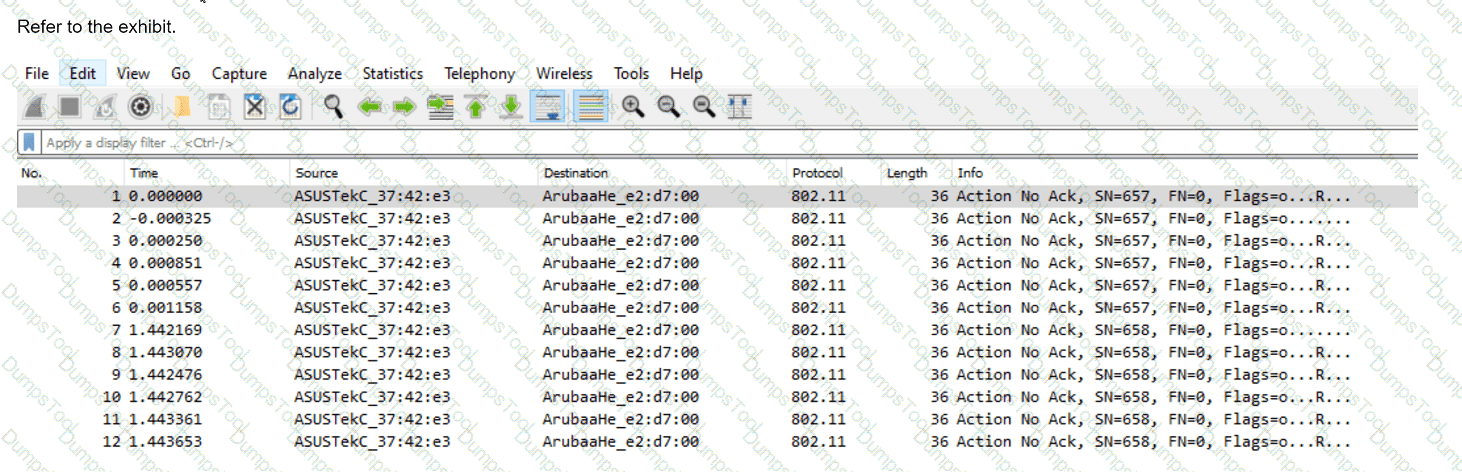
You have downloaded a packet capture that you generated on HPE Aruba Networking Central. When you open the capture in Wireshark, you see the output shown in the

exhibit.

What should you do in Wireshark so that you can better interpret the packets?

A.

Choose to decode UDP port 5555 packets as ARUBA_ERM and set the Aruba ERM Type to 0.

B.

Edit preferences for IEEE 802.11 and chose to ignore the Protection bit with IV.

C.

Apply the following display filter: wlan.fc.type == 1.

D.

Edit the Enabled Protocols and make sure that 802.11, GRE, and Aruba_ERM are enabled.

Full Access
Question # 34

A company assigns a different block of VLAN IDs to each of its access layer AOS-CX switches. The switches run version 10.07. The IDs are used for standard

purposes, such as for employees, VolP phones, and cameras. The company wants to apply 802.1X authentication to HPE Aruba Networking ClearPass Policy

Manager (CPPM) and then steer clients to the correct VLANs for local forwarding.

What can you do to simplify setting up this solution?

A.

Assign consistent names to VLANs of the same type across the AOS-CX switches and have user-roles reference names.

B.

Use the trunk allowed VLAN setting to assign multiple VLAN IDs to the same role.

C.

Change the VLAN IDs across the AOS-CX switches so that they are consistent.

D.

Avoid configuring the VLAN in the role; use trunk VLANs to assign multiple VLANs to the port instead.

Full Access
Question # 35

What is a typical use case for using HPE Aruba Networking ClearPass Onboard to provision devices?

A.

Enabling unmanaged devices to succeed at certificate-based 802.1X

B.

Enabling managed Windows domain computers to succeed at certificate-based 802.1X

C.

Enhancing security for loT devices that need to authenticate with MAC-Auth

D.

Enforcing posture-based assessment on managed Windows domain computers

Full Access
Question # 36

You are helping an organization deploy HPE Aruba Networking SSE. What is one reason to recommend that the company install agents on remote users' devices?

A.

To run posture checks and apply different permissions based on those checks.

B.

To permit admins to manage the HPE Aruba Networking SSE policy rules.

C.

To permit users to access private servers using SSH.

D.

To run threat inspection on clients in a local sandbox rather than in the cloud.

Full Access
Question # 37

A company is implementing a client-to-site VPN based on tunnel-mode IPsec.

Which devices are responsible for the IPsec encapsulation?

A.

Gateways at the remote clients' locations and devices accessed by the clients at the main site

B.

The remote clients and devices accessed by the clients at the main site

C.

The remote clients and a gateway at the main site

D.

Gateways at the remote clients' locations and a gateway at the main site

Full Access
Question # 38

You are setting up HPE Aruba Networking SSE to detect threats as remote users browse the internet.

What is part of this process?

A.

Creating a non-default file security profile

B.

Integrating HPE Aruba Networking SSE with a supported third-party antivirus provider

C.

Deploying a connector that can reach the remote users

D.

Creating an external web profile that enables SSL inspection

Full Access
Question # 39

A company is using HPE Aruba Networking Central SD-WAN Orchestrator to establish a hub-spoke VPN between branch gateways (BGWs) at 1164 site and VPNCs at multiple data centers. What is part of the configuration that admins need to complete?

A.

In VPNCs’ groups, establish VPN pools to control which branches connect to which VPNCs.

B.

In BGWs’ and VPNCs’ groups, create default IKE policies for the SD-WAN Orchestrator to use.

C.

In BGWs’ groups, select the VPNCs to which to connect in a DC preference list.

D.

At the global level, create default IPsec policies for the SD-WAN Orchestrator to use.

Full Access
Question # 40

A company has HPE Aruba Networking Central-managed APs. The company wants to block all clients connected through the APs from using YouTube.

Which steps should you take?

A.

Deploy gateways and have the APs tunnel traffic to the gateways. Then, enable the gateway IDS/IPS engine.

B.

Enable Client IPS at the "custom" level, and then specify the check for YouTube.

C.

Enable WebCC on all client firewall roles. Then, create WebCC category rules that deny suspicious URLs.

D.

Enable DPI. Then, create application rules to deny YouTube on the firewall roles.

Full Access