dumpstool logo

An administrator is tasked with designing a highly available vSAN ESA two-node cluster for a remote VMware Cloud Foundation (VCF) workload domain. The solution should be able to survive the failure of any disk group in addition to a host failure without data loss.
What is the minimum total number of nested fault domains required for the design?
A storage architect is designing a vSAN solution that enforces quotas and Access Based Enumeration (ABE) on all file shares.
What should the architect highlight as a design decision implication?
An administrator is preparing to enable vSAN Data-at-Rest Encryption and must verify that the identity and key provider prerequisites are met before proceeding with the configuration.
Which two requirements must be met? (Choose two.)
The Windows team is planning to deploy a Windows Server Failover Cluster. This requires a disk shared between all members of the cluster.
Which two options are available to fulfill this requirement on a vSAN ESA cluster? (Choose two.)
A customer attaches an external Fibre Channel (FC) VMFS datastore to a VMware Cloud Foundation (VCF) workload domain for backup staging. The administrator must confirm that the datastore is visible to all hosts, and that path and device health alarms will trigger should a fabric link or path fail.
Which action should the administrator take to verify this?
An administrator has been tasked with making changes to a VMware Cloud Foundation (VCF) Workload Domain cluster that is configured with NFS for both Principal storage and Supplemental storage.
The cluster has the following configuration:
• There are 3 x ESX host servers.
• There are 3 x NFS Datastores allocated to host Virtual Machines workloads.
• There is a single NFS Datastore allocated for hosting ISO files.
The administrator has the following concerns with the existing configuration:
• Every time a new Virtual Machine is deployed to the Workload Domain, the administrator must choose which datastore should be used.
• When reviewing the Datastores in VCF Operations:
One of the datastores has no Virtual Machines running in it.
The other two datastores have an imbalance of Virtual Machines and this is causing resource contention. The administrator has the following requirements: • Virtual Machines must be placed automatically on the most appropriate datastore based on utilization. • Migration recommendations on Virtual Machine placement should be made when one datastore reaches 50% utilization. • Virtual Machines must only be migrated to another datastore after being approved by an administrator. What four actions must the administrator take to meet all of the requirements? (Choose four.)
An administrator is responsible for managing a VMware Cloud Foundation (VCF) Private Cloud.
The following information has been provided about the environment:
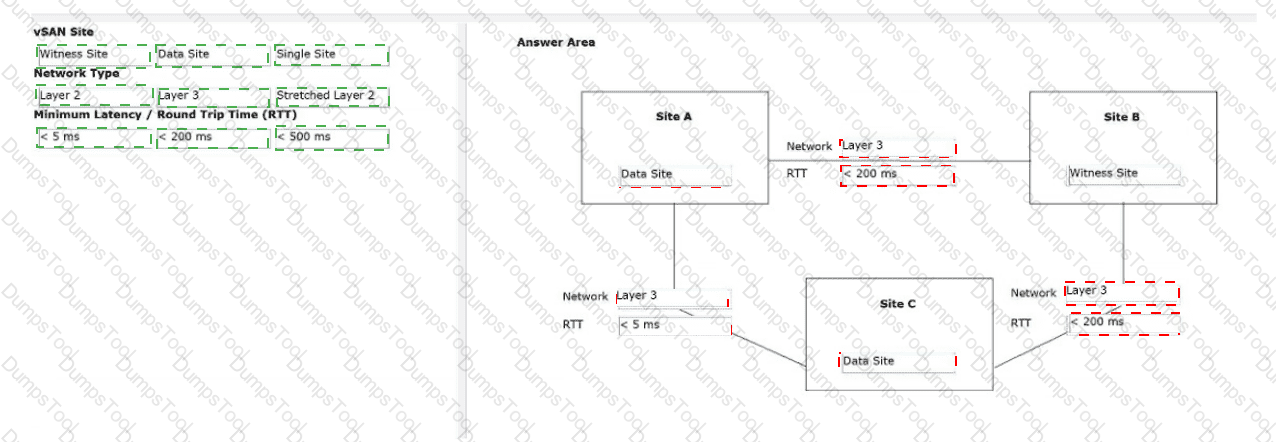
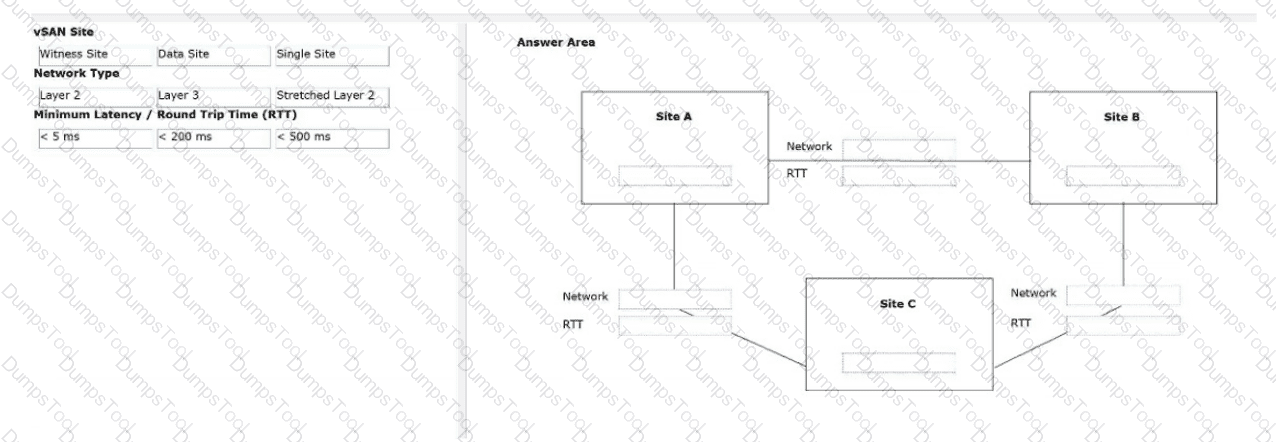
• There are 3 customer datacenters, Site A, Site B and Site C.
• The datacenter at Site A runs all Production Services.
• The datacenter at Site B has reached capacity and there is no space for additional physical hardware.
• The datacenter at Site C has been commissioned to replace Site B, because there is more rack space and power capacity to cater for future demand.
The administrator has been tasked with identifying the networking requirements for a new VMware vSAN Stretched Cluster with the following requirements:
• The solution will deploy a total of 10 new ESX host servers to create a VMware vSAN Stretched Cluster.
• The solution must deploy appropriate networking to ensure minimal disruption from issues with Spanning Tree Protocol (STP).
Drag and drop the correct vSAN Site Type, Networking Type and Round Trip Latency (RTT) within the boxes provided to complete the high-level diagram.
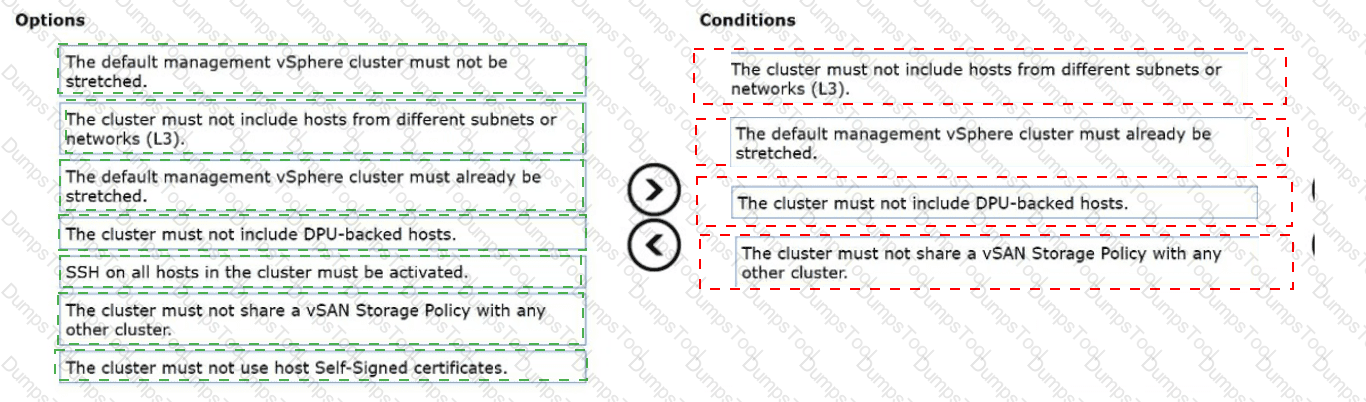
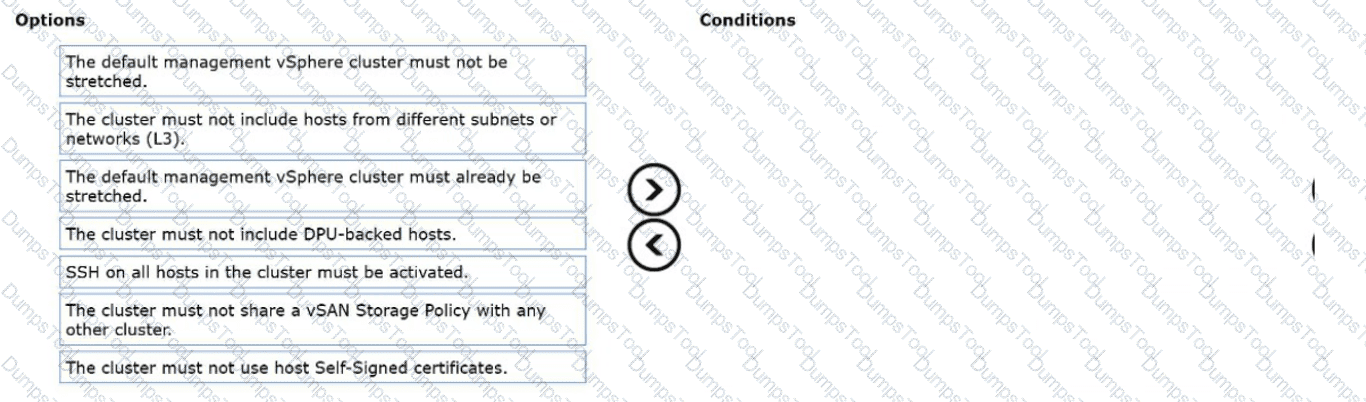
An administrator is tasked with stretching a vSAN cluster in a VMware Cloud Foundation (VCF) Workload Domain across two availability zones within a region. Both availability zones contain an equal number of hosts.
What four Conditions must also be met in order to stretch the cluster?
Drag and drop the four correct options from the Options list on the left and place them into the Conditions on the right in any order. (Choose four.)
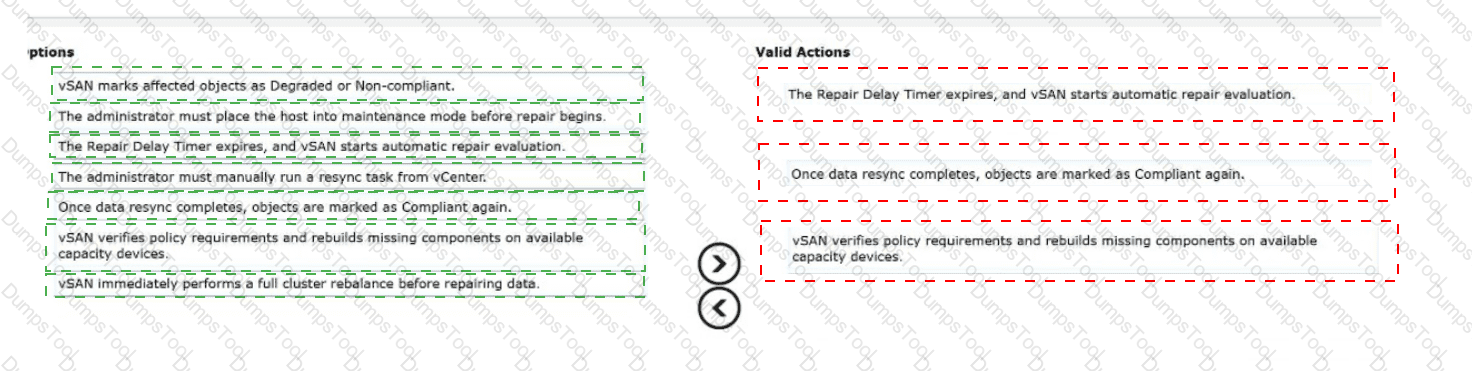
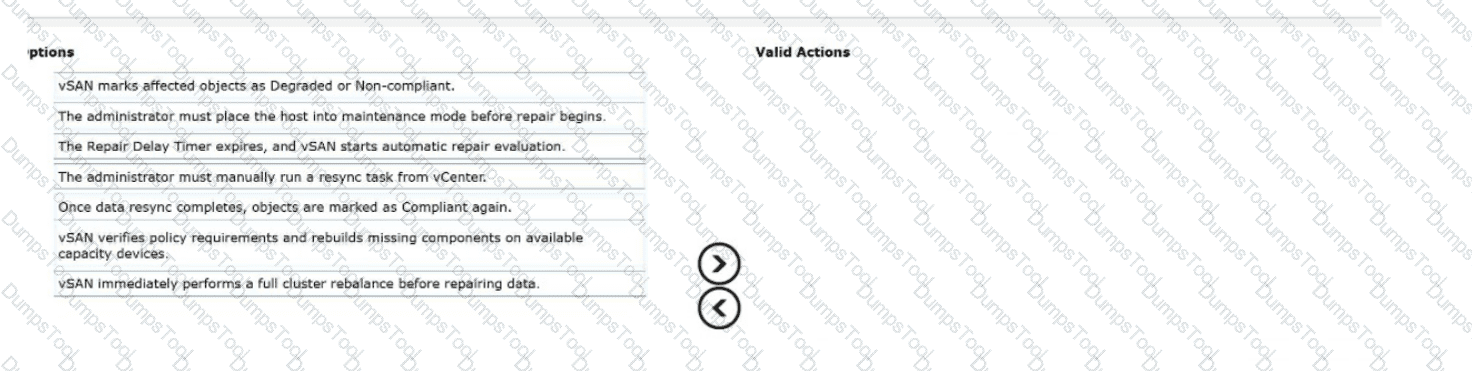
In a vSAN ESA cluster, one host goes offline unexpectedly for more than an hour.
When it returns online, vSAN needs to rebuild and restore compliance for several objects that became degraded during the outage.
Drag and drop the three correct options for the automatic recovery process from the Options list on the left and place them into the Valid Actions on the right in any order. (Choose three.)
A six-node vSAN ESA cluster contains multiple Virtual Machines (VMs), and a vSAN storage policy with the rule “Failures to tolerate” set to “1 failure - RAID-5 (Erasure Coding)” is assigned. A vSAN administrator has changed the rule in the assigned policy to “2 failures - RAID-6 (Erasure Coding).”
What is the result of this change?
An architect is presented with the following requirements for the storage solution in a VMware Cloud Foundation (VCF) Workload Domain.
The solution must:
• Allow for rapid recovery in case of an availability zone failure.
• Provide an extremely high amount of IOPS to all applications.
• Allow for additional storage to be added as application needs grow.
• Provide the lowest latency possible for configured applications.
• Provide recovery in case of datastore failure.
• Encrypt data in transit and at rest.
What two vSAN advanced technologies must be deployed to meet these requirements? (Choose two.)
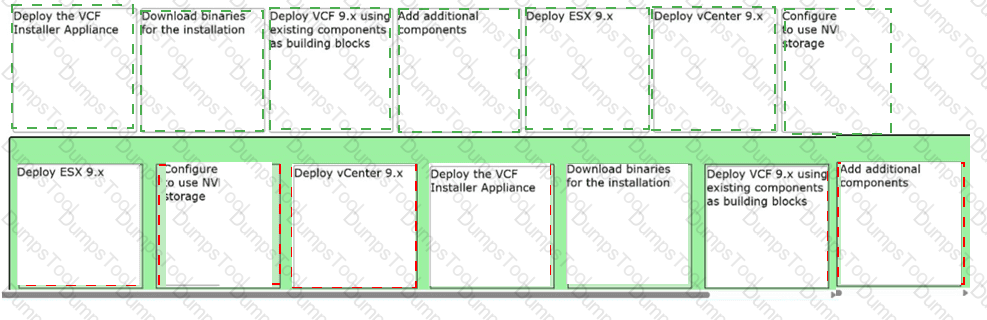
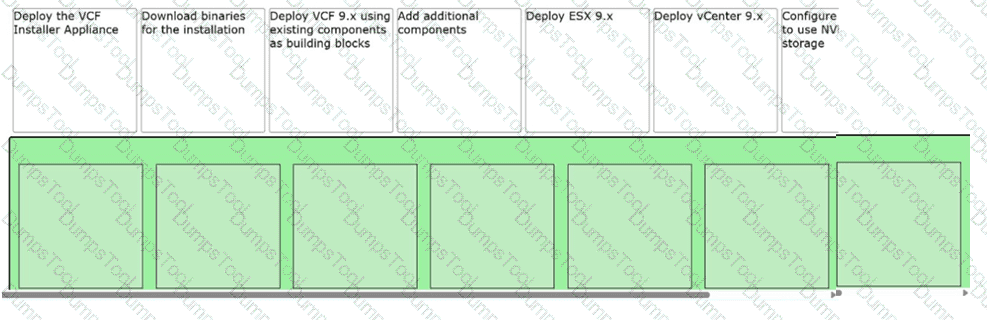
A VMware Cloud Foundation (VCF) Management Domain is requested to be deployed with the following information:
. 6 blade style hosts with no local storage beyond the operating system.
. 4 25 Gb networking cards installed in each host.
. A 30 TB external array configured to support NVMe/TCP only.
. 2 dVS switches, one configured for storage isolation and one for all other traffic.
. Aria Operations is not currently deployed in the environment.
Place the general steps in sequence for converging VCF on to this configuration.
An architect is designing a vSAN Original Storage Architecture (OSA) cluster for a VMware Cloud Foundation (VCF) Management Domain. The following details were made available:
• 12 hosts, each host with: 3 x 800 GB NVMe (cache) and 12 x 3.84 TB SAS SSD (capacity).
• Planned configuration: 3 disk groups per host (1 NVMe + 4 SSD each).
• Storage policy: FTT = 2 (RAID-1), Checksum. Deduplication and Compression are Enabled.
• Network: 25 GbE dedicated vSAN network fabric, properly configured for jumbo frames.
After deployment and loading test data to 70% capacity, the operations team reported extended resync times when two hosts are placed into maintenance mode with “Ensure Accessibility” selected and no hardware or network bottlenecks were detected.
How can the administrator explain the observed behavior?
An administrator attempts to enable vSAN Data-at-Rest Encryption on a cluster but receives the following error message:
“Key provider < vSphere Native Key Provider > is not available on host.”
The administrator configured the vSphere Native Key Provider (NKP) using the default settings.
What should the administrator validate before enabling vSAN Data-at-Rest Encryption?
An administrator has been tasked with suggesting storage models for a new VMware Cloud Foundation (VCF) Private Cloud. The following information has been provided:
• All existing implementations of VMware vSphere use the existing third-party block-based storage solution.
• The block-based storage solution only has sufficient scale, capacity and IOPS to cater for the new workload storage requirements.
• There is a dedicated and highly resilient storage area network connecting hosts to the provided block-based storage.
• There are 5 existing hosts with enough CPU and RAM resources and resilient Host Bus Adapters (HBAs) to cater for the new workload resource requirements only.
• There is sufficient budget to purchase some hardware, however the solution must re-use the existing hardware where possible.
The administrator suggests the following high-level solution:
• Single VCF Instance with a single Workload Domain.
• Deploy 4 new servers to create a Management Domain.
• Repurpose the 5 existing servers to create a single cluster in the Workload Domain.
Which two storage models should the administrator recommend? (Choose two.)
An enterprise is planning to deploy a new vSAN ESA enabled cluster to their existing VMware Cloud Foundation (VCF) Private Cloud Workload Domain. The following requirements have been given:
• 2 x 4 TB NVMe disks per host
• FTT=1/RAID-5 for all deployed Virtual Machines
• Expected dedupe/compression ratio = 1.5 (50%)
• Reserve enough capacity to rebuild a host completely in case of a failure (Host Rebuild Reservation)
• Operational Reserve of 10%
• Expected overhead for filesystem, object, etc. of 25%
How many hosts are required to meet a minimum usable capacity of 12 TB?
A storage architect has been called into a meeting with the accounting team who is trying to determine why 20% of their raw capacity is not available for consumption. Their vSAN cluster was created with the following characteristics:
• 2 x 2 TB NVMe disks in 6 hosts in their vSAN cluster.
• FTT=1, RAID-1 for the default policy.
• Host Rebuild Reserve not activated for this cluster.
Which two items should the Architect say accounts for most of the unusable capacity? (Choose two.)

TESTED 03 Oct 2026