New Year Sale - Special 70% Discount Offer - Ends in 0d 00h 00m 00s - Coupon code: 70dumps

MSP-Practitioner Questions and Answers

Question # 6

Which activity from the Smart Meter Programme should be delivered using a continual improvement approach?

A.

Align the terms and conditions for customer-facing staff

B.

Develop integrated billing and accounting services

C.

Develop automatic water leak detection systems

D.

Switch to installing new water meters gradually

Full Access
Question # 7

In delivering the capability, which role is responsible for aligning projects with programme objectives?

A.

SRO

B.

BCM

C.

Programme Manager

D.

Programme Office

Full Access
Question # 8

In which MSP theme would you expect to find the POTI model?

A.

Vision

B.

Blueprint Design and Delivery

C.

Leadership and Stakeholder Engagement

D.

Planning and Control

Full Access
Question # 9

Which of following is input for 'managing the tranches'?

A.

Programme preparation plan

B.

Programme Brief

C.

Approval to proceed

D.

Assurance review reports

Full Access
Question # 10

The programme is in Tranche 2 and has been progressing according to plan. However, there have been difficulties transitioning to the new ways of working at the end of Tranche 1 and UU has had some customer complaints as a result. Therefore, the SRO asked the programme manager to replan the programme so that all remaining capabilities are transitioned at the end of the programme, instead of at the end of the tranche.

Is this an appropriate application of the 'structure' theme, and why?

A.

Yes, because applying the ‘lead with purpose’ principle requires delivery to be planned to realize outcomes of benefit

B.

Yes, because applying the 'collaborate across boundaries' principle requires effective use of programme resources

C.

No, because applying the ‘realize measurable benefits’ principle requires outcomes of benefit to be embedded at intermediate landing points

D.

No, because applying the ‘align with priorities' principle requires the content of the tranches to be changed, rather than delaying transition

Full Access
Question # 11

It has been agreed with the sponsoring group that a risk review should be held before any of the new customer processes and web-based portal services are used by call centre staff to consider any risks before transition. This risk review needs to be documented appropriately.

Which role should approve the inclusion of this risk review in the relevant programme control document?

A.

Senior responsible owner

B.

Programme manager

C.

Business change manager

D.

Programme office lead

Full Access
Question # 12

Who has the responsibility for monitoring the progress of benefits realization against the plan?

A.

Business Change Manager

B.

Programme Office

C.

Senior Responsible Owner

D.

Programme Manager

Full Access
Question # 13

The programme is in the ‘evaluate new information' process at the end of Tranche 2. A new supplier has been identified that may be able to develop the next generation smart meters. This would be an alternative to developing them internally as part of the Research and Development Project and it could be faster and cheaper.

Which role should be responsible for evaluating this new information?

A.

Senior responsible owner

B.

Programme manager

C.

Business change manager

D.

Programme office lead

Full Access
Question # 14

Which of the following is an influencer type of stakeholder?

A.

Management board

B.

Business partner

C.

Media

D.

Supplier

Full Access
Question # 15

The programme is in the middle of Tranche 2. A new SRO has been appointed. To understand the current status of the programme, the SRO has asked for a health check to be carried out. The programme office lead has recruited an external consultant to carry out the health check.

Which assurance success factor does this demonstrate?

A.

Independence

B.

Accountability

C.

Coordination

D.

Risk appetite

Full Access
Question # 16

Which of following is not a principal control for managing the tranches?

A.

Business Case

B.

Benefit Review

C.

Business Case

D.

Dependency management

Full Access
Question # 17

Which one of below options is the delivery mechanism for 'stakeholder engagement'?

A.

Information management plan

B.

Programme communications plan

C.

Benefit profiles

D.

Resource management plan

Full Access
Question # 18

Which of the following is a KEY attribute for a Programme Manager?

A.

Have ongoing operational responsibilities within their business area

B.

Change management skills

C.

A good knowledge of project management approaches

D.

Have access to key stakeholders

Full Access
Question # 19

Halfway through Tranche 2, North City local government announced a new incentive programme to support green initiatives that help residents reduce their carbon footprint. UU is applying for this funding, claiming that its water smart meters and leak detection systems qualify as eco-friendly mechanisms aligned to the new government scheme. The cost of the application process will be more than paid for if UU is approved as part of the incentive programme.

Is this an appropriate application of the justification' theme, and why?

A.

Yes, because the programme budget should include financial contingency to deal with identified opportunities

B.

Yes, because the sponsoring group should pursue valuable opportunities and make them more likely to occur

C.

No, because the funding approach for this programme should ensure that the programme is self-funded by this point

D.

No, because the programme should consider the ‘do nothing’ option, plus at least two other options, before pursuing the opportunity

Full Access
Question # 20

Which of the following is Not one of MSP defined levels of stakeholder engagement?

A.

Maintain Interest

B.

Formally Approve

C.

Active Consultation

D.

Keep informed

Full Access
Question # 21

MSP is best suited for which programme?

A.

Technically complex but with defined outputs

B.

Simple programme with defined outcomes and strong governance in place

C.

Programme for long term societal change

D.

Launching new products

Full Access
Question # 22

The programme has just started. One outcome will be that fewer staff need to work as meter readers. The CEO of UU is keen to make the redundancy process as smooth as possible for the affected staff. As a result, the CEngO is attending a meeting with the meter readers to discuss UU’s plans for the future, as well as the different redundancy and early retirement packages.

Is this an appropriate application of the 'lead with purpose' principle?

A.

Yes, because this meeting should provide support to the meter readers and give them access to detailed information about the choices open to them

B.

Yes, because the CEngO should be able to explain to the meter readers what changes are being made and why

C.

No, because the CEO has personal experience of being a meter reader and should attend the meeting instead of the CEngO

D.

No, because the redundancies should not be discussed with affected staff until the Call Centre Rationalization Project has been started

Full Access
Question # 23

Which of the below is not a critical organizational element?

A.

Delivery mechanism for change

B.

Recruitment Policy

C.

Business as usual

D.

Corporate strategy

Full Access
Question # 24

Who produces Business Case?

A.

Sponsoring Group

B.

SRO

C.

Programme Manager

D.

BCM

Full Access
Question # 25

UU has partnered with a supplier who has expertise in training and change management. The supplier will provide a virtual change office function, helping staff in the business prepare for the significant transformation ahead and ensuring that the benefits will be realized. However, these change management services are very costly.

Is this an appropriate application of the ‘justification’ theme, and why?

A.

Yes, because the costs are justified by the support provided to staff members and the benefits to be delivered

B.

Yes, because the money saved by having a single call centre will provide contingency to pay for the change office

C.

No, because the BCM should use a network of internal change agents to support the changes in order to save money

D.

No, because defining the need for additional supporting offices is part of tailoring the ’organization’ theme

Full Access
Question # 26

The programme is in the ‘plan progressive delivery' process for the first time and the business case has been confirmed. The programme manager is now attempting to get commitment from the Call Centre Manager that they will provide the staff needed in Tranche 1.

Is this an appropriate application of the ‘plan progressive delivery' process, and why?

A.

Yes, because the Call Centre Manager should commit the resources before Tranche 1 begins

B.

Yes, because resources from the call centres will be critical to the success of Tranche 1

C.

No, because the sponsoring group should commit the resources before Tranche 1 begins

D.

No, because resources should be appointed by the project management team when Tranche 1 begins

Full Access
Question # 27

Which of the following is NOT an MSP Governance Theme?

A.

Leadership and Stakeholder Engagement

B.

Learning from Experience

C.

Quality Management

D.

Organization

Full Access
Question # 28

Which of the following statements is NOT TRUE?

A.

The SRO is accountable for confirming Programme Mandate.

B.

The SRO is accountable for the Programme Brief.

C.

The Programme Manager is responsible for the Vision Statement.

D.

The Programme Manager is responsible for the Blueprint.

Full Access
Question # 29

Which document identifies appropriate milestones for benefit reviews?

A.

Benefit realization plan

B.

Quality and assurance plan

C.

Information management plan

D.

Business case

Full Access
Question # 30

For a business transformation programme, which of scenarios will lead to high probability of success?

A.

Process change affecting technology and structures

B.

New products or services

C.

Internal, external and customer behavior

D.

Changing historical work practices

Full Access
Question # 31

Which of the following defines Dis-benefit?

A.

Measurable improvement resulting from outcome perceived as an advantage

B.

A scenario that may bring profit or loss to programme

C.

Unplanned scenario that has happened and needs management intervention to reduce negative impact

D.

Measurable decline resulting from outcome perceived as negative

Full Access
Question # 32

When it is found that an acceptable Business Case is not emerging, which of the following is NOT one of the normal options?

A.

Seek further funding for the programme

B.

Design a Blueprint that is less ambitious

C.

Close the Programme

D.

Find a different approach to delivering the Blueprint

Full Access
Question # 33

The Smart Meter Programme is in Tranche 2 and the Customer Processes Project is delivering ahead of schedule. This means that fewer resources are required to complete the project. The Training Project, which was due to start in Tranche 3, has now become a higher priority and needs to be started early. The programme manager has recommended starting the Training Project now although Tranche 2 and Tranche 3 will then overlap.

Is this an appropriate application of the structure' theme, and why?

A.

Yes, because available resource capacity should be fully utilized throughout the programme

B.

Yes, because tranches may overlap if the programme is making good progress and capability is available

C.

No, because tranches should be sequential to enable end-of-tranche reviews to take place before the next tranche is approved

D.

No, because tranches should remain sequential if overlapping the tranches would increase the risks to programme delivery

Full Access
Question # 34

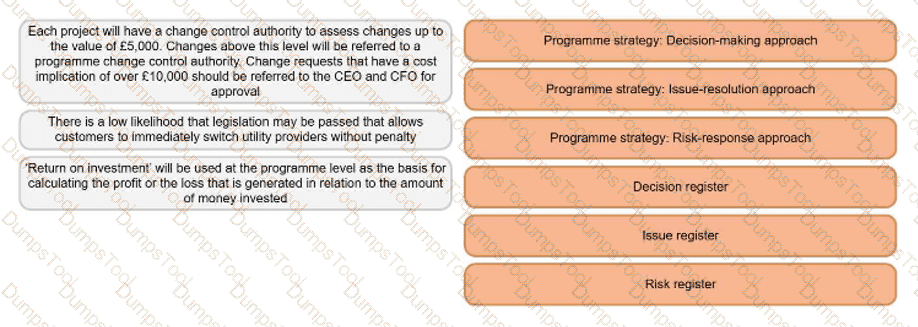
Three items of information have been recorded in the documents to support the 'decisions' theme. In which document should they be recorded?
Full Access
Question # 35

Which of the following is an Information Baseline?

A.

Governance

B.

Boundary

C.

Management

D.

All of above

Full Access
Question # 36

During the 'identify the programme’ process, the SRO identified that the utility regulator may be considering a fair pricing policy to protect vulnerable customers. The introduction of this policy would have a significant impact on the benefits expected by UU. The programme manager included this information in the programme brief.

How well does this apply the 'deal with ambiguity’ principle, and why?

A.

It applies it well, because the sponsoring group needs to understand the possible impact of this risk when deciding whether to proceed

B.

It applies it well, because UU needs to understand their risk appetite in the current business climate before they start the programme

C.

It applies it poorly, because a formal, documented, risk management process should be used to assess the risk before it is included in the programme brief

D.

It applies it poorly, because this risk is so significant that it should have been identified in the programme mandate by the sponsoring group

Full Access
Question # 37

Which of the following is a Governance document?

A.

Blueprint

B.

Project Dossier

C.

Quality and assurance strategy

D.

Risk Register

Full Access
Question # 38

Who approves Business Case?

A.

Sponsoring Group

B.

SRO

C.

Programme Manager

D.

BCM

Full Access
Question # 39

Which of following is part of critical benefits validation test?

A.

Currency

B.

Accurate

C.

Attribution

D.

Availability

Full Access