dumpstool logo

An architect is evaluating a use case with these requirements:
Visibility into the health of an end user’s path for the five most critical applications
Metrics showing the effect of endpoint health on an application
Centralized call-quality analytics from the Zoom video-conferencing solution
Insights into supporting protocols, such as DNS
Support for 600 users on Windows desktops in one sales office
Which solution should be recommended to satisfy these requirements?
An organization plans to modernize its legacy branch architecture. The current architecture is rigid, complex, and poorly suited to a cloud-first strategy, resulting in high operational costs and latency.
The four core data centers are strategically located in Dallas, Toronto, London, and Tokyo. They are interconnected through a dedicated MPLS backbone that provides reliable connectivity but has significant costs and limited bandwidth scalability.
Branches use MPLS or site-to-site VPN to connect to the geographically nearest data center. All branch internet-bound traffic is backhauled to the data-center egress firewalls, causing SaaS-application latency and additional bandwidth pressure on the MPLS links.
The organization needs a proposed WAN architecture for branch connectivity that improves security posture and SaaS application access, while supporting local internet breakout for every branch device, including IoT.
Which two implementations will meet the goal of modernizing the branch architecture? (Choose two.)
A global manufacturing organization has a strategic plan for rapid growth through mergers and acquisitions. Several components that the organization purchased are considered large deployments with existing IP address schemas and allocations that conflict with the parent organization. The manufacturing organization requires access to the resources before a re-IP initiative can be completed.
All deployments contain a variety of IoT devices. Leadership requires protection of vulnerable assets and identification of any known CVEs associated with the IoT devices. The governance, risk, and compliance (GRC) team requires comprehensive, non-repudiable logs to identify all IoT devices reporting “Critical (9.0+) CVE scores” for mandatory remediation.
Throughput must exceed the current 1 Gbps trending rate and, with anticipated growth, will soon scale to 5 Gbps.
Segmentation is mandatory, with enclaves based on region, device type, and function.
Which architectural component ensures IoT storage, integrity, and non-repudiation of this granular risk data for auditing purposes?
An organization has chosen Prisma SD-WAN ION devices for branch-office use and is developing a low-level design for its sites. A typical branch site includes a 10 Mbps MPLS circuit with fiber LC-SR and an RJ-45 Ethernet 50 Mbps DIA internet circuit.
There are 75 workstations, and a stacked core switch that supports LACP, M-LAG, BGP, and OSPF will be used. The core switch serves as the default gateway for all local VLANs. The final design will determine the appropriate model and accessories for the site.
Which statement applies to the Prisma SD-WAN architecture in this use case?
A global organization is upgrading its data-center and private-cloud infrastructure. The environment includes:
A Nutanix AHV cluster that hosts critical east-west application workloads
A VMware ESXi cluster with multi-socket hosts that supports high-throughput workloads ( > 10 Gbps)
A new pair of PA-5450 firewalls to secure the perimeter and perform encrypted-traffic inspection at scale
Strict performance service-level agreements (SLAs) for both north-south and east-west traffic, with heavy dependence on TLS 1.3 and IPSec
A Network Functions Virtualization (NFV) environment on KVM that delivers high-performance security services to maximize packet throughput and minimize latency
The chief architect must ensure that the firewall design prevents hypervisor contention, optimizes non-uniform memory access (NUMA), and uses hardware capabilities for encrypted traffic.
VM-Series on Nutanix AHV - Resource Allocation
Because the Nutanix cluster is already heavily utilized, the architect's primary concern is avoiding performance degradation of the virtual firewall. Thin provisioning or ballooning could add latency and unpredictability, which is unacceptable for a security-sensitive workload.
VM-Series on VMware ESXi - NUMA and vCPU Placement
In the VMware ESXi environment, the architect is deploying VM-Series for workloads exceeding 10 Gbps. Placing vCPUs across NUMA nodes or oversubscribing cores would cause latency through cross-socket memory access and scheduling delays. Likewise, dedicating logical hyperthreads does not deliver the deterministic data-plane performance required.
Operational Integration and High Availability
With performance assured through correct hypervisor and hardware provisioning, the architect also evaluates high availability (HA). VM-Series pairs are deployed in active/passive HA across Nutanix and VMware clusters, while PA-5450s provide the data center’s north-south secure-perimeter deployment. This provides resilience without adding unnecessary east-west inspection bottlenecks.
The recommendation must be a scalable, high-performance firewall deployment that aligns with enterprise SLAs and the CISO’s encrypted-traffic concerns.
To optimize throughput and minimize latency, what is recommended for configuring vCPUs and NUMA in this deployment?
A multinational organization has a large, global population of remote users. This population includes several persona types with distinct requirements and concerns about adopting a Zero Trust Network Access (ZTNA) solution.
Developers need to temporarily bypass security controls for business reasons, but the security team considers this a potential risk. Developers commonly access development servers on premises in private data centers and in the public cloud. These development applications use web (HTTP/HTTPS), API, RPC, and SMB-based applications.
Sales staff travel frequently and connect to the network through many different connection types, but they are generally limited to SaaS-based web applications. They often report performance issues whenever an agent is installed and want the ability to temporarily disable those agents. Data exfiltration and insider risk have been identified as the primary threats for this user class.
Executives are concerned about being high-value targets. Security must be consistent across multiple endpoint types, including mobile and desktop devices. Executive team members have stated that their primary objective is for the solution to be responsive and easy to troubleshoot.
Which two solutions will help mitigate risk to the sales staff? (Choose two.)
Which factor should be considered when deciding whether to recommend an NGFW edge architecture or a SASE architecture for a customer planning to implement a Zero Trust Network Access (ZTNA) solution?
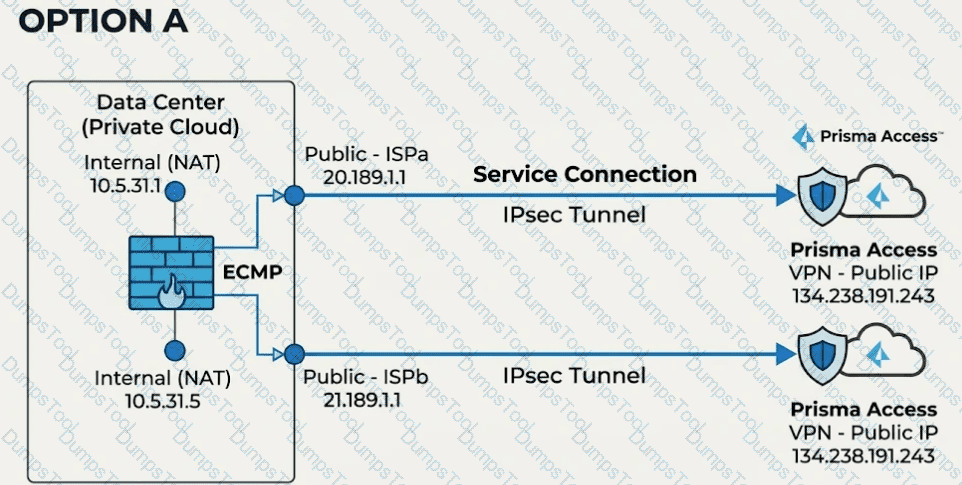
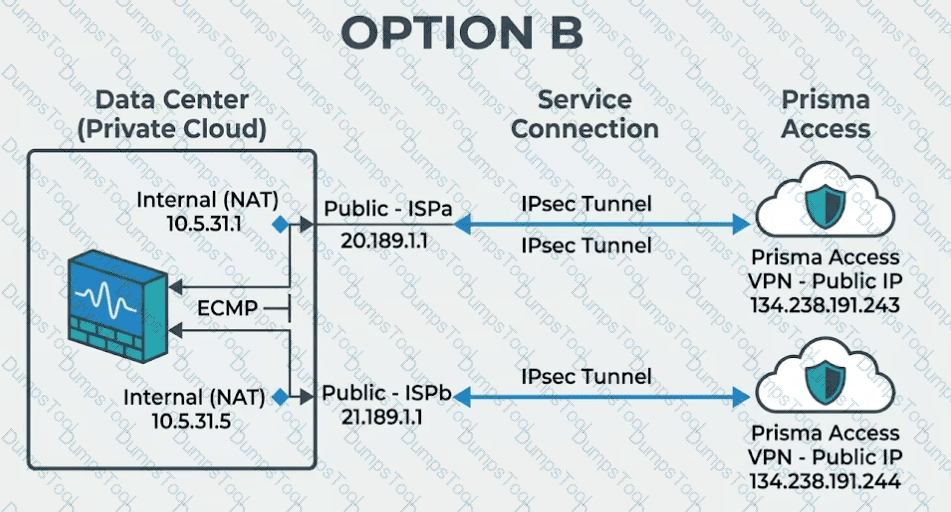
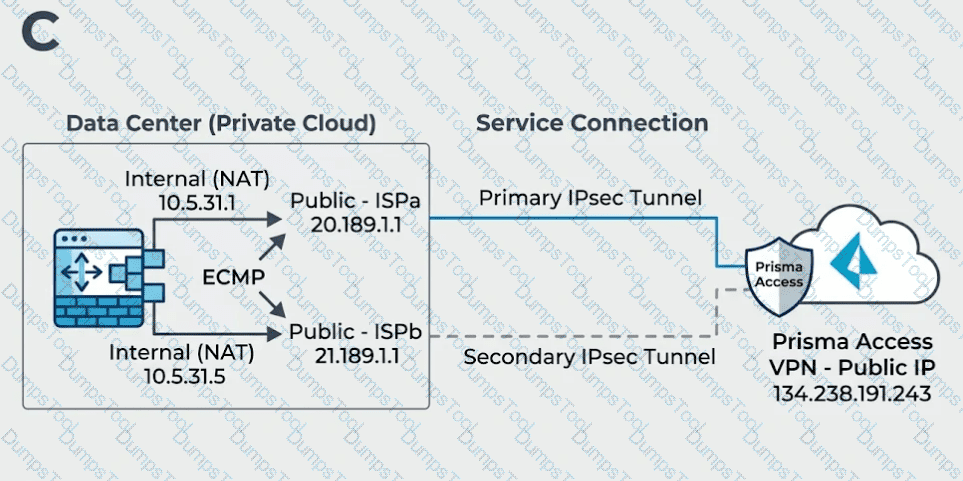
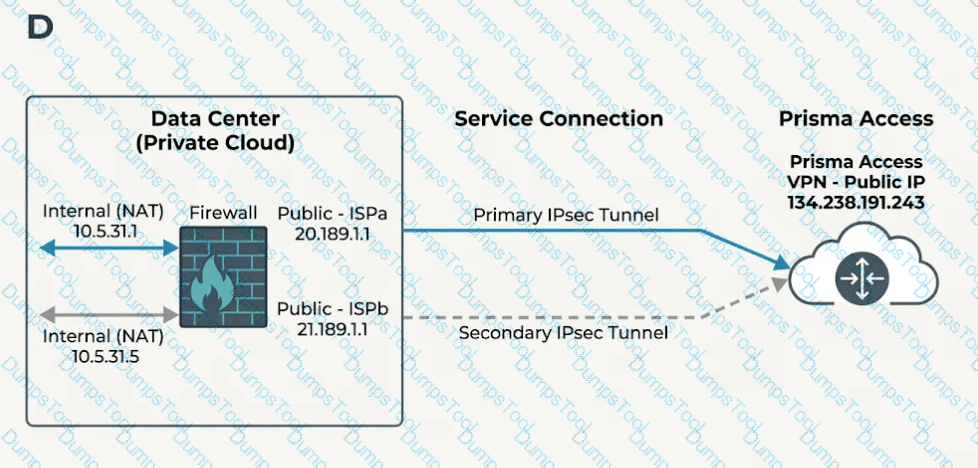
An organization is designing Prisma Access service connections for its data centers. Each data center has redundant 10 Gb internet links and must support at least 1.5 Gbps of throughput for Prisma Access-connected users and branches.
Which diagram shows a solution that satisfies these use-case requirements?

TESTED 21 Nov 2026