dumpstool logo

Which three factors should you consider while specifying Intercompany System options?
After completing a business requirement mapping session, it has been decided that only single Currency Journals will be entered for this Company.
To achieve this requirement, on which two objects should you enable “Limit a Journal to a Single Currency”? (Choose two.)
Task 3
Manage Chart of Accounts Mappings
Scenario
Your client needs to consolidate their UK Ledger to the Canadian parent ledger. Each Chart of Accounts
has the following segments:
Company-LoB-Account-Cost Center-Product-Intercompany
Know that the Company, LoB, Product, and Intercompany segments share the same value sets.
Create a Chart of Accounts mappings to map UK Chart of Accounts to CA Chart of Accounts that meets the following specifications:
Cost Center Mapping
. Balance Sheet (0 and 000) should be mapped to
Balance Sheet
. All other cost centers should be mapped to 610
Account Mapping
. Asset accounts (in the 1000 range) should be
mapped to account 11101
. Liability accounts (in the 2000 range) should be
mapped to account 22100
. Equity accounts (in the 3000 range) should be
mapped to account 34000
. Revenue accounts (in the 4000 range) should be
mapped to account 42000
. Expense accounts (from 5000 onwards) should be
mapped to account 51100
Note:
· Do not use conditions based on parents.
. Treat any account after the 5000 range as an expense.
· Ensure all maps are numeric only.
· When creating your mapping rules for each segment
please allow for existing and future segment values
Challenge 2
Manage Shorthand Aliases
Scenario
Your client intends to utilize the Shorthand Alias feature and would like to see how the aliases will appear when entering transactions.
Task 2
Create a shorthand alias for the US Chart of Accounts to record Revenue Domestic for Supremo Fitness, Line of Business 2, and US Operations Cost Center.
Note:
. Prefix your alias name with 07, where 07 is
your exam ID.
. There is no Product or Intercompany
impact.
Which three Oracle Transactional Business Intelligence (OTBI) objects can be created by using the tools in the Oracle Business Intelligence (BI) catalog?
Manage Chart of Accounts Structure and Instance
Scenario
Your client is implementing Oracle Fusion Cloud Financials. The decision is to have a 5-segment Chart of Accounts: Company, Cost Center, Account, Product, and Intercompany. You are working in
the General Ledger team and will be responsible for creating the Chart of Accounts Structure and Instance for the Chart of Accounts.
Task 1
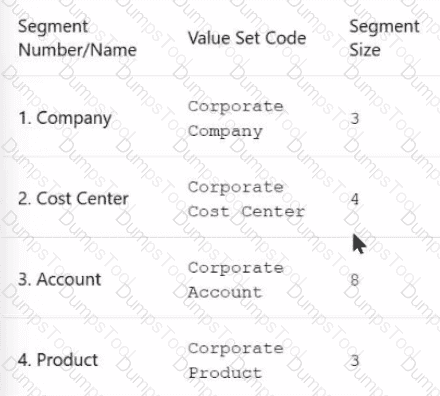
Create a Chart of Accounts Structure and Instance for the following Chart of Accounts:
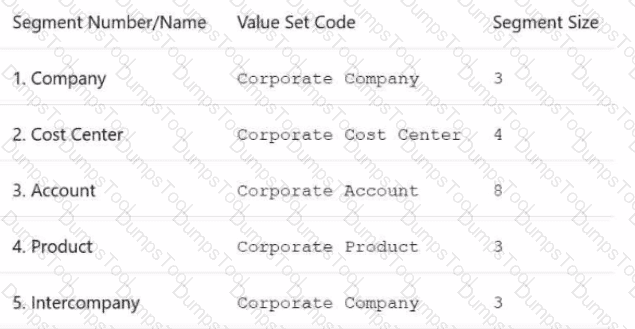
Note:
· Prefix all your setups with 07, where 07 is your candidate ID
· There is one balancing segment.
· Choose the appropriate segment labels.
. For the purpose of this test there is no need to deploy the flexfield.
. Valid code combinations should be added to the Code Combination table automatically.
· Shorthand aliases will not be implemented.
. Accept the defaults for the instance segments.
You have enabled the ledger option “Limit a journal to a single currency.” However, users are reporting that they can enter more than one currency when using the Create Journal task.
How would you resolve this issue?
You have just been hired to add a new subsidiary to the corporate enterprise structure in the customer ' s Oracle Fusion Cloud.
The subsidiary will capture transaction information from subledgers in the local currency and under International Financial Reporting standards (IFRS) and local GAAP for corporate reporting requirements, which will report via the use of a secondary ledger.
The secondary ledger is used only at period end; there is no need to have real-time transaction or Journal details. It is noted that most of the accounting between IFRS and Corporate GAAP is similar.
Which conversion level would you recommend to keep a thin secondary ledger?
Which two statements are true regarding the Intercompany Reconciliation Report? (Choose two.)
Your customer is a financial institution that needs to maintain average daily balances (ADB).
Which statement is true about this functionality in Oracle Fusion Cloud applications?
You need to define a chart of accounts that includes an intercompany segment. Your customer plans to use segment value security rules for the Company segment.
What is Oracle ' s recommended method to define this chart of accounts?
What are thetwo possible reasonsforencumbrance created on the purchase orderto go back to thebudget or funds availability?
You are setting up Close Monitor for your organization. What is the key consideration when selecting the ledgers or ledger sets that form part of the Close Monitor hierarchy?
You are planning to use the Related Value Sets feature with your Chart of Accounts to create a dependency between the Company and Cost Center segments. For example, when using Company 101, the list of displayed cost centers should be in the range 100 to 199. When setting up your value sets, which validation type should you choose for the Cost Center segment?
When constructing a new chart of accounts instances, it has been decided to control the list of values within certain segments, with the use of related value sets.
When defining new related value sets, which three configuration steps should be considered?

TESTED 02 Oct 2026