
Spring Sale - Special 70% Discount Offer - Ends in 0d 00h 00m 00s - Coupon code: 70dumps

NCP-CN Questions and Answers

Question # 6

A Kubernetes administrator has been tasked with deploying a new cluster to AWS. The administrator has received the following requirements for this deployment:

    Region us-east-1

    AMI rhel8.6What is a requirement for deploying a new cluster in AWS?

A.

Use --dry-run parameter

B.

Use --ami-format parameter

C.

Set an export AWS_REGION

D.

Set an export KUBECONFIG

Full Access
Question # 7

When deploying an NKP cluster onto air-gapped, pre-provisioned servers, Konvoy Image Builder is utilized to prepare the servers to become NKP cluster nodes.

What does the konvoy-image upload command do as a part of this preparation process?

A.

The command is used to create a konvoy userid on the servers, as well as upload artifacts to them such as the container runtime, the OS bundle, and Kubernetes components.

B.

The command is used to upload OS hardening scripts to the server (must be client supplied).

C.

The command uploads artifacts to the servers such as the container runtime, the OS bundle, and Kubernetes components.

D.

The command uploads artifacts to the servers such as the container runtime, the OS bundle, and Kubernetes components, including optional OS hardening scripts (must be client supplied).

Full Access
Question # 8

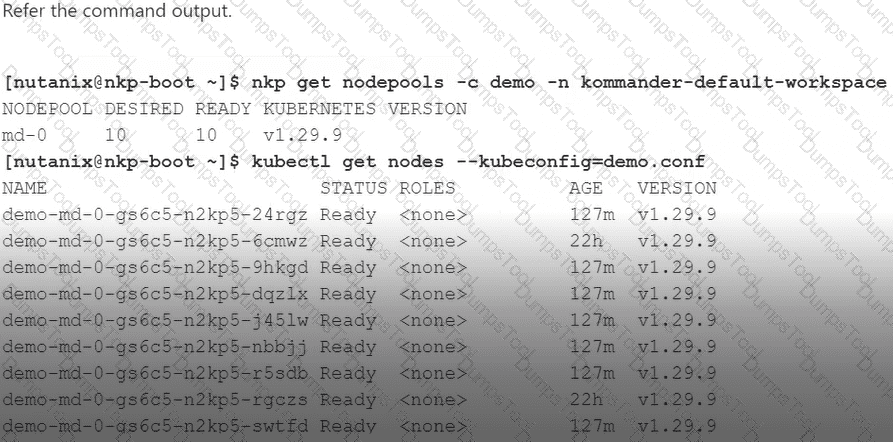
A Platform Engineer needs to create an NKP cluster on vSphere infrastructure, using the vSphere provisioning method. The cluster needs to have 3 worker node pools:

    First node pool should consist of 6 worker nodes

    Second node pool should consist of 3 worker nodes

    Third node pool should consist of 3 worker nodesAdditionally, the worker nodes in the first node pool should be set to 10 CPUs, the second node pool workers should be set to 8 CPUs, and the third node pool workers should be set to 6 CPUs. What is the proper way to create the NKP cluster using the NKP CLI?
A.

First, execute the nkp create cluster vsphere command, including the following parameters:

--worker-replicas 6

--worker-cpus 10

Then, execute the nkp create nodepool vsphere command, including the following parameters:

--worker-replicas 3

--worker-cpus 8

Then, execute the nkp create nodepool vsphere command, including the following parameters:

--worker-replicas 3

--worker-cpus 6

B.

First, execute the nkp create cluster vsphere command, including the following parameters:

--worker-replicas 6

--worker-cpus 10

Then, execute the nkp create nodepool vsphere command, including the following parameters:

--replicas 3

--cpus 6

C.

When executing the nkp create cluster vsphere command, include the following parameters:

--node-pools 3

--worker-replicas 6,3,3

--worker-cpus 10,8,6

D.

First, execute the nkp create cluster vsphere command, including the following parameters:

--worker-replicas 6

--worker-cpus 10

Then, execute the nkp create nodepools vsphere command, including the following parameters:

--replicas 3,3

--cpus 8,6

Full Access
Question # 9

The Platform Engineer needs to expand an NKP Pro demo cluster due to workload capacity constraints. The demo cluster has 150 vCPUs available to it from a licensing standpoint. Each worker node has 8 vCPUs and each control plane node has 4 vCPUs.

Which two options are valid for expanding the demo cluster and remaining compliant with licensing? (Choose two.)

A.

Add 6 additional control planes.

B.

Expand the original worker nodepool by up to 8 nodes.

C.

Create a new worker nodepool consisting of 10 nodes with 8 vCPUs per node.

D.

Expand the original worker nodepool by up to 4 nodes and create a new worker nodepool consisting of 6 nodes with 4 vCPUs/node.

Full Access
Question # 10

A Platform Engineer is preparing machine images for NKP through the NIB or KIB process. What is the purpose of doing this?

A.

Hardening an OS image with client-supplied hardening scripts

B.

Creating a custom user account for NKP admins to ensure access to NKP nodes

C.

Tagging the image to be used specifically for NKP

D.

Creating a CAPI-compliant image for use as NKP cluster nodes

Full Access
Question # 11

There is a private registry for the NKP deployment and the company has an NKP Ultimate license. A Platform Engineer is using the Podman tool and is already logged in. Now, the engineer needs to send the private registry with the NKP Catalog Applications.

What command should the engineer use?

A.

podman load -i ./container-images/nkp/catalog-applications-image-bundle-v2.12.0.tar

B.

nkp push bundle --bundle ./container-images/nkp/catalog-applications-image-bundle-v2.12.0.tar --to-registry=${REGISTRY_URL} --to-registry-username=${REGISTRY_USERNAME} --to-registry-password=${REGISTRY_PASSWORD}

C.

docker load -i ./container-images/nkp/catalog-applications-image-bundle-v2.12.0.tar

D.

nkp apply bundle -f ./container-images/nkp/catalog-applications-image-bundle-v2.12.0.tar --to-registry=${REGISTRY_URL} --to-registry-username=${REGISTRY_USERNAME} --to-registry-password=${REGISTRY_PASSWORD}

Full Access
Question # 12

A Cloud Engineer is deploying an NKP management cluster and plans to deploy multiple NKP workload clusters from it. The management cluster will be on Nutanix infrastructure, but the NKP workload clusters may be deployed in multiple provisioning environments, such as:

    Nutanix

    AWS

    AzureWhen the engineer deploys an NKP workload cluster in AWS, which two default behaviors will be performed by NKP on this newly-deployed cluster? (Choose two.)

A.

The NKP workload cluster will receive all of the GitOps sources that have been assigned to the NKP workspace.

B.

The NKP workload cluster will receive all of the NKP RBAC policy that has been assigned to this NKP workspace.

C.

The NKP workload cluster will also be assigned to all of the NKP projects that have been created within the NKP workspace.

D.

The NKP workload cluster will be deployed all of the applications that have been enabled on this NKP workspace.

Full Access
Question # 13

A Platform Engineer has deployed NKP and wants to utilize its OOB data storage feature.

What should the engineer enable to support backups within the NKP environment?

A.

MinIO

B.

Rook Ceph

C.

Volumes iSCSI

D.

Objects S3

Full Access
Question # 14

A Cloud Engineer is deploying an NKP cluster into an AWS environment. By default, when deploying NKP on AWS infrastructure, it generates the supporting infrastructure necessary for the cluster (VPC, subnets, ELBs). However, the AWS team has insisted that the NKP cluster be deployed on existing AWS infrastructure. How can the engineer meet this requirement?

A.

When using the nkp adopt infrastructure aws command set, include the valid parameters with the pre-existing VPC, subnets, and ELB to use. Deploy the NKP cluster using the nkp create cluster aws command set.

B.

Create an overrides file with the pre-existing VPC, subnets, and ELB to use. When using the nkp create cluster aws command set, include the overrides parameter with the overrides file that was created.

C.

Create an NKP infrastructure provider for AWS in the NKP UI. When deploying the NKP cluster through the UI, specify the pre-existing VPC, subnets, and ELB to use in the appropriate fields of the 'Infrastructure' section of the Create Cluster page.

D.

When using the nkp create cluster aws command set, include the valid parameters with the pre-existing VPC, subnets, and ELB to use.

Full Access
Question # 15

A company has a new DevOps team that needs to be provided cloud native computing resources. This team will need to have access to multiple NKP clusters for development, testing and validation of an in-house application. However, they also need to be restricted to a specific namespace and a consistent level of access across the clusters within this namespace so that they do not adversely impact the environment of other user groups or the clusters themselves.

As a part of this consideration, the new team also needs to be limited to the amount of storage, CPU and memory they can consume on the clusters. A Platform Engineer has been tasked with providing the appropriate level of access to the team on these multiple NKP clusters.

How should the engineer best accomplish this task?

A.

1.Create an NKP project and assign the NKP clusters to it.

2.Create quotas for the NKP project.

3.Create an NKP group for the DevOps team.

4.Assign that NKP group the proper RBAC roles within that NKP project.

B.

1.Create an NKP workspace and assign the NKP clusters to it.

2.Create quotas for the NKP workspace.

3.Create an NKP group for the DevOps team.

4.Assign that NKP group the proper RBAC roles within that NKP workspace.

C.

1.Create an NKP group for the DevOps team.

2.Assign that NKP group the proper RBAC roles in the NKP UI.

3.Select the export to yaml option once the RBAC role assignment to that NKP group is complete.

4.Apply the exported manifest to each of the NKP clusters using kubectl.

D.

1.Enable Gatekeeper on the NKP clusters.

2.Create an NKP group for the DevOps team.

3.Assign Gatekeeper quota and authorization policies to that NKP group.

Full Access
Question # 16

A Platform Engineer is deploying an NKP cluster within an air-gapped AWS environment. However, after an infrastructure planning session with the network team, it’s been determined that the default CIDR block range that is used by pods on NKP clusters is already in use in their environment.

How can the engineer ensure there are no collisions between NKP pod traffic and the existing network using that subnet range?

A.

Because the environment is air-gapped, there will be no network traffic collision concerns and no adjustment needs to be made to the pod network CIDR block range.

B.

Create an NKP infrastructure provider for AWS in the NKP UI.

Select the Advanced Options button from the Network section of the Create Cluster page and specify a unique CIDR block range within the pod network field.

C.

Create the NKP cluster’s manifest using the nkp create cluster command set and include the pod CIDR block range parameter when generating the cluster manifest.

Deploy the NKP cluster manifest.

D.

Create an NKP infrastructure provider for AWS in the NKP UI.

When deploying the NKP cluster through the UI, specify a unique CIDR block range for the pod network field in the Network section of the Create Cluster page.

Full Access
Question # 17

A Platform Engineer manages an NKP environment and is preparing a machine image to become an NKP cluster node. Which statement is correct regarding the default node preparation process?

A.

Packer is used to make the OS image CAPI-compliant for use as an NKP node.

B.

Ansible is used to make the OS image CAPI-compliant for use as an NKP node.

C.

Goss is used to harden the OS image for use as an NKP node.

D.

Terraform is utilized to clone an existing OS image for use as an NKP node.

Full Access
Question # 18

A Platform Engineer has been tasked with backing up and restoring a production environment to ensure persistent data is available during a disaster at a primary site. What is recommended for backup and restore production use cases?

A.

Protection Domain

B.

Rook Ceph

C.

External Storage Class

D.

S3-compatible API

Full Access
Question # 19

An administrator has been trying to deploy an initial AHV-based NKP cluster in a dark site (no Internet connectivity) environment using the command shown in the question.

nkp create cluster nutanix \

--cluster-name=$CLUSTER_NAME \

--control-plane-prism-element-cluster=$PE_NAME \

--worker-prism-element-cluster=$PE_NAME \

--control-plane-subnets=$SUBNET_ASSOCIATED_WITH_PE \

--worker-subnets=$SUBNET_ASSOCIATED_WITH_PE \

--control-plane-endpoint-ip=$AVAILABLE_IP_FROM_SAME_SUBNET \

--csi-storage-container=$NAME_OF_YOUR_STORAGE_CONTAINER \

--endpoint=$PC_ENDPOINT_URL \

--control-plane-vm-image=$NAME_OF_OS_IMAGE_CREATED_BY_NKP_CLI \

--worker-vm-image=$NAME_OF_OS_IMAGE_CREATED_BY_NKP_CLI \

--registry-url=${REGISTRY_URL} \

--registry-mirror-username=${REGISTRY_USERNAME} \

--registry-mirror-password=${REGISTRY_PASSWORD} \

--kubernetes-service-load-balancer-ip-range $START_IP-$END_IP \

--self-managed

Which missing attribute needs to be added in order for the deployment?

A.

--airgapped

B.

--insecure

C.

--registry-url

D.

--registry-username

Full Access
Question # 20

A dev team needed to optimize their logging system to be more robust, because the CPU and memory limits were insufficient, which caused delays in log collection and processing during times of high demand.

After a deep performance analysis, they decided to increase the CPU limits from 1 to 4 and the memory from 1000Mi to 4Gi.

Which ConfigMap should the development team run with custom resource requests and limit values for fluentd?

A.

bash

Copy

[nutanix@nkp-boot ~]$ cat < configmap.yaml

apiVersion v1

kind ConfigMap

metadata

name logging-operator-logging-overrides

namespace kommander

data

values.yaml |

fluentd

resources

limits

cpu 1

memory 1000Mi

requests

cpu 4

memory 4Gi

EOF

B.

bash

Copy

[nutanix@nkp-boot ~]$ cat < configmap.yaml

apiVersion: v1

kind: ConfigMap

metadata:

name: logging-operator-logging-overrides

namespace: kommander

data:

values.yaml: |

fluentd:

resources:

limits:

cpu: 4

memory: 4Gi

requests:

cpu: 4

memory: 4Gi

EOF

C.

bash

Copy

[nutanix@nkp-boot ~]$ cat < configmap.yaml

apiVersion v1

kind ConfigMap

metadata

name logging-operator-logging-overrides

namespace kommander

data

values.yaml |

fluentd

resources

limits

cpu 4

EOF

values.yaml |

fluentd

resources

limits

cpu 4

memory 4Gi

requests

cpu 1

memory 1000Mi

D.

bash

Copy

[nutanix@nkp-boot ~]$ cat < configmap.yaml

apiVersion: v1

kind: ConfigMap

metadata:

name: logging-operator-logging-overrides

namespace: kommander

data:

values.yaml: |

fluentd

resources

limits

cpu 4

memory 1000Mi

requests

cpu 1

memory 4Gi

EOF

Full Access
Question # 21

A Platform Engineer works for a service provider and needs to establish access and authentication for multiple clients into an NKP cluster. Each client has their own LDAP source that should be used for authentication into the cluster.

How would this be accomplished?

A.

A common LDAP source needs to be established and client specific groups and users need to be configured within this common LDAP provider. Then an LDAP connector would be created for this LDAP provider.

B.

An NKP workspace needs to be created for each client and an LDAP connector would be created for each NKP workspace.

C.

An NKP project would be created for each client and an LDAP connector would be created for each NKP project. Users would provide the project name their company was assigned as part of their login.

D.

The LDAP connector configuration would be modified to include an array for each client LDAP source to authenticate with. Users would provide the client name defined in the array as part of their login.

Full Access
Question # 22

A Platform Engineer is getting started with NKP and has created a bastion host with all needed prerequisites.

How should the engineer install Kommander?

A.

AWS CLI

B.

Terraform

C.

Ansible

D.

NKP CLI

Full Access
Question # 23

A Platform Engineer is deploying NKP into a highly secure vSphere environment. The NKP cluster will be air-gapped, and must also be FIPS compliant. The OS platform to be used for NKP cluster nodes is RHEL.

What must the engineer do to properly prep an OS image and have it be deployed as a FIPS compliant NKP cluster node?

A.

Verify the OS itself has been placed in fips mode.

When performing the NKP image build operation, be sure to include the offline fips override.

When performing the NKP cluster deploy operation, be sure to include the FIPS version references for kubernetes and etcd.

B.

Verify the OS itself has been placed in fips mode.

When performing the NKP image build operation, be sure to include the offline fips and fips overrides.

When performing the NKP cluster deploy operation, be sure to include the FIPS version references for kubernetes and etcd.

C.

Verify the OS itself has been placed in fips mode.

When performing the NKP image build operation, be sure to include the offline fips and fips overrides.

When performing the NKP cluster deploy operation, be sure to include the FIPS version references for kubernetes, kubectl and etcd.

D.

Verify the OS itself has been placed in fips mode.

When performing the NKP cluster deploy operation, be sure to include the FIPS version references for kubernetes, kubectl and etcd.

Full Access
Question # 24

NKP cluster nodes require a disk for some of its deployed components, outside of an application’s persistent volume requirements. What are these components and where are they deployed?

A.

kubelet and containerd, in /opt/nkp

B.

kubelet and containerd in /var/lib

C.

kubectl and kubelet in /opt/nkp

D.

kubectl and kubelet in /var/nkp

Full Access
Question # 25

At a national defense company, protecting sensitive data is their top priority. With the increase in cyber-attacks, they have decided to implement an air-gapped Kubernetes environment to manage their critical applications, ensuring that no information could leak to the outside. The Kubernetes environment has three clusters deployed for their applications with centralized management. What type of licensing is required to enable this environment?

A.

NKP Starter

B.

NKP Ultimate

C.

NKP Pro

D.

NKP UI

Full Access
Question # 26

A Cloud Engineer would like to configure an NKP cluster that is running in the cloud to dynamically expand and compact its resource capacity for running container workloads. This will help ensure efficient use of resources without impacting online retail transaction performance that is increasingly hitting unpredictable spikes and lulls.

Which autoscaling method does NKP use and how does it scale?
A.

Horizontal-Pod autoscaler and worker node replicas

B.

Horizontal-Pod autoscaler and worker node CPU/memory sizing

C.

Cluster autoscaler and worker node replicas

D.

Cluster autoscaler and worker node CPU/memory sizing

Full Access
Question # 27

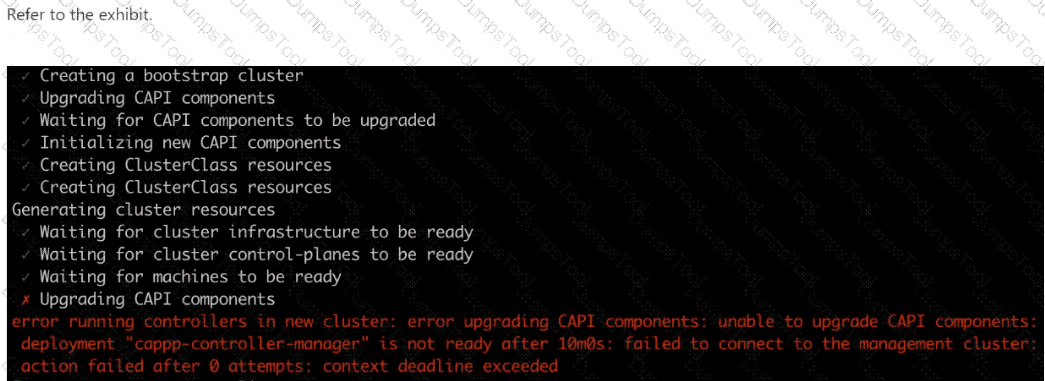
An administrator is provisioning an NKP cluster. After the VM creation task, the error shown in the exhibit is produced.

What could be the reason?

A.

Private registry software or version is not the recommended.

B.

VM does not have the Linux version.

C.

VM doesn’t have communication to the registry.

D.

NKP Software is not loaded in the registry.

Full Access
Question # 28

A Platform Engineer is attaching existing Kubernetes clusters to NKP, but a particular Kubernetes Amazon EKS cluster is getting errors with application deployments. These errors are related to persistent volumes. What could be the issue, and what can the engineer do?

A.

The storage appliance is having issues. The storage engineer should be contacted to take a look.

B.

There is no compatible storage to be attached to the EKS cluster. Ask for compatible storage.

C.

There is no default StorageClass. Storage classes should be reviewed, and only one should be set as default.

D.

There could be a misconfiguration in the ConfigMap. It should be adjusted to NKP requirements.

Full Access
Question # 29

NKP Starter is bundled with which entitlement?

A.

NCI Pro

B.

NCI Starter

C.

NCM Pro

D.

NCM Starter

Full Access
Question # 30

A Platform Engineer is preparing an AWS instance using KIB for becoming an NKP cluster node. During the process, the source AMI is successfully cloned, and multiple preparation steps have occurred against the cloned AMI, such as gathering OS-release facts and uploading image bundles to it. However, the process encounters an error and ultimately fails. What is one troubleshooting step the engineer can perform that may help identify the root cause of the issue?

A.

Rerun the KIB command, including the pause parameter, so that each command in the KIB-prep sequence and its return can be reviewed in detail before allowing the prep process to continue.

B.

Rerun the KIB command, including the parameter to set the verbosity level to debug, so that all issued AWS CLI commands and their returns are included and added to an exported log file for review.

C.

Rerun the KIB command, including the parameter to instruct Packer not to automatically delete the cloned AMI on error. This way the OS image can be accessed and further inspected.

D.

Rerun the KIB command, including the parameter to instruct Ansible not to automatically delete the cloned AMI on error. This way the OS image can be accessed and further inspected.

Full Access
Question # 31

A company has enabled auto-scaling within an NKP cluster. What is the behavior for auto-scaling?

A.

CPU is hot-added or hot-removed from a node.

B.

Memory is hot-added or hot-removed from a node.

C.

The Power-On Status/Mode of a node is changed to meet load conditions.

D.

Nodes will be CAPI-created or CAPI-deleted as needed by the cluster.

Full Access
Question # 32

A company has standardized on NKP for their Kubernetes platform and needs to deploy their first cluster with the following requirements:

    Dark site ready

    Custom Service CIDR Block

    Custom Pod CIDR Block

    Hosted on Nutanix AHV ClusterWhich tool would the administrator use to perform the deployment?

A.

kubectl CLI

B.

NKP GUI

C.

NKP CLI

D.

OCP CLI

Full Access