Summer Sale - Special 70% Discount Offer - Ends in 0d 00h 00m 00s - Coupon code: 70dumps

4A0-D03 Questions and Answers

Question # 6

A host is connected to multiple PEs through multi-homing.

Which of the following is NOT a function of the EVPN route-type 4 route?

A.

Allows the other PEs to discover which PEs are connected to the same Ethernet segment.

B.

Triggers the election of a designated forwarder.

C.

Identifies the type of algorithm to be used in the election process.

D.

Identifies the redundancy mode of the Ethernet segment.

Full Access
Question # 7

When providing L3 multi-homing on two or more leaf routers, which of the following is FALSE?

A.

In a single-active multi-homing scenario, the DF-election is used to identify the active leaf router.

B.

In an all-active multi-homing scenario, the DF-election is used to identify the leaf router that is responsible for forwarding BUM traffic to the host.

C.

All learned 3rd party prefixes are advertised using EVPN route type 5.

D.

The Ethernet segment is associated with the next-hop for the 3rd party prefixes.

Full Access
Question # 8

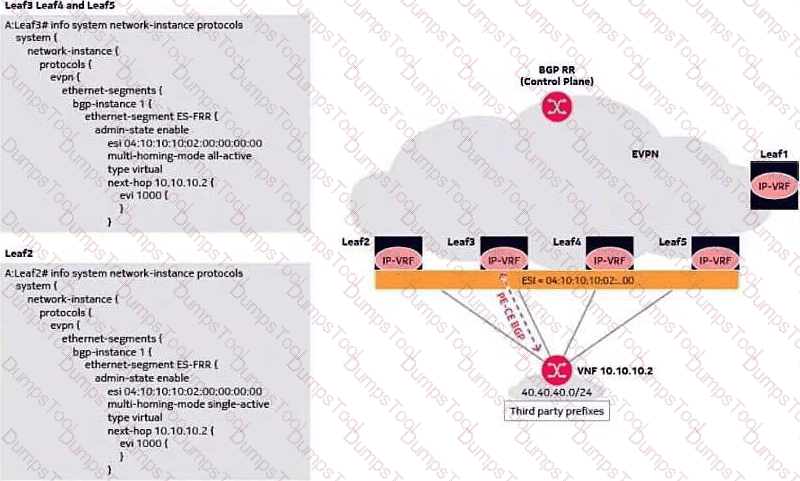
Consider the exhibit.

Question # 8

All IP-VRFs are configured properly and are operational.

Which of the following statements is FALSE?

A.

One of the connected leaf routers will be elected DF.

B.

The elected DF will use the AD per EVI update to identify itself as primary.

C.

Only the elected DF will advertise the customer IP prefix route to the BGP route reflector.

D.

All connected leaf routers will use an AD per ES update to advertise single-active redundancy.

Full Access
Question # 9

Which of the following statements about the decoupled gateway-based data center interconnect solution is TRUE?

A.

The IP addresses of all the leaf routers and route-reflectors must be reachable by the routers in the WAN.

B.

There is a clear demarcation for security and QoS between the data center border leaf and the WAN PE.

C.

The WAN PE maintains a peering session with the data center route reflector.

D.

VXLAN tunnels are established between the leaf routers in the different data centers.

Full Access
Question # 10

Consider the exhibit.

Question # 10

Which of the following statements about the configuration and operation of this setup is TRUE?

A.

The MAC-VRF on Leaf1 and Leaf2 is configured with multi-homing-mode all-active.

B.

The MAC-VRF on Leaf3 will need to be configured with ECMP to be able to load balance between Leaf1 and Leaf2.

C.

The host will be required to be configured with a LAG.

D.

The Ethernet segment ES-1 will be associated to the ports that connect to the host.

Full Access
Question # 11

Consider the exhibit.

Question # 11

All IP-VRFs are configured properly and are operational.

Which of the following statements is FALSE?

A.

One of the leaf routers will be elected DF.

B.

All connected leaf routers will use single active redundancy.

C.

The AD per EVI update will be used to identify which connected leaf is primary.

D.

All traffic destined to 40.40.40.0/24 will be forwarded through Leaf3 due to the BGP connection to the CE VNF.

Full Access
Question # 12

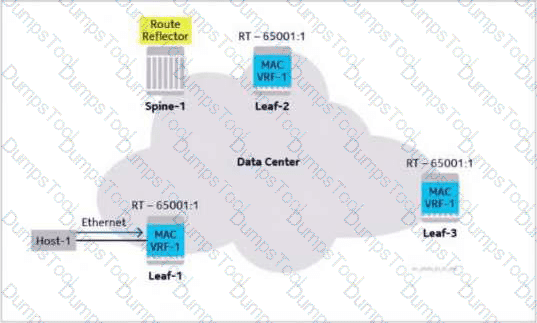
Consider the exhibit.

Question # 12

All three leafs have an EVPN MP-BGP session with the route reflector in Spine-1. Leaf-2 and Leaf-3 have existing instances of an L2 EVPN named MAC VRF-1. Leaf-1 has just enabled a new instance of MAC VRF-1.

Which of the following steps is NOT taken when this new instance is enabled?

A.

Leaf-1 generates an IMET route.

B.

Leaf-1 advertises the IMET route in a BGP EVPN update directly to Leaf-2 and Leaf-3.

C.

Leaf-2 and Leaf-3 auto-discover the new peer based on the route target in the received IMET route.

D.

Leaf-2 and Leaf-3 add Leaf-1 to their existing flooding list for BUM traffic.

Full Access
Question # 13

Which of the following statements about utilizing VXLAN for the data plane in the data center is FALSE?

A.

It allows the creation of a Layer 2 overlay network that can span the entire data center.

B.

VXLAN was developed to support EVPN networks in the data center.

C.

It may use ECMP to provide efficient utilization of the underlay interfaces within the data center.

D.

It has the capability to isolate up to 16 million different overlays.

Full Access
Question # 14

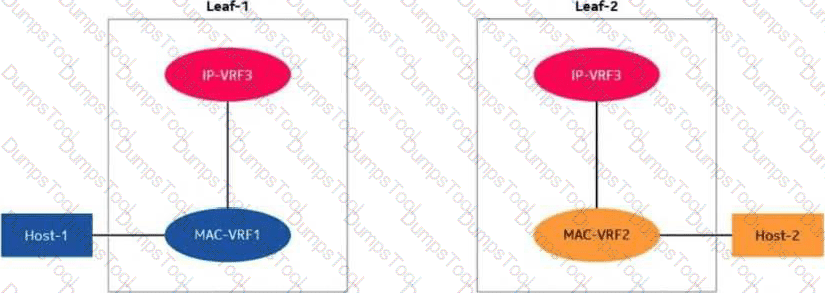
Consider the exhibit.

Question # 14

The network is going to be designed to use interface-less symmetric routing.

Which of the following statements is TRUE?

A.

An instance of each mac-vrf is required on each leaf.

B.

The ingress PE will perform layer 2 and layer 3 lookups while the egress PE will perform layer 2 lookup.

C.

The IRB configuration does not require anycast gateway configuration on the ip-vrf.

D.

Forwarding information will be exchanged between the PEs using EVPN route-type 2 updates.

Full Access
Question # 15

Which of the following statements about EVPN PE-CE routing, using BGP as the routing protocol, is FALSE?

A.

The PE advertises IPv4/IPv6 BGP updates to the CE based on the EVPN routes received from other PEs.

B.

The PE advertises updates received from the CE as EVPN route type 5 updates to the other PEs.

C.

iBGP is preferred between the CE and PE so that they will be in the same autonomous system.

D.

The PE and CE can utilize import and export policies to control the updates that are sent and received.

Full Access
Question # 16

Which of the following statements about the decoupled gateway-based data center interconnect solution is FALSE?

A.

VLAN tags are used to identify traffic between the data center border leaf and the WAN PE.

B.

The EVPN services in the data center are interconnected to different VPN services in the WAN.

C.

The separation between the border leaf and the WAN PE provides a clear demarcation for security and QoS.

D.

The WAN PE maintains a peering session with the data center route-reflector for the exchange of updates.

Full Access