dumpstool logo

Jasmine works for a Saskatchewan employer and earns $500.00 weekly. Calculate her Employment Insurance (EI) premium.
PF1 Exam – Net Pay Calculation (Template Worksheet)
Scenario
Diane Lemay works for Monarch Construction in Alberta and earns an annual salary of $49,500.00, paid on a semi-monthly basis.
The company provides its employees with group term life insurance coverage of two times annual salary and pays a monthly premium of $0.62 per $1,000.00 of coverage.
Diane uses her car to meet with clients on company business and receives a taxable car allowance of $50.00 per pay.
The company has a defined contribution pension plan to which Diane contributes 5% of her salary each pay.
Diane also contributes $20.00 to United Way and has $5.00 deducted for her social club membership each pay. She belongs to a union and pays 2% of her salary in union dues per pay period.
Diane’s federal and provincial TD1 claim codes are 1. She will not reach the first Canada Pension Plan or Employment Insurance annual maximums this pay period.
Required: Calculate the employee’s net pay, following the order of the steps in the net pay template.
EXHIBIT A — Net Pay Template (Fill in all blanks)
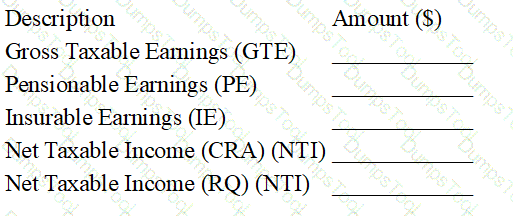
STATUTORY DEDUCTIONS
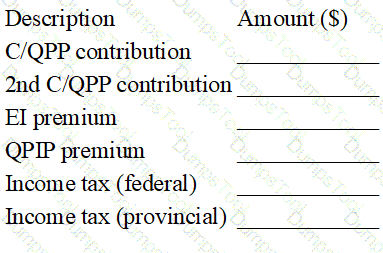
OTHER DEDUCTIONS
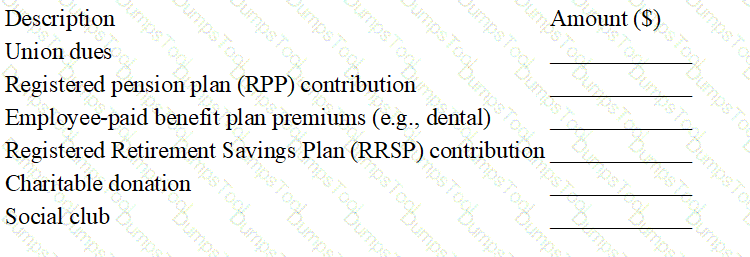
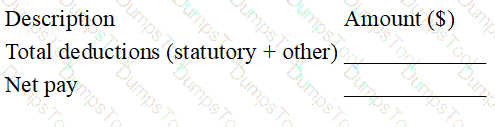
Given Data (Reference)
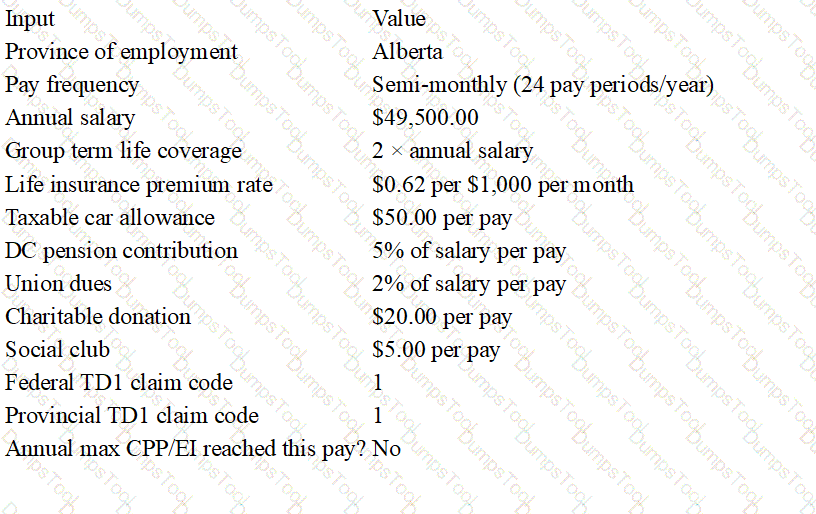
Step 1 — Calculate the employee’s gross taxable earnings (GTE) for this pay.
[ _________________________________ ]
Step 2 — Calculate the pensionable earnings (PE).
[ _________________________________ ]
Step 3 — Calculate the insurable earnings (IE).
[ _________________________________ ]
Step 4 — Calculate the net taxable income (CRA) (NTI).
[ _________________________________ ]
Step 5 — Calculate the net taxable income (RQ) (NTI).
[ _________________________________ ]
Step 6 — Calculate Diane’s Canada Pension Plan contribution.
[ _________________________________ ]
Step 7 — Calculate Diane’s Employment Insurance premium.
[ _________________________________ ]
Step 8 — Calculate Diane’s Quebec Parental Insurance Plan premium.
[ _________________________________ ]
Step 9 — Determine Diane’s federal income tax.
[ _________________________________ ]
Step 10 — Determine Diane’s provincial income tax.
[ _________________________________ ]
Step 11 — Calculate Diane’s total deductions (statutory + other).
[ _________________________________ ]
Step 12 — Calculate Diane’s net pay.
[ _________________________________ ]
An employee has the use of a company-leased vehicle for both business and personal use. This is an example of:
Helen is reimbursed for the cost of the protective clothing that is legally required for her job. The clothing she bought isnot supported by receiptsand is a reasonable reimbursement amount. This is considered:
Phan was employed fromMarch 1, 1992throughJanuary 10, 2007. He was not a member of the organization’s pension plan. Calculate the number of years eligible for the$1,500.00portion of a retiring allowance.
(PF1 Exam – Net Pay Calculation Template Worksheet: Quebec)
Question ID: pf1-exam-npc-q-f
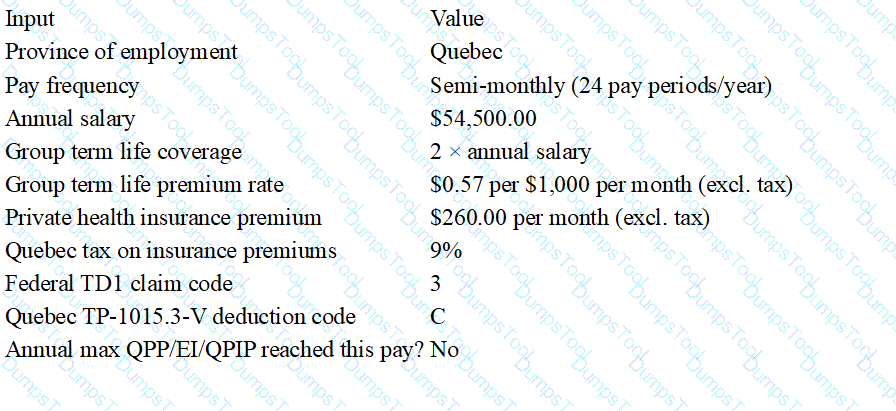
Mara Poirier works for Affordable Transport in Quebec and earns an annual salary of $54,500.00, paid on a semi-monthly basis.
In addition to her regular salary, Mara’s employer provides the following benefits:
Group term life insurance coverage through a third party of two times her annual salary.
Monthly group term life insurance premiums are $0.57 per $1,000.00 of coverage, excluding taxes.
Private health insurance benefits with a monthly premium of $260.00, excluding taxes.
The tax on insurance premiums in Quebec is 9%.
Mara’s federal TD1 claim code is 3 and her provincial TP-1015.3-V deduction code is C.
Mara will not reach the annual maximums for QPP, EI, or QPIP in this pay period.
Required: Calculate Mara’s net pay, following the order of the steps in the net pay template.
EXHIBIT A — Net Pay Template (Fill in all blanks)
Earnings / Income Bases
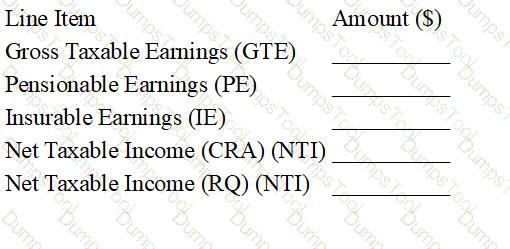
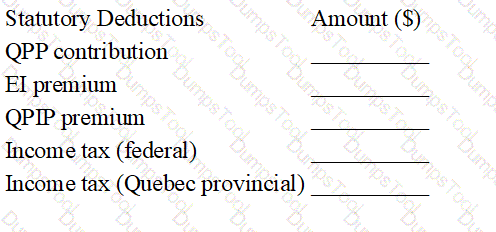
Step 1 — Calculate Mara’s gross earnings for this pay period (GTE).
[ ____________________________________________ ]
Step 2 — Calculate the pensionable earnings (PE).
[ ____________________________________________ ]
Step 3 — Calculate the insurable earnings (IE).
[ ____________________________________________ ]
Step 4 — Calculate the net taxable income (CRA) (NTI).
[ ____________________________________________ ]
Step 5 — Calculate the net taxable income (RQ) (NTI).
[ ____________________________________________ ]
Step 6 — Calculate Mara’s Quebec Pension Plan (QPP) contribution.
[ ____________________________________________ ]
Step 7 — Calculate Mara’s Employment Insurance (EI) premium.
[ ____________________________________________ ]
Step 8 — Calculate Mara’s Quebec Parental Insurance Plan (QPIP) premium.
[ ____________________________________________ ]
Step 9 — Determine Mara’s federal income tax.
[ ____________________________________________ ]
Step 10 — Determine Mara’s Quebec provincial income tax.
[ ____________________________________________ ]
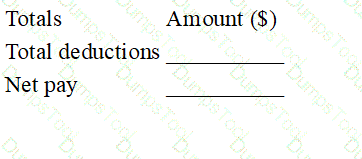
Step 11 — Calculate Mara’s total deductions.
[ ____________________________________________ ]
Step 12 — Calculate Mara’s net pay.
[ ____________________________________________ ]
What is the portion of a retiring allowance eligible to be transferred into a Registered Retirement Savings Plan (RRSP) or a registered pension plan (RPP) tax free based on?
When would a Record of Employment be issued for an employee paid mainly by commission?
Charmaine’s employment was terminated by her employer on April 13 of the current year. Charmaine had worked for her employer for 3 years and was paid 3 weeks of legislated wages in lieu of notice and two weeks’ vacation pay with her final pay. What date should be recorded in Block 11 on Charmaine’s Record of Employment?
Which of the following situations would not require an employer to issue a Record of Employment?
A premium payment for overtime hours worked or a rate per piece of goods produced is an example of:
Evangeline earns $1,075.00 weekly plus $154.00 in overtime. Calculate Evangeline’s Québec Parental Insurance Plan (QPIP) premium.
Anthony earns $750.00 per week. He has a cash taxable benefit of $25.00 per week. Anthony is exempt from CPP contributions. Calculate the net taxable income for the week.
Matt earns $10.10 per hour and works 37.5 hours per week. Calculate Matt’s regular bi-weekly earnings.

TESTED 09 Oct 2026