dumpstool logo

When using eDesigner to configure HUAWEI CLOUD Stack compute resources, which of the following service scenarios does eDesigner not support?
Configuration based on the total number of VMs
Configuration based on VM specifications
Configuration based on PM specifications
Configuration based on the total capacity of VMs
The eDesigner ECS configuration page lists configuration by total VM capacity, by VM flavor, and by PM. It does not list configuring solely by the total count of VMs as an independent mode. A pure VM count is insufficient for sizing because instances have different CPU, memory, storage, and workload requirements. Using capacity or a flavor mix allows the tool to estimate the required physical-host quantity and resource headroom. In a Stack delivery design, supported combinations depend on the selected region architecture, physical network topology, resource pool, and product release. A broadly possible technology choice is not automatically a valid deployment configuration. The correct interpretation should be limited to the product version and topology in the cited training material. Later product releases or alternative deployment modes should not silently be substituted for the V3.0 curriculum. A practical verification step is to identify which component owns the operation, which network or storage plane carries it, and which resource object records the state. This prevents confusing an architectural dependency with an optional capability.
Exact source extract: “storage pools for storage. If both Arm and x86 servers are required, configure”
Official reference: HCIE-Cloud Computing V3.0 Training Material, PDF pages 81,82.
───────────────────────────────────
In HUAWEI CLOUD Stack, after security services are installed, O & M engineers must create a commissioning project to verify that the services were installed correctly. If a commissioning project fails, the failed service must be uninstalled and then reinstalled.
TRUE
FALSE
Commissioning tasks validate a deployed service and can reveal configuration, connectivity, or dependency issues. Huawei ' s Deploy workflow allows parameter correction and continuation or other targeted fault handling after an error; uninstalling and reinstalling the entire service is not an automatic remedy. Troubleshooting should identify the failed step, review logs, and use the supported recovery procedure. The claim that every commissioning failure mandates uninstallation is excessively absolute. For security questions, distinguish the scope of the enforcement policy from the point where the service is managed. Tenant, subnet, interface, VPC, regional, and perimeter protections have different responsibilities. The correct interpretation should be limited to the product version and topology in the cited training material. Later product releases or alternative deployment modes should not silently be substituted for the V3.0 curriculum. A practical verification step is to identify which component owns the operation, which network or storage plane carries it, and which resource object records the state. This prevents confusing an architectural dependency with an optional capability.
Source-extract limitation: No directly matching text could be verified in the selected PDF text layer; consult the cited diagram/slide.
Official reference: HCIE-Cloud Computing V3.0 Training Material, PDF pages 340,435.
───────────────────────────────────
When a container is started, the container engine adds a writable container layer, and the running container uses the same kernel version as the host machine.
TRUE
FALSE
Docker starts a conventional Linux container by mounting read-only image layers with an additional writable container layer. File changes are stored in the upper writable layer rather than modifying the base image. The container shares the running host kernel while namespaces and cgroups provide isolation and resource accounting. A container may package a different user-space distribution, but that does not imply an independent kernel. Kata containers are an exception because they deliberately use micro-VM guest kernels. In the V3.0 container curriculum, the precise command, Kubernetes API field, runtime behavior, and selected node or namespace matter. Similar-looking terms often refer to separate lifecycle stages and are not interchangeable. The correct interpretation should be limited to the product version and topology in the cited training material. Later product releases or alternative deployment modes should not silently be substituted for the V3.0 curriculum. A practical verification step is to identify which component owns the operation, which network or storage plane carries it, and which resource object records the state. This prevents confusing an architectural dependency with an optional capability.
Exact source extract: “A container engine uses namespaces and cgroups to virtually isolate applications”
Official reference: HCIE-Cloud Computing V3.0 Training Material, PDF pages 847, 844,847,901.
───────────────────────────────────
A department deploys multiple services across different Virtual Private Clouds (VPCs). Each service consists of a front-end web system and a back-end database.
Which of the following services can control access between users and services, as well as access between services?
Virtual Private Cloud Peering (VPC Peering)
Network ACL
Cloud Firewall (CFW)
Application Operations Management (AOM)
CFW provides fine-grained traffic control and workload-based micro-segmentation for applications deployed across VPCs. It can govern client-to-service and service-to-service communication using workload and security-policy context. VPC Peering establishes connectivity but not the same centralized application policy model. Network ACLs filter subnet traffic, while AOM provides monitoring rather than enforcement. The Huawei CFW functions slide identifies fine-grained ECS NIC rules and service-tag policy capabilities. For security questions, distinguish the scope of the enforcement policy from the point where the service is managed. Tenant, subnet, interface, VPC, regional, and perimeter protections have different responsibilities. For examination accuracy, absolute phrases such as ' always ' , ' must ' , ' only ' , and ' cannot ' deserve special attention. The source sometimes demonstrates a supported example without establishing that every other deployment is prohibited. The distinction also matters operationally: selecting a setting outside the supported architecture can create a failure that resembles a network, storage, or application fault, even though the root cause is configuration incompatibility. The correct interpretation should be limited to the product version and topology in the cited training material. Later product releases or alternative deployment modes should not silently be substituted for the V3.0 curriculum.
Source-extract limitation: No directly matching text could be verified in the selected PDF text layer; consult the cited diagram/slide.
Official reference: HCIE-Cloud Computing V3.0 Training Material, PDF pages 1139,1141,1143.
───────────────────────────────────
For a HUAWEI CLOUD Stack delivery project, which of the following devices is recommended to be installed in the same cabinet?
Network and compute nodes
Border firewalls and core switches
Backup nodes and backup storage
Active and standby backup nodes
Cabinet planning separates devices that must communicate at high bandwidth from equipment with different cooling, power, and cabling requirements. Locating backup nodes near their backup storage can simplify cable lengths and reduce the number of inter-cabinet connections. That does not mean all network and compute devices should share one cabinet. Huawei ' s physical planning should also respect redundant power, rack density, maintenance access, and storage interface requirements. The selected cabinet pairing remains provisional without a matching equipment-placement table. In a Stack delivery design, supported combinations depend on the selected region architecture, physical network topology, resource pool, and product release. A broadly possible technology choice is not automatically a valid deployment configuration. A practical verification step is to identify which component owns the operation, which network or storage plane carries it, and which resource object records the state. This prevents confusing an architectural dependency with an optional capability. For examination accuracy, absolute phrases such as ' always ' , ' must ' , ' only ' , and ' cannot ' deserve special attention. The source sometimes demonstrates a supported example without establishing that every other deployment is prohibited.
Source-extract limitation: No directly matching text could be verified in the selected PDF text layer; consult the cited diagram/slide.
Official reference: HCIE-Cloud Computing V3.0 Training Material, PDF pages 104,110,115.
───────────────────────────────────
Which statement below is true about CSDR and CSHA in HUAWEI CLOUD Stack?
Both CSDR and CSHA can achieve RPO=0.
CSDR and CSHA do not support DR protection for BMSs.
CSDR and CSHA protect ECSs in the same region.
Service storage in CSDR and CSHA does not support Huawei distributed storage.
CSHA uses HyperMetro active-active protection to achieve zero RPO for supported failures. CSDR can also achieve zero RPO with synchronous replication, while its asynchronous modes may have nonzero RPO. CSDR operates across regions, unlike same-region CSHA protection across availability zones. Huawei supports distributed storage for selected protection designs. An absolute statement about unsupported BMS protection needs a specific compatibility matrix; only the zero-RPO statement is positively established. DR and backup workflows must be evaluated by their protected resource, replication direction, recovery point, and recovery time. A backup copy, a synchronous protection pair, and a restarted service are not equivalent outcomes. The distinction also matters operationally: selecting a setting outside the supported architecture can create a failure that resembles a network, storage, or application fault, even though the root cause is configuration incompatibility. The correct interpretation should be limited to the product version and topology in the cited training material. Later product releases or alternative deployment modes should not silently be substituted for the V3.0 curriculum.
Source-extract limitation: No directly matching text could be verified in the selected PDF text layer; consult the cited diagram/slide.
Official reference: HCIE-Cloud Computing V3.0 Training Material, PDF pages 748,761,765.
; B unresolved
───────────────────────────────────
Which of the following statements regarding Kubernetes workflows are correct?
Select All that Apply
kubelet creates pods as requested.
kube-scheduler finds out the best-fit worker node according to the requests stored in etcd and the kubelet status.
kube-apiserver receives pod creation requests and saves the requests in etcd.
controller-manager checks whether the created pod meets the requirements.
The Kubernetes API server accepts resource requests and persists desired state through etcd; the scheduler selects an eligible node; kubelet starts and monitors Pods; controllers reconcile observed and desired state. The Huawei workflow diagram depicts these cooperating components. However, the scheduler normally obtains cached state through the API server rather than directly querying kubelet and etcd. Controller-manager reconciliation is broader than directly validating application health, so the all-four key reflects a simplified teaching diagram. In the V3.0 container curriculum, the precise command, Kubernetes API field, runtime behavior, and selected node or namespace matter. Similar-looking terms often refer to separate lifecycle stages and are not interchangeable. The distinction also matters operationally: selecting a setting outside the supported architecture can create a failure that resembles a network, storage, or application fault, even though the root cause is configuration incompatibility. The correct interpretation should be limited to the product version and topology in the cited training material. Later product releases or alternative deployment modes should not silently be substituted for the V3.0 curriculum.
Source-extract limitation: No directly matching text could be verified in the selected PDF text layer; consult the cited diagram/slide.
Official reference: HCIE-Cloud Computing V3.0 Training Material, PDF pages 950,951,954.
; scheduler wording imprecise
───────────────────────────────────
In HUAWEI CLOUD Stack physical networking, Edge Firewall (EdgeFW) relies on a hardware firewall. How can this hardware firewall be deployed?
Select All that Apply
Connected to the management core switch in off-path mode
Connected to the storage core switch in off-path mode
Connected to the service core switch in off-path mode
Deployed together with the egress firewall of the data center in converged mode
EdgeFW protects north-south border traffic using hardware firewalls orchestrated through SecoManager. Service-core connectivity is consistent with its tenant traffic purpose, and a converged deployment with suitable egress firewall infrastructure may be possible. However, the course does not explicitly establish the described converged model ' s compatibility rules. Management-core and storage-core firewall placements have different objectives. C/D remains a provisional key until the exact EdgeFW physical networking table is available. In a Stack delivery design, supported combinations depend on the selected region architecture, physical network topology, resource pool, and product release. A broadly possible technology choice is not automatically a valid deployment configuration. For examination accuracy, absolute phrases such as ' always ' , ' must ' , ' only ' , and ' cannot ' deserve special attention. The source sometimes demonstrates a supported example without establishing that every other deployment is prohibited. The distinction also matters operationally: selecting a setting outside the supported architecture can create a failure that resembles a network, storage, or application fault, even though the root cause is configuration incompatibility.
Exact source extract: “The hardware firewall records the detected EIP traffic exceptions in SSA-ES/SSA-”
Official reference: HCIE-Cloud Computing V3.0 Training Material, PDF pages 1156, 1112,1155,1156.
; converged mode unsupported
───────────────────────────────────
The docker network create command creates a network and defines network attributes. The docker network delete command removes a network.
TRUE
FALSE
docker network create can create a named network using a selected driver, as shown in Huawei ' s bridge-network lab. docker network delete is not the standard removal subcommand; docker network rm removes an eligible network. Active container attachments can prevent removal. The test is intentionally about exact CLI syntax rather than whether Docker supports creating and deleting networks conceptually. Because one command is invalid, the combined statement is false. In the V3.0 container curriculum, the precise command, Kubernetes API field, runtime behavior, and selected node or namespace matter. Similar-looking terms often refer to separate lifecycle stages and are not interchangeable. For examination accuracy, absolute phrases such as ' always ' , ' must ' , ' only ' , and ' cannot ' deserve special attention. The source sometimes demonstrates a supported example without establishing that every other deployment is prohibited. The distinction also matters operationally: selecting a setting outside the supported architecture can create a failure that resembles a network, storage, or application fault, even though the root cause is configuration incompatibility.
Source-extract limitation: No directly matching text could be verified in the selected PDF text layer; consult the cited diagram/slide.
Official reference: HCIE-Cloud Computing V3.0 Training Material, PDF pages 15,17,890.
───────────────────────────────────
In HUAWEI CLOUD Stack, which of the following types of communication is implemented by Cloud Connect?
Communications between networks provided by different vendors
Communications between cloud and on-premises networks
Communications between VPCs in different regions
Communications with the Internet
Cloud Connect provides private connectivity for virtual cloud networks spanning different cloud regions. In contrast, Direct Connect and VPN address cloud-to-on-premises links, and EIP/NAT provide Internet-related access. A VPC peering connection is typically used to interconnect VPCs within the supported region scope. The distinction is geographic and architectural: the question asks which communication model specifically corresponds to Cloud Connect rather than listing every possible enterprise connection technology. The V3.0 course describes these capabilities as parts of an integrated enterprise-cloud architecture. Interpretation should follow Huawei ' s service definitions rather than assuming two similarly named components provide identical functions. The correct interpretation should be limited to the product version and topology in the cited training material. Later product releases or alternative deployment modes should not silently be substituted for the V3.0 curriculum. A practical verification step is to identify which component owns the operation, which network or storage plane carries it, and which resource object records the state. This prevents confusing an architectural dependency with an optional capability.
Exact source extract: “departments and VM communication across VPCs. VPC Peering enables you to”
Official reference: HCIE-Cloud Computing V3.0 Training Material, PDF pages 20,21,207.
───────────────────────────────────
Match the Docker commands to their functions.
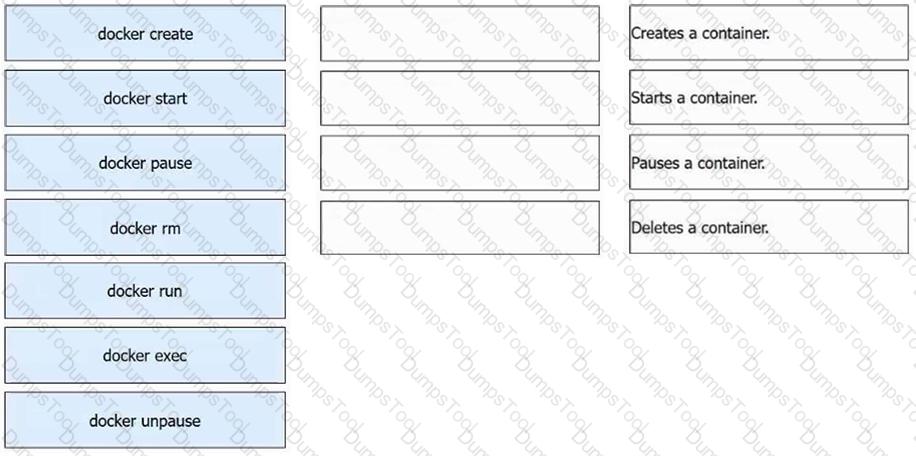
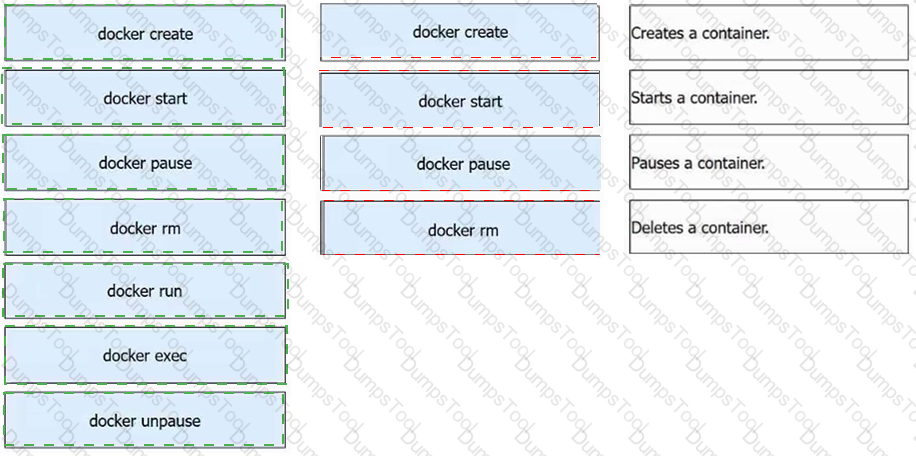
docker create - > create; docker start - > start; docker pause - > pause; docker rm - > delete
Docker lifecycle commands have distinct functions: create makes a stopped container object; start runs an existing one; pause suspends its processes; rm deletes its object. docker run combines creation and startup, docker exec adds a process to a running container, and docker unpause resumes suspended processes. The four matching answers in the original exhibit are directly demonstrated by Huawei ' s lab. Retain the unselected source exhibit and provide the mapping in a separate answer table. The original exhibit is included with this question. Its displayed fields, order, numeric parameters, and labels are part of the evidence; the answer mapping must be read against that exhibit rather than against a generic example. In the V3.0 container curriculum, the precise command, Kubernetes API field, runtime behavior, and selected node or namespace matter. Similar-looking terms often refer to separate lifecycle stages and are not interchangeable. A practical verification step is to identify which component owns the operation, which network or storage plane carries it, and which resource object records the state. This prevents confusing an architectural dependency with an optional capability.
Source-extract limitation: No directly matching text could be verified in the selected PDF text layer; consult the cited diagram/slide.
Official reference: HCIE-Cloud Computing V3.0 Training Material, PDF pages 12,13.
───────────────────────────────────
If no information appears after running the docker ps -q command to list containers, there are no containers on the node.
TRUE
FALSE
docker ps -q displays identifiers of running containers only. A stopped, exited, or created container may still exist even when no output appears. docker ps -a lists all lifecycle states, while docker ps -aq combines quiet identifiers with all containers. Huawei ' s lifecycle lab repeatedly uses -a following create, start, pause, stop, and restart to demonstrate the distinction. Empty running-container output does not prove the node has no container objects. In the V3.0 container curriculum, the precise command, Kubernetes API field, runtime behavior, and selected node or namespace matter. Similar-looking terms often refer to separate lifecycle stages and are not interchangeable. For examination accuracy, absolute phrases such as ' always ' , ' must ' , ' only ' , and ' cannot ' deserve special attention. The source sometimes demonstrates a supported example without establishing that every other deployment is prohibited. The distinction also matters operationally: selecting a setting outside the supported architecture can create a failure that resembles a network, storage, or application fault, even though the root cause is configuration incompatibility.
Source-extract limitation: No directly matching text could be verified in the selected PDF text layer; consult the cited diagram/slide.
Official reference: HCIE-Cloud Computing V3.0 Training Material, PDF pages 12,15.
───────────────────────────────────
In Kubernetes, the container runtime must be deployed on both worker nodes and master nodes so that the containers running the control plane components can be created. Control plane components may also be deployed on worker nodes. However, to avoid resource contention with application containers, control plane components commonly run on dedicated VMs or physical machines.
TRUE
FALSE
In the Huawei kubeadm lab, the control-plane components run as containers, so the master nodes require a container runtime as do worker nodes executing application workloads. The course uses Docker in Stack 8.1.1. Separating control-plane processes onto dedicated machines reduces resource contention and improves operational stability. Other Kubernetes variants may externalize control-plane services, so the claim ' s must applies specifically to the demonstrated containerized architecture. In the V3.0 container curriculum, the precise command, Kubernetes API field, runtime behavior, and selected node or namespace matter. Similar-looking terms often refer to separate lifecycle stages and are not interchangeable. The distinction also matters operationally: selecting a setting outside the supported architecture can create a failure that resembles a network, storage, or application fault, even though the root cause is configuration incompatibility. The correct interpretation should be limited to the product version and topology in the cited training material. Later product releases or alternative deployment modes should not silently be substituted for the V3.0 curriculum.
Exact source extract: “Master node components, also called control plane components, manage”
Official reference: HCIE-Cloud Computing V3.0 Training Material, PDF pages 951, 30,31,32,951.
; kubeadm architecture
───────────────────────────────────
In HUAWEI CLOUD Stack, if the IP address used by security services on the External OM plane differs from the address used by IaaS basic services, which of the following could cause this issue?
Select All that Apply
The system had low requirements for External_OM plane IP addresses, so that different External_OM plane IP addresses were used.
Different External_OM planes were planned for security services and IaaS basic services.
The External_OM plane was scaled out when its remaining IP addresses were insufficient for installing security services.
Security services and IaaS basic services were not deployed in the same region.
External_OM is a management network plane shared by IaaS and service-management components in the relevant architecture. Different regional deployments can have separate External_OM addressing, and expansion may introduce additional IP pools when existing capacity is insufficient. Yet different individual component IPs are normal even within one shared subnet. The question fails to distinguish different IP addresses from different network segments, and the asserted scale-out cause is not directly documented. Treat C/D as provisional. For security questions, distinguish the scope of the enforcement policy from the point where the service is managed. Tenant, subnet, interface, VPC, regional, and perimeter protections have different responsibilities. For examination accuracy, absolute phrases such as ' always ' , ' must ' , ' only ' , and ' cannot ' deserve special attention. The source sometimes demonstrates a supported example without establishing that every other deployment is prohibited. The distinction also matters operationally: selecting a setting outside the supported architecture can create a failure that resembles a network, storage, or application fault, even though the root cause is configuration incompatibility.
Exact source extract: “External_OM: management plane of gPaaS & AI DaaS service management VMs”
Official reference: HCIE-Cloud Computing V3.0 Training Material, PDF pages 416,450.
; External_OM IP terminology
───────────────────────────────────
Before HUAWEI CLOUD Stack is delivered, you must prepare these outputs: HLD, BOQ, and LLD.
TRUE
FALSE
HLD describes the high-level topology and solution architecture; LLD supplies concrete physical and logical settings required for implementation; BOQ records the approved equipment and service quantities. These documents form a coherent delivery baseline. They connect capacity and security requirements to purchasable equipment and then to implementable network, compute, and storage configurations. The delivery team should reconcile the documents before deployment because inconsistencies between high-level intent and low-level parameters create avoidable commissioning faults. In a Stack delivery design, supported combinations depend on the selected region architecture, physical network topology, resource pool, and product release. A broadly possible technology choice is not automatically a valid deployment configuration. The correct interpretation should be limited to the product version and topology in the cited training material. Later product releases or alternative deployment modes should not silently be substituted for the V3.0 curriculum. A practical verification step is to identify which component owns the operation, which network or storage plane carries it, and which resource object records the state. This prevents confusing an architectural dependency with an optional capability.
Source-extract limitation: No directly matching text could be verified in the selected PDF text layer; consult the cited diagram/slide.
Official reference: HCIE-Cloud Computing V3.0 Training Material, PDF pages 231,232,234.
───────────────────────────────────
SecoManager is the management platform for Huawei hardware firewalls. In Edge Firewall (EdgeFW), SecoManager interconnects with ManageOne to enable HUAWEI CLOUD Stack to manage and control EdgeFW.
TRUE
FALSE
EdgeFW combines tenant-facing security-service requests with hardware firewall enforcement managed by SecoManager. The user applies for the service and configures policies in ManageOne; the security-service components pass requests to SecoManager, which orchestrates configuration for the hardware firewalls. This makes the statement true in functional terms, even if ManageOne does not directly speak to every firewall device without intermediary service-management components. For security questions, distinguish the scope of the enforcement policy from the point where the service is managed. Tenant, subnet, interface, VPC, regional, and perimeter protections have different responsibilities. A practical verification step is to identify which component owns the operation, which network or storage plane carries it, and which resource object records the state. This prevents confusing an architectural dependency with an optional capability. For examination accuracy, absolute phrases such as ' always ' , ' must ' , ' only ' , and ' cannot ' deserve special attention. The source sometimes demonstrates a supported example without establishing that every other deployment is prohibited. The distinction also matters operationally: selecting a setting outside the supported architecture can create a failure that resembles a network, storage, or application fault, even though the root cause is configuration incompatibility.
Exact source extract: “SCC-Service calls SecoManager. SecoManager automatically orchestrates security”
Official reference: HCIE-Cloud Computing V3.0 Training Material, PDF pages 1156, 1155,1156.
───────────────────────────────────
Volcano is a container batch-computing engine contributed by HUAWEI CLOUD to the Cloud Native Computing Foundation (CNCF). It augments Kubernetes for batch scheduling and orchestration of AI, big data, and high-performance computing jobs. Cloud native technologies make computing more efficient.
TRUE
FALSE
Volcano augments Kubernetes scheduling for AI training, batch analytics, and high-performance computing. Its features include coordinated workloads, rescheduling, overcommitment, and unified allocation of cluster resources. This is a scheduling and orchestration capability, not a network driver. The Huawei CCE architecture explicitly identifies Volcano under Big Data/AI scheduling. The separate historical statement about project contribution to CNCF is not fully established by the extracted course passages. In the V3.0 container curriculum, the precise command, Kubernetes API field, runtime behavior, and selected node or namespace matter. Similar-looking terms often refer to separate lifecycle stages and are not interchangeable. The correct interpretation should be limited to the product version and topology in the cited training material. Later product releases or alternative deployment modes should not silently be substituted for the V3.0 curriculum. A practical verification step is to identify which component owns the operation, which network or storage plane carries it, and which resource object records the state. This prevents confusing an architectural dependency with an optional capability.
Exact source extract: “scheduling to improve the performance of AI and big data jobs by 30%. In”
Official reference: HCIE-Cloud Computing V3.0 Training Material, PDF pages 51,1050.
; CNCF history not separately sourced
───────────────────────────────────
If a compute resource pool cannot satisfy the current business requirements, which of the following methods can expand the compute resource pool without changing the network egress?
Adding a region
Adding compute nodes in an AZ
Adding an AZ to a region
Adding a global zone
Compute capacity can grow through additional compute nodes in an existing AZ or an additional AZ within the region. Huawei ' s expansion workflow supports adding an AZ without expanding network egress when the existing bandwidth and address capacity remain sufficient. Adding a Global zone changes management architecture, while adding another region is a separate geographical or administrative expansion. Both B and C meet the stated capacity goal, despite the original missing Select All that Apply direction. That issue is material to the answer key and must be retained rather than silently treating an intended selection as an unconditional technical rule. Expansion planning must respect management-node scale, existing AZ capacity, network-egress bandwidth, and storage compatibility. Raw capacity calculations may be overridden by Huawei ' s minimum supported deployment size. The distinction also matters operationally: selecting a setting outside the supported architecture can create a failure that resembles a network, storage, or application fault, even though the root cause is configuration incompatibility.
Exact source extract: “If the network bandwidth still meets service requirements after compute resource”
Official reference: HCIE-Cloud Computing V3.0 Training Material, PDF pages 395, 378,395,397.
───────────────────────────────────
During server migration on Rainbow, both file-level and block-level migration tasks support performing final data synchronization multiple times. Successful completion of a final data synchronization indicates that a migration task has been completed.
TRUE
FALSE
Rainbow can perform iterative or incremental synchronization while preparing a migration, but successful final synchronization is a terminal state. Huawei requires source applications to be stopped before final Windows synchronization to prevent further data modifications. The course explicitly states that after successful final synchronization the task is complete and the same task cannot synchronize again. Confusing multiple incremental cycles with repeated final synchronization makes the statement false. Rainbow migration decisions depend on the source operating system, disk and filesystem characteristics, network reachability, and the stage of synchronization. An operation valid for Linux migration is not necessarily valid for Windows block-level migration. The distinction also matters operationally: selecting a setting outside the supported architecture can create a failure that resembles a network, storage, or application fault, even though the root cause is configuration incompatibility. The correct interpretation should be limited to the product version and topology in the cited training material. Later product releases or alternative deployment modes should not silently be substituted for the V3.0 curriculum.
Exact source extract: “Once the synchronization is successful, the task is complete and data”
Official reference: HCIE-Cloud Computing V3.0 Training Material, PDF pages 648,649.
───────────────────────────────────
In HUAWEI CLOUD Stack, which of the following methods can tenants use to log in to an ECS?
Select All that Apply
Using VNC on ManageOne Operation Portal on an intranet
Using VNC on Service OM on an intranet
Using VPN or Direct Connect over an external network connection
Using VNC on ManageOne Operation Portal over an Internet connection
Tenants can access cloud servers through supported portal console methods and through private network connections. VPN or Direct Connect supplies a routed private path, while ManageOne VNC access can be exposed through the documented operations portal when the customer configures the relevant firewall, DNS, and NAT. Service OM access is an operations-management function, not necessarily a tenant-facing VNC login path. The Internet portal option depends on the publication and security configuration. For security questions, distinguish the scope of the enforcement policy from the point where the service is managed. Tenant, subnet, interface, VPC, regional, and perimeter protections have different responsibilities. For examination accuracy, absolute phrases such as ' always ' , ' must ' , ' only ' , and ' cannot ' deserve special attention. The source sometimes demonstrates a supported example without establishing that every other deployment is prohibited. The distinction also matters operationally: selecting a setting outside the supported architecture can create a failure that resembles a network, storage, or application fault, even though the root cause is configuration incompatibility.
Source-extract limitation: No directly matching text could be verified in the selected PDF text layer; consult the cited diagram/slide.
Official reference: HCIE-Cloud Computing V3.0 Training Material, PDF pages 260,261,263.
───────────────────────────────────
Which of the following statements regarding container networking are true?
Select All that Apply
When a container uses a bridge network, the container network interface and the corresponding bridge must be in the same namespace.
You are advised to use networking plug-ins recognized by Cloud Native Computing Foundation (CNCF) for container orchestration.
When a container uses a host network, the network interface of the container and that of the host must be in the same namespace.
Docker has its own networking subsystems and does not support third-party networking plug-ins.
In Docker bridge networking, the host bridge and a container ' s virtual Ethernet interface ordinarily occupy different network namespaces linked by a veth pair. Host networking removes that separation by placing the container in the host network namespace. Kubernetes networking typically uses supported CNI plug-ins. Docker also supports extensible network drivers, so the claim that it cannot use third-party drivers is false. Different network modes trade isolation, performance, and operational simplicity. In the V3.0 container curriculum, the precise command, Kubernetes API field, runtime behavior, and selected node or namespace matter. Similar-looking terms often refer to separate lifecycle stages and are not interchangeable. A practical verification step is to identify which component owns the operation, which network or storage plane carries it, and which resource object records the state. This prevents confusing an architectural dependency with an optional capability. For examination accuracy, absolute phrases such as ' always ' , ' must ' , ' only ' , and ' cannot ' deserve special attention. The source sometimes demonstrates a supported example without establishing that every other deployment is prohibited.
Source-extract limitation: No directly matching text could be verified in the selected PDF text layer; consult the cited diagram/slide.
Official reference: HCIE-Cloud Computing V3.0 Training Material, PDF pages 885,886,889.
───────────────────────────────────
In HUAWEI CLOUD Stack, are all Elastic Cloud Servers (ECSs) that are bound to Elastic IPs (EIPs) protected by Edge Firewall (EdgeFW)?
TRUE
FALSE
An ECS bound to an EIP does not automatically become protected by an EdgeFW subscription. A tenant applies for EdgeFW, configures policies, and the service-management flow delivers them through SecoManager to the hardware firewall. Merely assigning a public address establishes reachability, not evidence that relevant firewall routing and enforcement are active. The Huawei EdgeFW service flow begins with explicit portal provisioning rather than automatic protection of every EIP. For security questions, distinguish the scope of the enforcement policy from the point where the service is managed. Tenant, subnet, interface, VPC, regional, and perimeter protections have different responsibilities. The correct interpretation should be limited to the product version and topology in the cited training material. Later product releases or alternative deployment modes should not silently be substituted for the V3.0 curriculum. A practical verification step is to identify which component owns the operation, which network or storage plane carries it, and which resource object records the state. This prevents confusing an architectural dependency with an optional capability.
Exact source extract: “policies and delivers them to the hardware firewall”
Official reference: HCIE-Cloud Computing V3.0 Training Material, PDF pages 1156, 1155,1156.
───────────────────────────────────
In the independent Global networking of HUAWEI CLOUD Stack, which of the following is unnecessary in the global management zone?
BMC access switches
Management core switches
Management nodes
Management TOR switches
Independent Global networking separates central management infrastructure from regional resource pools. Management nodes, management core switches, and access switches are selected according to the dedicated Global topology. The question asks which component is not required in the specific independent Global management zone rather than which equipment exists anywhere in the environment. Without the exact topology diagram, treating BMC access switches as the unnecessary component is provisional; the accepted delivery design must preserve out-of-band management where required. In a Stack delivery design, supported combinations depend on the selected region architecture, physical network topology, resource pool, and product release. A broadly possible technology choice is not automatically a valid deployment configuration. The correct interpretation should be limited to the product version and topology in the cited training material. Later product releases or alternative deployment modes should not silently be substituted for the V3.0 curriculum. A practical verification step is to identify which component owns the operation, which network or storage plane carries it, and which resource object records the state. This prevents confusing an architectural dependency with an optional capability.
Source-extract limitation: No directly matching text could be verified in the selected PDF text layer; consult the cited diagram/slide.
Official reference: HCIE-Cloud Computing V3.0 Training Material, PDF pages 111,117,143.
───────────────────────────────────
Which statement below is false about a source Windows server migrated to HUAWEI CLOUD Stack by using Rainbow?
Only NTFS file systems are supported.
Externally mounted shared partitions (such as CIFS and NFS) cannot be migrated.
Migration service ports 445 and 8899 need to be enabled.
Shared disks can be migrated.
Rainbow Windows source migration supports NTFS local volumes and does not migrate shared disks. Huawei lists port 445 for SMB and port 8899 for agent management, with another data transmission port as needed. External CIFS/NFS shared mounts are not automatically copied as local NTFS disks. The assertion that shared disks can be migrated directly is explicitly contradicted by the Rainbow restriction slide. Rainbow migration decisions depend on the source operating system, disk and filesystem characteristics, network reachability, and the stage of synchronization. An operation valid for Linux migration is not necessarily valid for Windows block-level migration. For examination accuracy, absolute phrases such as ' always ' , ' must ' , ' only ' , and ' cannot ' deserve special attention. The source sometimes demonstrates a supported example without establishing that every other deployment is prohibited. The distinction also matters operationally: selecting a setting outside the supported architecture can create a failure that resembles a network, storage, or application fault, even though the root cause is configuration incompatibility.
Source-extract limitation: No directly matching text could be verified in the selected PDF text layer; consult the cited diagram/slide.
Official reference: HCIE-Cloud Computing V3.0 Training Material, PDF pages 668,671.
───────────────────────────────────
In HUAWEI CLOUD Stack, Cloud Container Engine (CCE) has a non-strong dependency on Object Storage Service (OBS) 3.0: CCE can be installed without OBS, and services running on CCE do not require OBS.
TRUE
FALSE
A weak CCE dependency on OBS 3.0 means CCE installation can proceed without OBS but some optional functions or applications may not operate. It does not mean workloads running on CCE universally have no need for object storage. A specific application may require OBS access, while the base cluster does not. Huawei defines strong versus weak dependency explicitly and offers OBS configuration parameters when integration is needed. The question incorrectly turns install-time independence into absolute runtime independence. In the V3.0 container curriculum, the precise command, Kubernetes API field, runtime behavior, and selected node or namespace matter. Similar-looking terms often refer to separate lifecycle stages and are not interchangeable. For examination accuracy, absolute phrases such as ' always ' , ' must ' , ' only ' , and ' cannot ' deserve special attention. The source sometimes demonstrates a supported example without establishing that every other deployment is prohibited. The distinction also matters operationally: selecting a setting outside the supported architecture can create a failure that resembles a network, storage, or application fault, even though the root cause is configuration incompatibility.
Source-extract limitation: No directly matching text could be verified in the selected PDF text layer; consult the cited diagram/slide.
Official reference: HCIE-Cloud Computing V3.0 Training Material, PDF pages 421,434.
───────────────────────────────────
Which of the following statements regarding the WORKDIR /tmp/test command in a Dockerfile are true?
Select All that Apply
If you need to switch to another directory during image build, you need to run the WORKDIR command again to specify the directory.
When building an image, this command switches the image path to /tmp/test on the host.
When building an image, the operations specified by the command are performed in the /tmp/test directory.
If /tmp/test does not exist in the image, the image will not be built.
WORKDIR sets the working directory for subsequent applicable Dockerfile instructions and for the resulting runtime context. Further WORKDIR instructions can change it, and missing directories are created automatically. It does not switch the Docker host ' s working directory. Commands issued after WORKDIR operate relative to the specified path, subject to absolute path overrides. This behavior simplifies image construction and avoids repeatedly writing full directory paths for application files. In the V3.0 container curriculum, the precise command, Kubernetes API field, runtime behavior, and selected node or namespace matter. Similar-looking terms often refer to separate lifecycle stages and are not interchangeable. For examination accuracy, absolute phrases such as ' always ' , ' must ' , ' only ' , and ' cannot ' deserve special attention. The source sometimes demonstrates a supported example without establishing that every other deployment is prohibited. The distinction also matters operationally: selecting a setting outside the supported architecture can create a failure that resembles a network, storage, or application fault, even though the root cause is configuration incompatibility.
Source-extract limitation: No directly matching text could be verified in the selected PDF text layer; consult the cited diagram/slide.
Official reference: HCIE-Cloud Computing V3.0 Training Material, PDF pages 23,925.
───────────────────────────────────
Which HUAWEI CLOUD Stack management component must be deployed in the global zone?
ECS management components
eReplication Server
EI service management components
IAM
The Global zone provides centralized cloud-management and identity capabilities shared across multiple regions. Identity and Access Management is a Global-level management component, whereas ECS and database service management are primarily regional or service-specific. The global deployment scale reflects resources managed across regions rather than solely within one availability zone. A management-function deployment should follow the Global/Region component division rather than the tenant service names alone. An installation parameter is meaningful only within the supported Stack release, hardware bill of materials, and selected Global/Region deployment model. Validate prerequisites and the parameter table before executing commissioning tasks. The correct interpretation should be limited to the product version and topology in the cited training material. Later product releases or alternative deployment modes should not silently be substituted for the V3.0 curriculum. A practical verification step is to identify which component owns the operation, which network or storage plane carries it, and which resource object records the state. This prevents confusing an architectural dependency with an optional capability.
Exact source extract: “global deployment is the same as that of a regional deployment. If multiple”
Official reference: HCIE-Cloud Computing V3.0 Training Material, PDF pages 324,325.
───────────────────────────────────
To avoid creating too many layers, you can execute multiple commands after the RUN instruction in a Dockerfile, separating them with two consecutive ampersands ( & amp; & amp;).
TRUE
FALSE
Multiple related shell commands can be combined within one Dockerfile RUN instruction using & & . This helps reduce unnecessary instruction layering and allows sequential execution where later commands depend on earlier success. Image size still depends on chosen packages, intermediate files, and cleanup. Huawei recommends combining RUN commands and choosing lightweight base images. The optimization concerns build instructions, not a guarantee that every multi-command RUN always produces the smallest possible image. In the V3.0 container curriculum, the precise command, Kubernetes API field, runtime behavior, and selected node or namespace matter. Similar-looking terms often refer to separate lifecycle stages and are not interchangeable. The correct interpretation should be limited to the product version and topology in the cited training material. Later product releases or alternative deployment modes should not silently be substituted for the V3.0 curriculum. A practical verification step is to identify which component owns the operation, which network or storage plane carries it, and which resource object records the state. This prevents confusing an architectural dependency with an optional capability.
Source-extract limitation: No directly matching text could be verified in the selected PDF text layer; consult the cited diagram/slide.
Official reference: HCIE-Cloud Computing V3.0 Training Material, PDF pages 922,931,933.
───────────────────────────────────
Run docker run -d busybox ping -c 100 www.huawei.com to start a container, use the docker attach command to attach to the container, and press Ctrl+C.
After the preceding operations have completed, what is the container’s status?
Deleted
Running
Stopped
Paused
docker run -d launches BusyBox ping as the container ' s primary process in detached mode. docker attach connects the user ' s terminal to that process. Pressing Ctrl+C typically interrupts ping, causing it to exit, and the container stops when its primary process terminates. The container is not deleted or paused by that action. Afterward docker ps -a can display the exited object even though docker ps no longer lists it as running. In the V3.0 container curriculum, the precise command, Kubernetes API field, runtime behavior, and selected node or namespace matter. Similar-looking terms often refer to separate lifecycle stages and are not interchangeable. The correct interpretation should be limited to the product version and topology in the cited training material. Later product releases or alternative deployment modes should not silently be substituted for the V3.0 curriculum. A practical verification step is to identify which component owns the operation, which network or storage plane carries it, and which resource object records the state. This prevents confusing an architectural dependency with an optional capability.
Source-extract limitation: No directly matching text could be verified in the selected PDF text layer; consult the cited diagram/slide.
Official reference: HCIE-Cloud Computing V3.0 Training Material, PDF pages 11,12,15.
───────────────────────────────────
Which of the following Kubernetes commands may be used to update an object?
Select All that Apply
kubectl patch
kubectl edit
kubectl apply
kubectl change
kubectl patch changes selected resource fields; kubectl edit opens the current resource for interactive modification; kubectl apply reconciles an object using a declarative YAML or JSON configuration. All three commands are part of Kubernetes object update workflows. kubectl change is not a standard counterpart. The source training slide explicitly lists the three valid operations and differentiates apply from imperative create. Some object fields are immutable, so success still depends on the resource schema. In the V3.0 container curriculum, the precise command, Kubernetes API field, runtime behavior, and selected node or namespace matter. Similar-looking terms often refer to separate lifecycle stages and are not interchangeable. For examination accuracy, absolute phrases such as ' always ' , ' must ' , ' only ' , and ' cannot ' deserve special attention. The source sometimes demonstrates a supported example without establishing that every other deployment is prohibited. The distinction also matters operationally: selecting a setting outside the supported architecture can create a failure that resembles a network, storage, or application fault, even though the root cause is configuration incompatibility.
Source-extract limitation: No directly matching text could be verified in the selected PDF text layer; consult the cited diagram/slide.
Official reference: HCIE-Cloud Computing V3.0 Training Material, PDF pages 35,37,968,972.
───────────────────────────────────
During HUAWEI CLOUD Stack planning and design, HUAWEI CLOUD Stack Designer automatically creates a logical network topology from configuration parameters.
If customer requirements change and the topology must be adjusted, which of the following statements is correct?
The topology cannot be modified. You need to create a new project and adjust the topology in the new project based on customer requirements.
You can modify networking parameters to cause the tool to adjust the topology.
You can export the topology, modify it, and then upload it to the tool.
The topology generated by the tool is editable and can be as required directly on the tool page.
HUAWEI CLOUD Stack Designer generates a logical topology from selected project and networking parameters. Changing those inputs can regenerate or alter the design, but this should not be confused with unrestricted manual editing of topology objects. The user request may allow more than one workflow, including changing parameters and using supported interactive design features. The two defensible options should remain flagged rather than silently forcing an unsupported single answer. In a Stack delivery design, supported combinations depend on the selected region architecture, physical network topology, resource pool, and product release. A broadly possible technology choice is not automatically a valid deployment configuration. The distinction also matters operationally: selecting a setting outside the supported architecture can create a failure that resembles a network, storage, or application fault, even though the root cause is configuration incompatibility. The correct interpretation should be limited to the product version and topology in the cited training material. Later product releases or alternative deployment modes should not silently be substituted for the V3.0 curriculum.
Exact source extract: “If the automatically generated networking is manually adjusted, the delivery”
Official reference: HCIE-Cloud Computing V3.0 Training Material, PDF pages 98, 94,96,98,101.
; D could be defensible
───────────────────────────────────
In a newly deployed HUAWEI CLOUD Stack, an engineer plans a network segment for the cloud administrator and configures that segment on the core switch. During actual use, the cloud administrator can access only VMs in the Public VRF and cannot access VMs in the DMZ VRF.
Which of the following is a cause?
The route from the network segment planned for the cloud administrator to the DMZ VRF is not configured on the core switch.
The gateway of the network segment is not configured on the core switch.
The firewall does not allow the traffic from the DMZ zone to the Public zone.
The firewall does not allow related packets to pass through.
A cloud administrator able to reach VMs in Public VRF but not DMZ VRF has a selective reachability problem. Missing routing between the administrator network and DMZ VRF is a plausible cause, whereas a completely absent gateway usually disrupts broader inter-subnet connectivity. Firewall policies can also deny traffic to the DMZ, so a routing-only answer cannot be proven without route tables, logs, and firewall evidence. Huawei ' s maintenance design requires explicit authorization to reach DMZ nodes. An installation parameter is meaningful only within the supported Stack release, hardware bill of materials, and selected Global/Region deployment model. Validate prerequisites and the parameter table before executing commissioning tasks. For examination accuracy, absolute phrases such as ' always ' , ' must ' , ' only ' , and ' cannot ' deserve special attention. The source sometimes demonstrates a supported example without establishing that every other deployment is prohibited. The distinction also matters operationally: selecting a setting outside the supported architecture can create a failure that resembles a network, storage, or application fault, even though the root cause is configuration incompatibility.
Source-extract limitation: No directly matching text could be verified in the selected PDF text layer; consult the cited diagram/slide.
Official reference: HCIE-Cloud Computing V3.0 Training Material, PDF pages 251,263.
; firewall policy alternative
───────────────────────────────────
An engineer uses the docker run -d busybox ping -c 100 www.huawei.com command to create a container.
Which of the following commands can be run while the container is running without affecting the tasks that are already running?
docker ps -a
docker attack d1 echo $? (d1 indicates the container ID.)
docker run -it d1 echo $? (d1 indicates the container ID.)
docker exec d1 echo $? (d1 indicates the container ID.)
The ping container runs a primary process in detached mode. docker ps -a simply lists container status and does not affect the task. docker exec starts an additional process in the running container without replacing its primary process. docker run creates a different container, and docker attack is not a valid Docker command. Therefore both A and D satisfy the stated non-disruption requirement even though the question is phrased as single choice. Also beware shell expansion of $? when using docker exec. . That issue is material to the answer key and must be retained rather than silently treating an intended selection as an unconditional technical rule. In the V3.0 container curriculum, the precise command, Kubernetes API field, runtime behavior, and selected node or namespace matter. Similar-looking terms often refer to separate lifecycle stages and are not interchangeable. For examination accuracy, absolute phrases such as ' always ' , ' must ' , ' only ' , and ' cannot ' deserve special attention. The source sometimes demonstrates a supported example without establishing that every other deployment is prohibited.
Source-extract limitation: No directly matching text could be verified in the selected PDF text layer; consult the cited diagram/slide.
Official reference: HCIE-Cloud Computing V3.0 Training Material, PDF pages 12,15,944.
; multiple valid options; invalid docker attack
───────────────────────────────────
Which of the following statements is accurate about NE VMs in HUAWEI CLOUD Stack?
The functions of Direct Connect, VPC Peering, and Layer 2 bridging are implemented on the same group of NE VMs.
The functions of security groups, elastic IP addresses (EIPs), and NAT gateways are implemented on the same group of NE VMs.
The functions of Virtual Private Cloud (VPC), VPC endpoint, and VPC Peering are implemented on the same group of NE VMs.
The functions of Elastic Load Balance (ELB), Virtual Private Network (VPN), and Direct Connect are implemented on the same group of NE VMs.
Huawei deploys virtual network elements to implement services such as cross-VPC routing, NAT, load balancing, and network connectivity. It is important not to assume that all named functions reside in one identical group of VMs. The intended correspondence should be taken from the HUAWEI CLOUD Stack NE architecture and its mapping of virtual routers, NATGW, ENAT, and other elements. Several options combine functions from different service layers. The selected answer is provisional because the available question and cited diagram admit implementation-dependent interpretations. The V3.0 course describes these capabilities as parts of an integrated enterprise-cloud architecture. Interpretation should follow Huawei ' s service definitions rather than assuming two similarly named components provide identical functions. The distinction also matters operationally: selecting a setting outside the supported architecture can create a failure that resembles a network, storage, or application fault, even though the root cause is configuration incompatibility. The correct interpretation should be limited to the product version and topology in the cited training material. Later product releases or alternative deployment modes should not silently be substituted for the V3.0 curriculum.
Source-extract limitation: No directly matching text could be verified in the selected PDF text layer; consult the cited diagram/slide.
Official reference: HCIE-Cloud Computing V3.0 Training Material, PDF pages 196,201,205,207.
───────────────────────────────────
For cloud federation with HUAWEI CLOUD Stack, it is recommended to connect the management plane between HUAWEI CLOUD Stack and HUAWEI CLOUD through IPsec VPNs, and to connect the service plane through Direct Connect.
TRUE
FALSE
Cloud federation separates management connectivity from service-data connectivity. The Huawei design describes IPsec VPN connectivity for the service plane and secured management access through the designated management path. The assertion reverses these recommended connections by placing management over IPsec and service over Direct Connect as a universal design. The exact routing depends on the federation architecture and the deployed public/private endpoints. In a Stack delivery design, supported combinations depend on the selected region architecture, physical network topology, resource pool, and product release. A broadly possible technology choice is not automatically a valid deployment configuration. The distinction also matters operationally: selecting a setting outside the supported architecture can create a failure that resembles a network, storage, or application fault, even though the root cause is configuration incompatibility. The correct interpretation should be limited to the product version and topology in the cited training material. Later product releases or alternative deployment modes should not silently be substituted for the V3.0 curriculum.
Exact source extract: “management plane and use VPCEP to connect to the private IP address of the”
Official reference: HCIE-Cloud Computing V3.0 Training Material, PDF pages 143,144.
───────────────────────────────────
Which of the following are security requirements for companies migrating to the cloud?
Select All that Apply
Convenient control and O & M
Data confidentiality
Compliance
Service continuity
Enterprises moving workloads to the cloud need practical security operation and O & M control, data confidentiality, regulatory compliance, and service continuity. Huawei ' s shared responsibility model assigns complementary obligations to platform and customer. Data security requires encryption, access control, and monitoring, while continuity uses HA, backup, and disaster recovery. These are simultaneous cloud migration requirements rather than mutually exclusive product choices. A compliant platform does not automatically make every customer workload compliant. For security questions, distinguish the scope of the enforcement policy from the point where the service is managed. Tenant, subnet, interface, VPC, regional, and perimeter protections have different responsibilities. For examination accuracy, absolute phrases such as ' always ' , ' must ' , ' only ' , and ' cannot ' deserve special attention. The source sometimes demonstrates a supported example without establishing that every other deployment is prohibited. The distinction also matters operationally: selecting a setting outside the supported architecture can create a failure that resembles a network, storage, or application fault, even though the root cause is configuration incompatibility.
Exact source extract: “compliance certification, data protection, and privacy security”
Official reference: HCIE-Cloud Computing V3.0 Training Material, PDF pages 1115, 24,26,1108,1115.
───────────────────────────────────
Which of the following compute and storage-pool designs are viable in HUAWEI CLOUD Stack?
Select All that Apply
Create StoragePool1 and StoragePool2 in the same OceanStor V5 device and map them to the same AZ.
Create StoragePool1 and StoragePool2 in the same OceanStor Pacific system and map StoragePool1 to an x86 AZ and StoragePool2 to an Arm AZ.
Create StoragePool1 and StoragePool2 in two OceanStor Pacific storage systems and map them to both an x86 AZ and ARM AZ.
Create StoragePool1 and StoragePool2 in the same OceanStor Pacific system and map them to both an x86 AZ and Arm AZ.
Compute availability zones can consume supported storage pools from storage devices including Huawei SAN and distributed block storage, subject to backend and processor-architecture compatibility limits. The four configurations compare same-device versus separate-cluster resource pools and x86 versus Arm connectivity. Exact validity depends on the product ' s published storage mapping rules and maximum storage-system associations. Do not generalize from virtualization theory alone; the accepted four-choice set is qualified by the HUAWEI CLOUD Stack compatibility table. In a Stack delivery design, supported combinations depend on the selected region architecture, physical network topology, resource pool, and product release. A broadly possible technology choice is not automatically a valid deployment configuration. The correct interpretation should be limited to the product version and topology in the cited training material. Later product releases or alternative deployment modes should not silently be substituted for the V3.0 curriculum. A practical verification step is to identify which component owns the operation, which network or storage plane carries it, and which resource object records the state. This prevents confusing an architectural dependency with an optional capability.
Exact source extract: “Virtualization type: Select a virtualization type for the compute resource pool in”
Official reference: HCIE-Cloud Computing V3.0 Training Material, PDF pages 324, 263,267,314,324.
───────────────────────────────────
Kata Containers is an open-source container runtime that provides enhanced container security.
Which of the following describes how Kata Containers runs in the cloud-native ecosystem?
Kata Containers is essentially a VM. Since VMs are not an element of cloud native, Kata Containers cannot be cloud native.
When using Kata Containers, you run VMs in containers. Cloud native container orchestration and management tools can be called through CRI.
When using Kata Containers, you run containers on VMs. Cloud native tools interact with the hypervisor where VMs are created to orchestrate and manage containers.
Kata Containers is a runtime that complies with Open Container Initiative (OCI). Cloud native container orchestration and management tools can be called through Container Runtime Interface (CRI).
Kata Containers combines the container-management model with isolation using independent lightweight virtual machines. Each Pod can execute within a micro-VM with its own guest kernel, improving separation from other tenants. OCI runtime compatibility and CRI integration allow Kubernetes and related tools to manage those workloads through established container interfaces. It is neither a VM running inside a regular container nor a requirement that orchestrators directly manipulate the hypervisor for each operation. In the V3.0 container curriculum, the precise command, Kubernetes API field, runtime behavior, and selected node or namespace matter. Similar-looking terms often refer to separate lifecycle stages and are not interchangeable. For examination accuracy, absolute phrases such as ' always ' , ' must ' , ' only ' , and ' cannot ' deserve special attention. The source sometimes demonstrates a supported example without establishing that every other deployment is prohibited. The distinction also matters operationally: selecting a setting outside the supported architecture can create a failure that resembles a network, storage, or application fault, even though the root cause is configuration incompatibility.
Exact source extract: “container (pod) runs on an independent micro-VM, has an independent OS”
Official reference: HCIE-Cloud Computing V3.0 Training Material, PDF pages 858.
───────────────────────────────────
Which of the following tools produces the HUAWEI CLOUD Stack integration design solution?
HUMEP iPreinstall
SCT quotation tool
HUAWEI CLOUD Stack Designer
UniSTAR eDesigner
HUAWEI CLOUD Stack Designer produces the integrated project design solution using selected service scale, hardware, networking, and storage parameters. Other tools are used for pricing, quotation, or equipment preparation rather than synthesizing the cloud architecture. Designer can generate planning outputs that are reviewed and adjusted before deployment. The product must not be confused with UniSTAR eDesigner unless the course expressly equates those tool names. In a Stack delivery design, supported combinations depend on the selected region architecture, physical network topology, resource pool, and product release. A broadly possible technology choice is not automatically a valid deployment configuration. The correct interpretation should be limited to the product version and topology in the cited training material. Later product releases or alternative deployment modes should not silently be substituted for the V3.0 curriculum. A practical verification step is to identify which component owns the operation, which network or storage plane carries it, and which resource object records the state. This prevents confusing an architectural dependency with an optional capability.
Exact source extract: “The content of the solution design can be imported from eDesigner. The”
Official reference: HCIE-Cloud Computing V3.0 Training Material, PDF pages 96, 94,96,98,101.
───────────────────────────────────
When installing Cloud Container Engine (CCE) in HUAWEI CLOUD Stack, you must plan 76 External_OM addresses.
Which of the following CCE components uses these addresses?
RegionLB
PODLB
CCE-PaaS-CFE-Mgr01
CDK-CCE01
RegionLB connects cloud-service management interactions on External_OM to service management and load-balancer components. The training architecture associates RegionLB with that plane more strongly than PODLB or arbitrary CCE deployment VMs. However, identifying External_OM use does not prove a component is allocated exactly 76 addresses. A numerical network-plan key requires the official address allocation table, which is not established in the inspected material. In the V3.0 container curriculum, the precise command, Kubernetes API field, runtime behavior, and selected node or namespace matter. Similar-looking terms often refer to separate lifecycle stages and are not interchangeable. A practical verification step is to identify which component owns the operation, which network or storage plane carries it, and which resource object records the state. This prevents confusing an architectural dependency with an optional capability. For examination accuracy, absolute phrases such as ' always ' , ' must ' , ' only ' , and ' cannot ' deserve special attention. The source sometimes demonstrates a supported example without establishing that every other deployment is prohibited.
Exact source extract: “ReverseLB, RegionLB, and PODLB are load balancing components for gPaaS and”
Official reference: HCIE-Cloud Computing V3.0 Training Material, PDF pages 415,425.
; 76 IP count unsupported
───────────────────────────────────

TESTED 21 Nov 2026
Copyright © 2014-2026 DumpsTool. All Rights Reserved