New Year Sale - Special 70% Discount Offer - Ends in 0d 00h 00m 00s - Coupon code: 70dumps

H13-511_V5.5 Questions and Answers

Question # 6

In compute virtualization, which of the following is the operating system running on a virtual machine (VM)?

A.

Hypervisor

B.

Host OS

C.

Guest OS

D.

Host machine

Full Access
Question # 7

In FusionCompute, which of the following statements are false about security groups?

A.

Similar to firewalls, security groups use iptables to filter packets for access control.

B.

A running VM can be added to a security group.

C.

If VM A is added to security group B, it cannot be added to other security groups.

D.

Users can create security groups on VMs and add security group rules.

Full Access
Question # 8

Which of the following statements isfalseabout host requirements during FusionCompute installation?

A.

The location where the host OS is booted first must be the location where the host OS is installed.

B.

The disk requirements of the host where the VRM is located are the same as those of other compute nodes.

C.

If CPU virtualization is not enabled for a host, virtual machines cannot be created on the host.

D.

FusionCompute can be installed even if there is only one host network port.

Full Access
Question # 9

For a small enterprise with no more than 100 employees, using the FusionAccess gateway and load balancer deployment solution for office scenarios, which of the following plans isrecommended?

A.

Two CNA nodes, each deployed with two VMs that integrate the vAG and vLB

B.

Two CNA nodes, each deployed with a vAG VM and a VM that integrates the vAG and vLB

C.

Two CNA nodes, each deployed with a VM that integrates the vAG and vLB

D.

Two CNA nodes, each deployed with a vAG VM and a vLB VM

Full Access
Question # 10

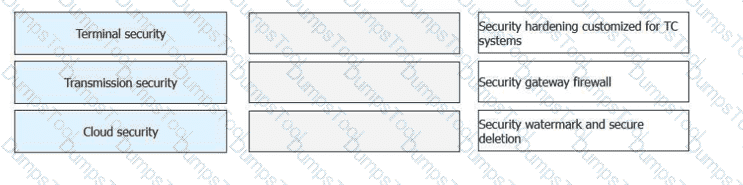
FusionAccess provides three protection mechanisms and 11 key measures to prevent data from being stored locally and make behaviors traceable and processes auditable, enhancing

end-to-end security. Match the key measures with the following protection mechanisms.
Full Access
Question # 11

The Central Processing Unit (CPU) is the computer's computing and control core. Mainly composed of an arithmetic logic unit (ALU) and a controller, it reads and executes data according to instructions.

A.

TRUE

B.

FALSE

Full Access
Question # 12

To enhance the security of user desktops, FusionAccess supports diverse access management policies. Which of the following statements about access management policies are true?

A.

MAC address-based access control. This policy can be applied only to users or user groups.

B.

Time-based access control. This policy implements only whitelist control. Users can log in to desktops only in the specified time segment.

C.

IP address-based access control. This policy implements blacklist and whitelist control and allows configuring a single IP address or IP address segment.

D.

Certificate-based access control. This policy is applied globally.

Full Access
Question # 13

Which of the following statements aretrueabout deploying Compute Node Agent (CNA) and Virtual Resource Management (VRM) in Huawei FusionCompute?

A.

CNA can be deployed on virtual machines or physical servers.

B.

If the VRM nodes are deployed on physical servers, the active and standby VRM nodes must be deployed on two physical servers.

C.

If the VRM nodes are deployed on virtual machines, you need to select two hosts in the management cluster and deploy the active and standby VRM VMs on these hosts.

D.

VRM can be deployed on virtual machines or physical servers.

Full Access
Question # 14

The service modes for cloud computing include Infrastructure as a Service (IaaS), Platform as a Service (PaaS), and Software as a Service (SaaS). Which of the following statements arefalseabout the IaaS model?

A.

Users need to install a virtualization suite to integrate resources.

B.

Users only need to pay attention to applications.

C.

Users only need to focus on applications and data.

D.

Users only need to focus on systems and applications.

Full Access
Question # 15

On FusionAccess, which of the following operations isnot requiredfor VM creation during thequick provision process?

A.

Select a VM template.

B.

Select a VM group to which the VM belongs.

C.

Select a desktop group to which the VM belongs.

D.

Enter the number of VMs to be provisioned.

Full Access
Question # 16

In the OpenStack solution,Swiftprovides persistent block storage.

A.

TRUE

B.

FALSE

Full Access
Question # 17

During template creation on FusionAccess, you need to enter a temporary account to install Windows OS. Which of the following is the temporary account?

A.

PrivateAccount

B.

LocalAccount

C.

AreaAccount

D.

SafeAccount

Full Access
Question # 18

Cloud-native technologies enable organizations to build and run scalable applications in public, private, or hybrid cloud environments. Which of the following isnota representative cloud-native technology?

A.

Service mesh

B.

Virtualization

C.

Microservice

D.

Container

Full Access
Question # 19

On FusionAccess, if a full copy VM cannot be re-assigned after being unassigned, which of the following assignment types does the full copy VM use?

A.

Assign a Computer to Dynamic Multiple Users

B.

Assign a Computer to Pooled Users

C.

Assign a Computer to a User

D.

Assign a Computer to Multiple Users

Full Access
Question # 20

In FusionCompute, the security auditor in role-based access control (RBAC) mode is only permitted to view and export logs.

A.

TRUE

B.

FALSE

Full Access
Question # 21

Which of the following statements about the differences betweenuser groupsandorganizational units (OUs)aretrue?

A.

OUs and user groups are Active Directory objects.

B.

An OU can contain objects such as accounts, computers, printers, and shared folders.

C.

Group policies can be configured for both OUs and user groups.

D.

A user group can only contain accounts.

Full Access
Question # 22

In Huawei FusionCompute, which of the following resources cannot be reduced?

A.

NIC quantities

B.

Disk capacity

C.

CPU resources

D.

Memory resources

Full Access
Question # 23

Match the emerging technologies with their respective features or application scenarios
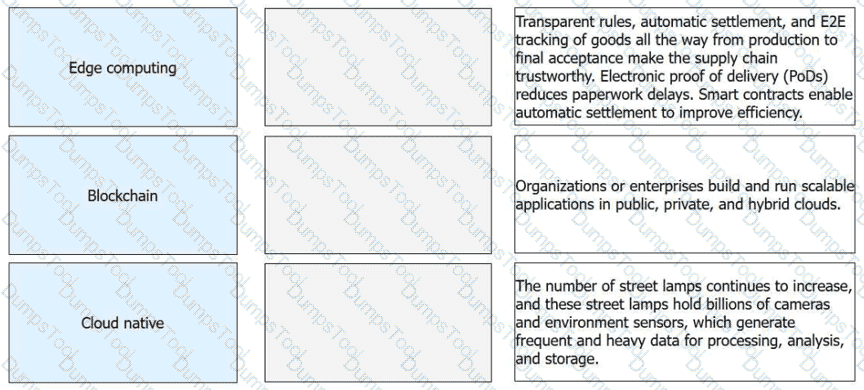
Full Access
Question # 24

On FusionAccess policy management, match the following scenarios with their operations.

Full Access
Question # 25

In FusionCompute, the user can set the priority for each member port in a port group.

A.

TRUE

B.

FALSE

Full Access
Question # 26

In Huawei FusionAccess, Huawei Desktop Protocol (HDP) classifies displayed bitmaps. It uses a lossless compression algorithm for text and a lossy compression algorithm for nonsensitive data, saving bandwidth without compromising user experience.

A.

TRUE

B.

FALSE

Full Access
Question # 27

KVM is a type of paravirtualization. It can implement CPU and memory virtualization, but not device I/O virtualization.

A.

TRUE

B.

FALSE

Full Access
Question # 28

Which of the following statements are true about system encapsulation and Sysprep (system encapsulation tool) for creating a full copy template on FusionAccess?

A.

Sysprep can delete specific system information from an installed Windows image.

B.

Sysprep can be used to reset Windows product activation.

C.

System encapsulation can complete system installation in minutes.

D.

During system encapsulation, you cannot add software to the system.

Full Access
Question # 29

The essence of ___ technology is to convert physical devices into logical ones, thereby decoupling software from hardware.

Full Access
Question # 30

Which of the following statements isfalseabout High Availability (HA) in Huawei FusionCompute?

A.

Administrators can set different HA policies for VMs based on their importance.

B.

When data is stored in shared storage, if a VM is faulty, no data will be lost.

C.

This function enables a VM to reboot if the VM encounters a failure.

D.

The system periodically detects VM status. If a VM fault caused by a CNA host failure is detected, the system automatically migrates the VM to another CNA host in the same cluster and restarts the VM, thereby quickly restoring VM services.

Full Access
Question # 31

FusionCompute supports the following memory overcommitment technologies: memory sharing, memory swapping, and memory ballooning. After host memory overcommitment is enabled in cluster resource control, one of the preceding memory overcommitment technologies needs to be selected.

A.

TRUE

B.

FALSE

Full Access
Question # 32

Which of the following statements is false about a Virtual Image Management System (VIMS) file system?

A.

VIMS is the technical basis of advanced features such as thin-provisioned disks, snapshots, and storage migration.

B.

VIMS is compatible with FC SAN storage, IP SAN storage, and local disks.

C.

VIMS is a universal storage virtualization file system in the industry.

D.

VIMS is a high-performance cluster file system.

Full Access
Question # 33

Common storage networks include direct attached storage (DAS), network attached storage (NAS), and storage area network (SAN). SANs are divided into Fibre Channel storage area networks (FC SANs) and IP storage area networks (IP SANs).

A.

TRUE

B.

FALSE

Full Access
Question # 34

In virtualization, KVM and Xen are typical hardware-assisted virtualization technologies. They implement virtualization based on kernel modules in the operating system.

A.

TRUE

B.

FALSE

Full Access