dumpstool logo

A company reduces water usage and increases usage of more expensive resources after regulations become more stringent. This most likely impacts:
Senior management at a global manufacturer of commercial flooring explores strategies to reduce capital costs and improve company valuation, resulting in a comprehensive sustainability strategy. Management determines all future flooring products will be carbon neutral across their full product life cycle. The risk team is tasked with updating the company ERM framework in accordance with COSO guidelines to include ESG and climate-related risks. The team reviews and updates each of the ERM components.
What action should the team recommend the company take as part of the communication component of the ERM framework?
A global electronics manufacturer experiences severe flooding in one of its key locations. Company senior management will mitigate supply chain risk and adhere to environmental standards by issuing a bond. The bond proceeds will simultaneously address floodwater contaminated by industrial chemicals and assist communities experiencing deterioration of health conditions due to waterborne diseases.
Which bond is the company likely to issue?
The sustainability team at a global airline company enhances long-term operational efficiency and resilience. The team reviews potential strategies using scenario analysis to assess climate transition risks and optimize logistics. How can the airline company use scenario analysis to assess transition risk?
A credit loan officer at a commercial bank reviews a loan application from a company engaged in coal-fired power generation. The loan officer examines transition risks associated with the company’s business strategy.
What policy risk driver should the loan officer identify?
A global logistics company evaluates how climate change could disrupt its global distribution network. The CSO recommends a scenario analysis exercise to explore long-term risks and opportunities. Which of the following variables should the company include to effectively develop climate scenarios?
A federal regulator analyzes how the increasing frequency of natural disasters may impact the banking sector. The regulator reviews and evaluates the potential for widespread climate events to simultaneously affect multiple financial institutions and drive cascading economic disruptions. What risk type is the regulator most likely evaluating?
To inform climate policy in a European country, a coalition of government scientists prepares a report on future climate conditions. Within the report, the scientists summarize how positive feedback loops accelerate the rate of climate change. Which feedback loop will the scientists most likely include in the coalition report?
A European bank surveyed its most prominent clients to assess interest in sustainability-linked loans (SLLs) and green loans. The survey came after a recent study showed higher profitability rates of SLLs and green products than classical banking products. After positive feedback, the bank decides to introduce SLLs and green loans. The bank’s sustainability loan officer writes a new loan product guideline for corporate clients that explains SLLs and green loans.
How will the bank officer describe these loan types?
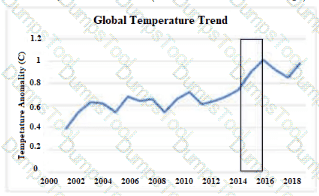
A scientist at a large agricultural company develops an internal presentation that explains weather variation and long-term climate change. The scientist presents global annual temperature anomalies (relative to a 1951-1980 average) throughout the last 20 years:
What natural forcing contributed to the temperature trend from 2014 to 2016?
T he sustainability team at a Central European agricultural firm identifies nature-related risks threatening agricultural productivity and supply chain resilience. Declining yields are linked to environmental degradation and biodiversity loss. To avoid biodiversity loss, which of the following actions will the team most likely recommend?
An economist at a large US state pension fund assesses transition risk and opportunities in response to pensioner requests that the fund increase transparency on climate strategies. The economist uses IAMs to inform this analysis.
Which of the following will the economist most likely demonstrate by using IAMs?
A large real estate investment firm increases resources to understand transition and physical risks as it expands into markets with climate regulations and increasing flooding events. Senior leadership requires the risk team train all business units in understanding how both climate risks can impact operations.
During this process, how should the risk team define commonalities between both risks?
A prominent institutional investor forms a committee to support global investments to achieve net zero GHG emissions by 2050. To inform this investment strategy, the committee relies on the IEA Net-Zero Scenario.
How should the committee proceed with investments to align with IEA milestones?
An investment bank of a southern African country appoints a task force to assess current climate risk practices. The task force examines the potential of climate change to cause systemic risk at the macro level to inform climate investment strategies. The task force evaluates potential disruption scenarios to the financial system due to climate risk. Which risk type will most likely have the lowest potential to cause systemic risk to the financial system of the country?
A major hurricane extensively damages the electrical infrastructure of a utility company. To improve the utility’s risk management, the risk director prepares a strategy plan and incorporates climate risk considerations within the existing risk management framework.
Which recommendation should the director make to incorporate climate risk into the framework’s risk identification component?
A large insurance company in South America expands use of climate scenario analysis. The company used RCPs in previous scenario analyses but now hires an actuary with climate expertise to incorporate SSPs in this process.
How can the actuary advise the insurance company use SSPs going forward?
The risk team for a multinational company, that operates and franchises hotel and timeshare properties, prepares talking points for an upcoming business continuity plan meeting. A key area for discussion are the risks that can impact the company’s financial and reputational stability. The team recommends the company conduct climate-related scenario analysis and provides examples of scenarios and their use.
Which of the following is correct for the team to include as part of the talking points?
A senior advisor from a government agency in Southeast Asia proposes a national framework to classify sustainable economic activities, aligned with the EU Taxonomy. The new framework will limit environmental harm and promote sustainable growth. Which EU Taxonomy requirement will the advisor most likely incorporate into the proposed framework?
A financial services firm in South America evaluates climate-related financial risks and opportunities to align with ISSB reporting standards. The firm initiates a scenario analysis to determine potential impacts on its investment portfolio. To enable a thorough assessment, which climate scenario input parameter should the firm prioritize in the analysis?
A Southeast Asian national military plans infrastructure investments that incorporate climate risk considerations. Part of the planning process includes climate scenario analysis. After considering several scenarios, the military assumes a future with increasing regional rivalry and conflict among nations.
The military will rely on which global reference scenario to inform its scenario analysis?
A fashion company raises an SLL to improve the company ESG score. The sustainability team identifies two sustainability KPIs for finalizing the loan with a financial institution. Which of the following KPIs did the team most likely recommend for the SLL?
At an international finance bank, a lack of staff clarity regarding sustainability, climate, and ESG definitions led to overlapping and inefficient initiatives. To minimize inefficiencies, the sustainability department develops new terminology for use across the bank.
What should the department include in this new terminology?
A coalition of African central banks reviews member bank prudential policies for alignment with climate-related financial risk mitigation. To shape the coalition’s climate risk and business continuity planning objectives, coalition leaders review key risk metrics. Which of the following metrics will the coalition most likely use to evaluate operational risk due to climate change?
A timber products company in the southeastern US plants, manages, and harvests a species of trees with a 30-year growth cycle. Prior to a planting cycle, the risk management team measures company exposure to stranded asset risk. Which of the following will the team most likely use to measure stranded asset exposure risk to the company?
A European commercial bank recently became a signatory to the UNEP FI PRB. To fulfill PRB commitments, the bank CRO emphasizes the need to holistically integrate ESG considerations into lending decisions to reduce long-term risk exposure. Which of the following strategies will the bank most likely adopt going forward?
A product manager at a regional bank analyzes customer feedback and sustainability trends to enhance bank offerings. After completing the review, the manager recommends a new consumer-facing product to attract sustainability-conscious customers. Which product does the manager most likely recommend?
After recent summer and winter temperature extremes disrupt operations, a national oil company evaluates its 10-year business plan. The risk department reviews how corporate assets, both physical and human, are resilient to climate change. Early in the planning process, a risk team member emphasizes the importance of planning for both acute and chronic climate hazards.
How should the team member describe acute and chronic hazards in terms of the 10-year strategy?
To align with industry trends, the risk team at a fashion merchandizing company evaluates the company climate risk framework. The risk team enhances the company climate risk framework by including a list of potential transition risks. Which of the following transition risks does the team most likely include in the framework?
As climate change poses new financial risks to a central bank’s monetary policy operations, the bank decides to adapt operations with NGFS guidelines. Because the central bank does not include climate change in supervision practices, the bank consults subject matter experts (SMEs) to develop a proposal for central bank action on climate change. After completing the risk assessment, SMEs recommend the bank incorporate microprudential and macroprudential measures to embed climate change into supervision practices.
Which action are SMEs likely to recommend?

TESTED 03 Oct 2026