New Year Sale - Special 70% Discount Offer - Ends in 0d 00h 00m 00s - Coupon code: 70dumps

NSE7_SSE_AD-25 Questions and Answers

Question # 6

What is the role of ZTNA tags in the FortiSASE Secure Internet Access (SIA) and Secure Private Access (SPA) use cases? (Choose one answer)

A.

ZTNA tags are created to isolate browser sessions in SIA and enforce data loss prevention in SPA for all devices.

B.

ZTNA tags determine device posture for non-web traffic protocols and are applied only in agentless deployments for SIA.

C.

ZTNA tags determine device posture for endpoints running FortiClient and are used to grant or deny access in SIA or SPA based on that posture.

D.

ZTNA tags are applied to unmanaged endpoints without FortiClient to secure HTTP and HTTPS traffic in SIA and SPA.

Full Access
Question # 7

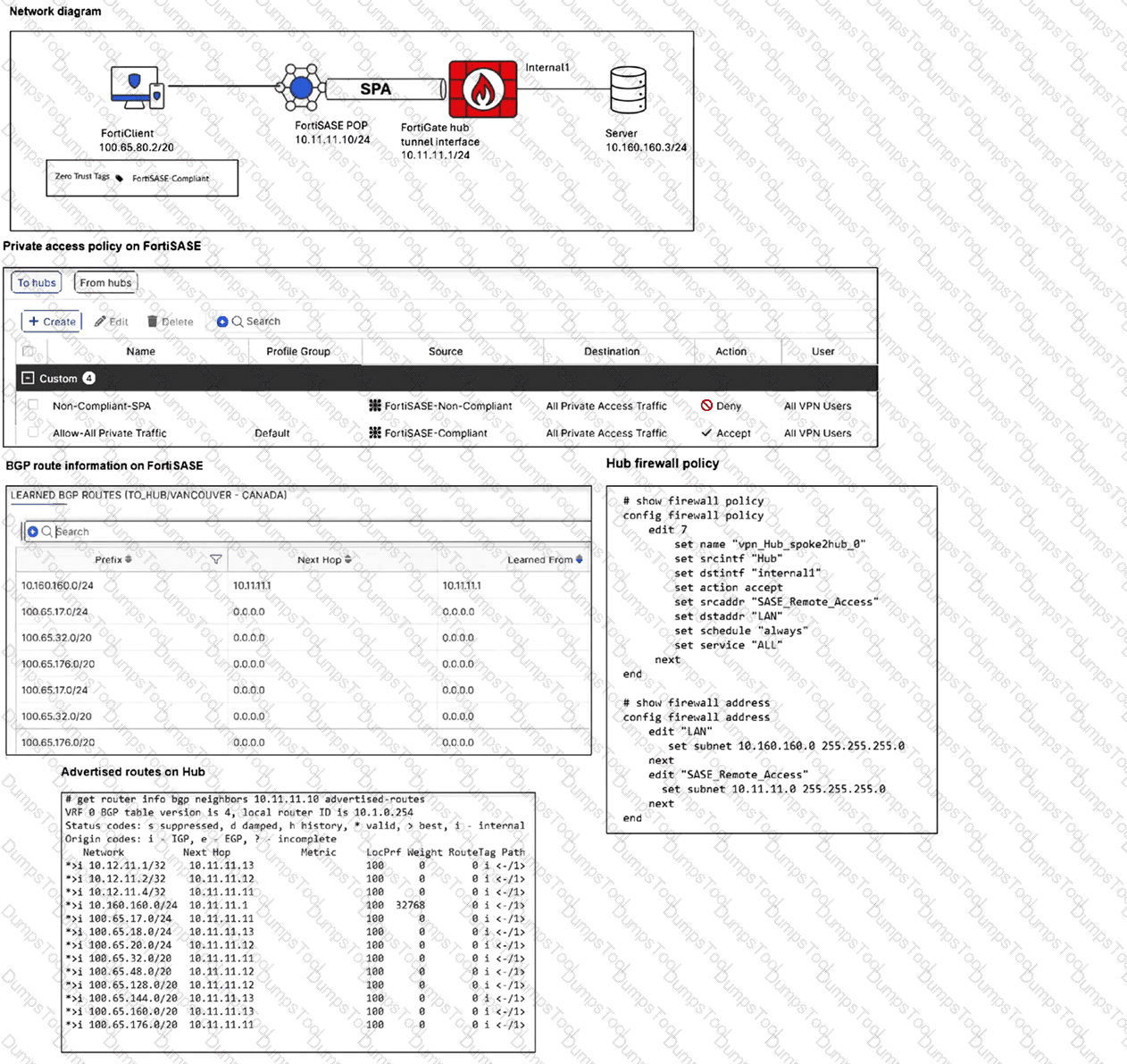
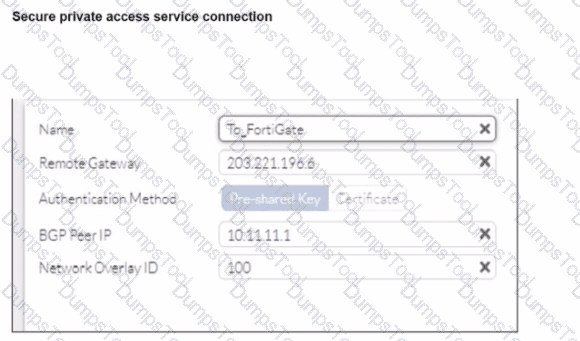
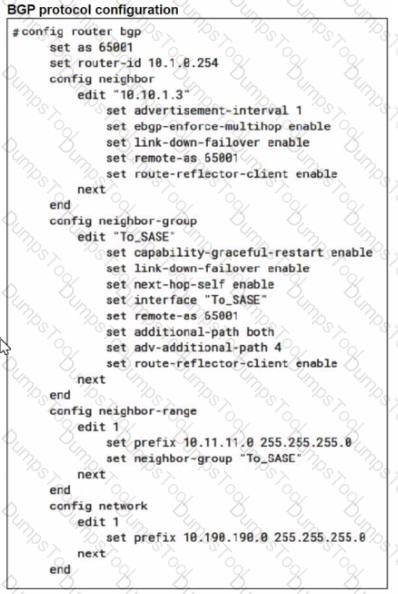
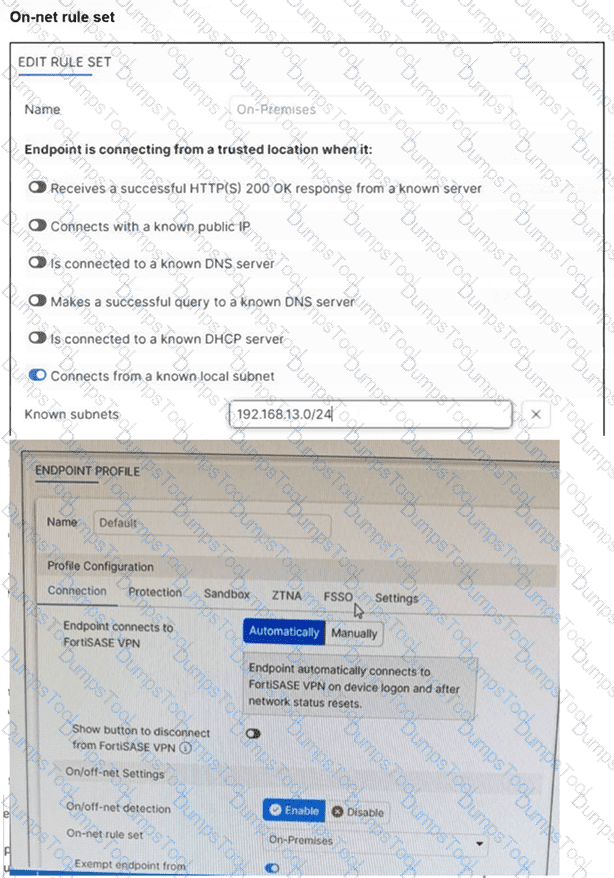
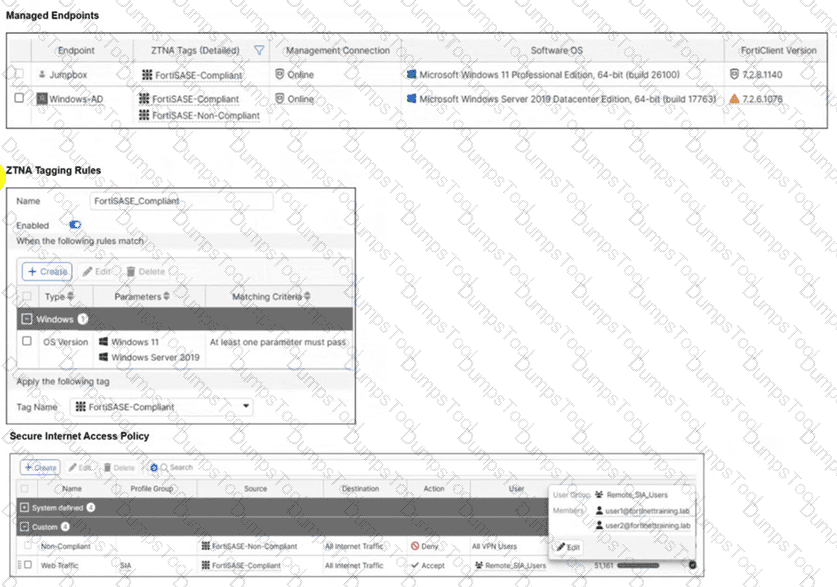
Refer to the exhibits.

A FortiSASE administrator has configured FortiSASE as a spoke to a FortiGate hub. The tunnel is up to the FortiGate hub. However, the remote FortiClient is not able to access the web server hosted behind the FortiGate hub. What is the reason for the access failure? (Choose one answer)

A.

The hub is not advertising the required routes.

B.

A private access policy has denied the traffic because of failed compliance.

C.

The hub firewall policy does not include the FortiClient address range.

D.

The server subnet BGP route was not received on FortiSASE.

Full Access
Question # 8

Which statement best describes the Digital Experience Monitor (DEM) feature on FortiSASE? (Choose one answer)

A.

It monitors the FortiSASE POP health based on ping probes.

B.

It is used for performing device compliance checks on endpoints.

C.

It provides end-to-end network visibility from all the FortiSASE security PoPs to a specific SaaS application.

D.

It gathers all the vulnerability information from all the FortiClient endpoints.

Full Access
Question # 9

You are designing a new network for Company X and one of the new cybersecurity policy requirements is that all remote user endpoints must always be connected and protected Which FortiSASE component facilitates this always-on security measure?

A.

site-based deployment

B.

thin-branch SASE extension

C.

unified FortiClient

D.

inline-CASB

Full Access
Question # 10

Refer to the exhibits.

A FortiSASE administrator is trying to configure FortiSASE as a spoke to a FortiGate hub. The tunnel is up to the FortiGale hub. However, the administrator is not able to ping the webserver hosted behind the FortiGate hub.

Based on the output, what is the reason for the ping failures?

A.

The Secure Private Access (SPA) policy needs to allow PING service.

B.

Quick mode selectors are restricting the subnet.

C.

The BGP route is not received.

D.

Network address translation (NAT) is not enabled on the spoke-to-hub policy.

Full Access
Question # 11

Refer to the exhibit.

Based on the configuration shown, in which two ways will FortiSASE process sessions that require FortiSandbox inspection? (Choose two answers)

A.

All files will be sent to an on-premises FortiSandbox for inspection.

B.

FortiClient quarantines only infected files that FortiSandbox detects as medium level.

C.

All files executed on a USB drive will be sent to FortiSandbox for analysis.

D.

Only endpoints assigned a profile for sandbox detection will be processed by the sandbox feature.

Full Access
Question # 12

How does FortiSASE hide user information when viewing and analyzing logs?

A.

By hashing data using Blowfish

B.

By hashing data using salt

C.

By encrypting data using Secure Hash Algorithm 256-bit (SHA-256)

D.

By encrypting data using advanced encryption standard (AES)

Full Access
Question # 13

Which role does FortiSASE play in supporting zero trust network access (ZTNA) principles9

A.

It offers hardware-based firewalls for network segmentation.

B.

It integrates with software-defined network (SDN) solutions.

C.

It can identify attributes on the endpoint for security posture check.

D.

It enables VPN connections for remote employees.

Full Access
Question # 14

Which two advantages does FortiSASE bring to businesses with multiple branch offices? (Choose two.)

A.

It offers centralized management for simplified administration.

B.

It enables seamless integration with third-party firewalls.

C.

it offers customizable dashboard views for each branch location

D.

It eliminates the need to have an on-premises firewall for each branch.

Full Access
Question # 15

An existing Fortinet SD-WAN customer is reviewing the FortiSASE ordering guide to identify which add-on is needed to allow future FortiSASE remote users to reach private resources. Which add-on should the customer consider to allow private access? (Choose one answer)

A.

FortiSASE Global add-on

B.

FortiSASE Branch On-Ramp add-on

C.

FortiSASE SPA add-on

D.

FortiSASE Dedicated Public IP Address add-on

Full Access
Question # 16

A company must provide access to a web server through FortiSASE secure private access for contractors. What is the recommended method to provide access? (Choose one answer)

A.

Configure a TCP access proxy forwarding rule and push it to the contractor FortiClient endpoint.

B.

Publish the web server URL on a bookmark portal and share it with contractors.

C.

Update the PAC file with the web server URL and share it with contractors.

D.

Update the DNS records on the endpoint to access private applications.

Full Access
Question # 17

When you configure FortiSASE Secure Private Access (SPA) with SD-WAN integration, you must establish a routing adjacency between FortiSASE and the FortiGate SD-WAN hub. Which routing protocol must you use?

A.

BGP

B.

IS-IS

C.

OSPF

D.

EIGRP

Full Access
Question # 18

Which policy type is used to control traffic between the FortiClient endpoint to FortiSASE for secure internet access?

A.

VPN policy

B.

thin edge policy

C.

private access policy

D.

secure web gateway (SWG) policy

Full Access
Question # 19

For monitoring potentially unwanted applications on endpoints, which information is available on the FortiSASE software installations page? (Choose two answers)

A.

The endpoint the software is installed on1

B.

The license status of the software2

C.

The vendor of the software3

D.

The usage frequency of the software

Full Access
Question # 20

Refer to the exhibit.

The daily report for application usage shows an unusually high number of unknown applications by category.

What are two possible explanations for this? (Choose two.)

A.

Certificate inspection is not being used to scan application traffic.

B.

The inline-CASB application control profile does not have application categories set to Monitor

C.

Zero trust network access (ZTNA) tags are not being used to tag the correct users.

D.

Deep inspection is not being used to scan traffic.

Full Access
Question # 21

A FortiSASE administrator is configuring a Secure Private Access (SPA) solution to share endpoint information with a corporate FortiGate.

Which three configuration actions will achieve this solution? (Choose three.)

A.

Add the FortiGate IP address in the secure private access configuration on FortiSASE.

B.

Use the FortiClient EMS cloud connector on the corporate FortiGate to connect to FortiSASE

C.

Register FortiGate and FortiSASE under the same FortiCloud account.

D.

Authorize the corporate FortiGate on FortiSASE as a ZTNA access proxy.

E.

Apply the FortiSASE zero trust network access (ZTNA) license on the corporate FortiGate.

Full Access
Question # 22

What are two benefits of deploying secure private access (SPA) with SD-WAN? (Choose two answers)

A.

ZTNA posture check performed by the hub FortiGate

B.

Support of both TCP and UDP applications

C.

A direct access proxy tunnel from FortiClient to the on-premises FortiGate

D.

Inline security inspection by FortiSASE

Full Access
Question # 23

A customer needs to implement device posture checks for their remote endpoints while accessing the protected server. They also want the TCP traffic between the remote endpoints and the protected servers to be processed by FortiGate.

In this scenario, which two setups will achieve these requirements? (Choose two answers)

A.

Configure ZTNA tags on FortiGate.

B.

Configure FortiGate as a zero trust network access (ZTNA) access proxy.

C.

Configure ZTNA servers and ZTNA policies on FortiGate.

D.

Configure private access policies on FortiSASE with ZTNA.

Full Access
Question # 24

What is the purpose of security posture tagging in ZTNA? (Choose one answer)

A.

To assign usernames to different devices for security logs

B.

To ensure that all devices and users are monitored continuously

C.

To provide granular access control based on the compliance status of devices and users1

D.

To categorize devices and users based on their role in the organization

Full Access