Spring Sale - Special 70% Discount Offer - Ends in 0d 00h 00m 00s - Coupon code: 70dumps

200-201 Questions and Answers

Question # 6

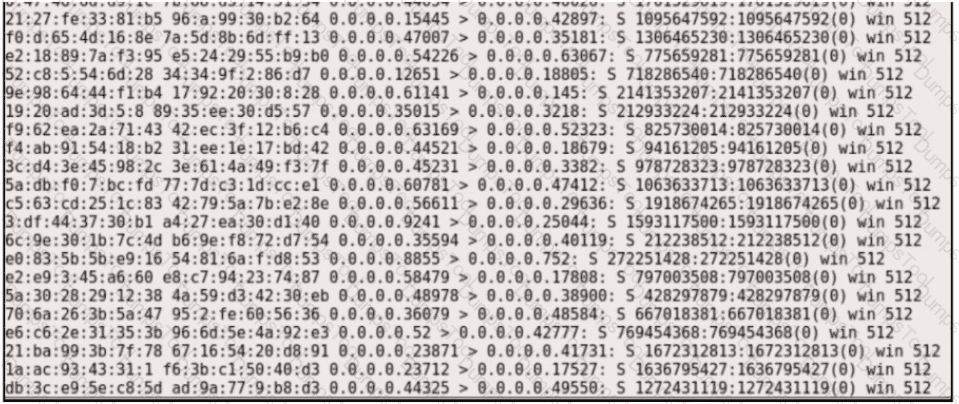
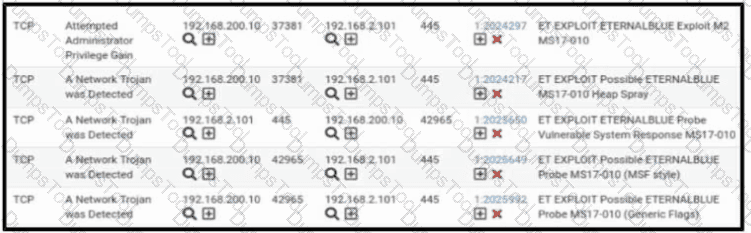
Refer to the exhibit. A security engineer receives several alerts from the SNORT IPS/IDS reporting malicious traffic. What should the engineer understand by examining the SNORT logs?

A.

A remote threat performs an EternalBlue attack on a Windows system on several ports.

B.

An inside threat performs an EternalBlue attack on hosts 192.168.2.101 and 192.168.200.10 on port 445.

C.

A remote threat performs an EternalBlue attack on several hosts and different ports.

D.

An inside threat performs an EternalBlue attack on a Windows system on port 445.

Full Access
Question # 7

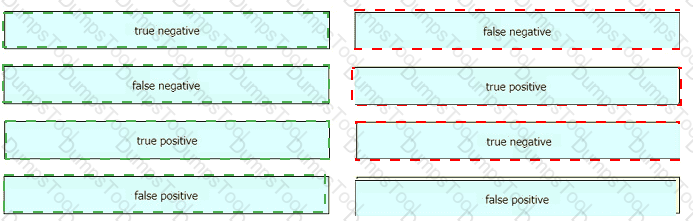
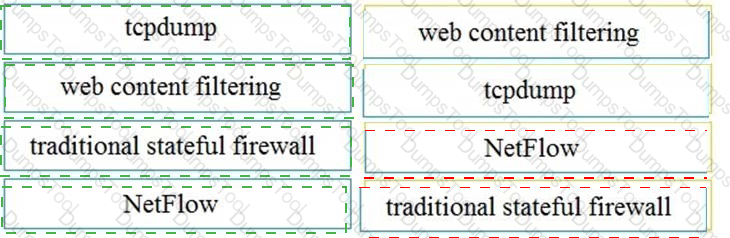
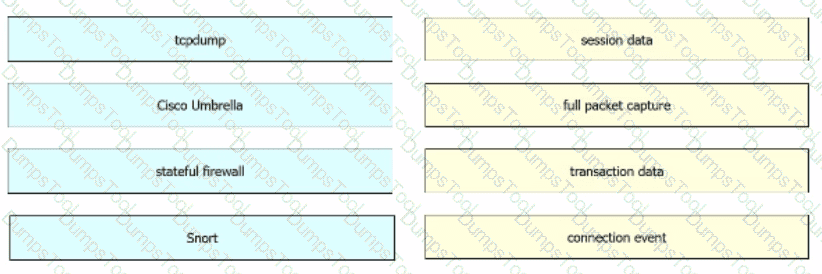
Drag and drop the technologies from the left onto the data types the technologies provide on the right.
Full Access
Question # 8

A malicious file has been identified in a sandbox analysis tool.
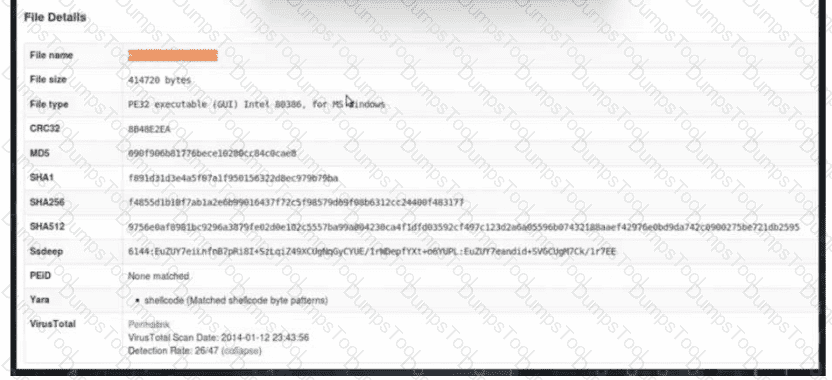
Which piece of information is needed to search for additional downloads of this file by other hosts?

A.

file header type

B.

file size

C.

file name

D.

file hash value

Full Access
Question # 9

A security engineer has a video of a suspect entering a data center that was captured on the same day that files in the same data center were transferred to a competitor.

Which type of evidence is this?

A.

best evidence

B.

prima facie evidence

C.

indirect evidence

D.

physical evidence

Full Access
Question # 10

According to CVSS, what is attack complexity?

A.

existing exploits available in the wild exploiting the vulnerability

B.

existing circumstances beyond the attacker's control to exploit the vulnerability

C.

number of actions an attacker should perform to exploit the vulnerability

D.

number of patches available for certain attack mitigation and how complex the workarounds are

Full Access
Question # 11

STION NO: 102

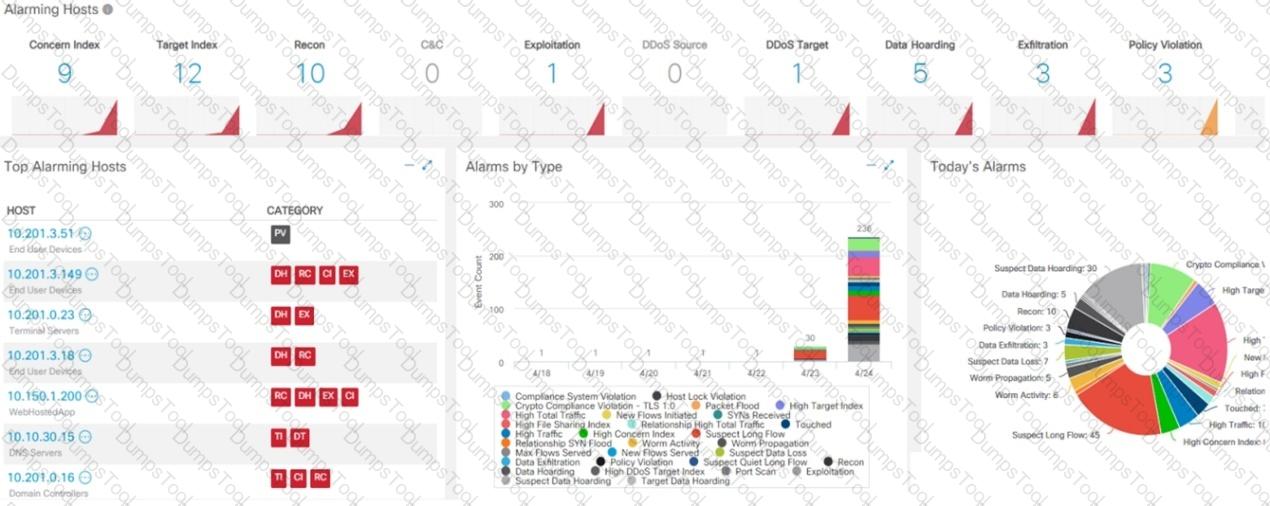
Refer to the exhibit.

What is the potential threat identified in this Stealthwatch dashboard?

A.

A policy violation is active for host 10.10.101.24.

B.

A host on the network is sending a DDoS attack to another inside host.

C.

There are three active data exfiltration alerts.

D.

A policy violation is active for host 10.201.3.149.

Full Access
Question # 12

A user received an email attachment named "Hr405-report2609-empl094.exe" but did not run it. Which category of the cyber kill chain should be assigned to this type of event?
A.

installation

B.

reconnaissance

C.

weaponization

D.

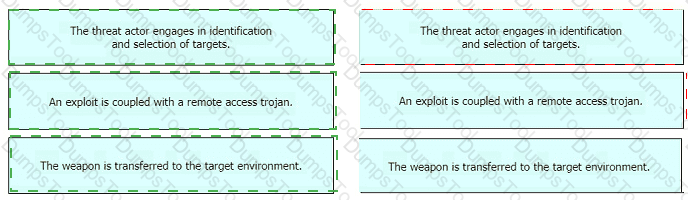
delivery

Full Access
Question # 13

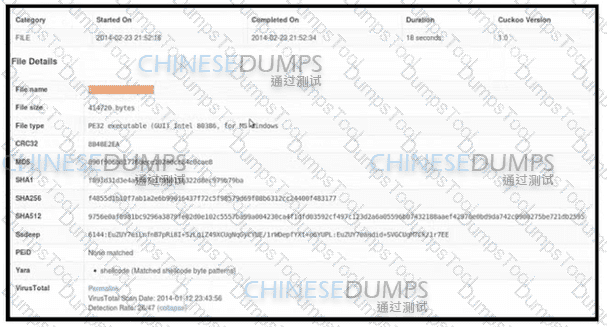
Refer to the exhibit. An employee received an email from an unknown sender with an attachment and reported it as a phishing attempt. An engineer uploaded the file to Cuckoo for further analysis. What should an engineer interpret from the provided Cuckoo report?

A.

Win32.polip.a.exe is an executable file and should be flagged as malicious.

B.

The file is clean and does not represent a risk.

C.

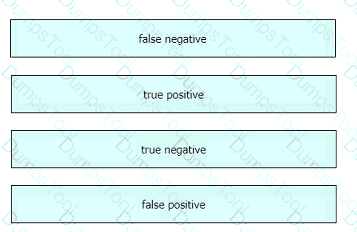
Cuckoo cleaned the malicious file and prepared it for usage.

D.

MD5 of the file was not identified as malicious.

Full Access
Question # 14

What is a Heartbleed vulnerability?

A.

information disclosure

B.

buffer overflow

C.

denial of service

D.

command injection

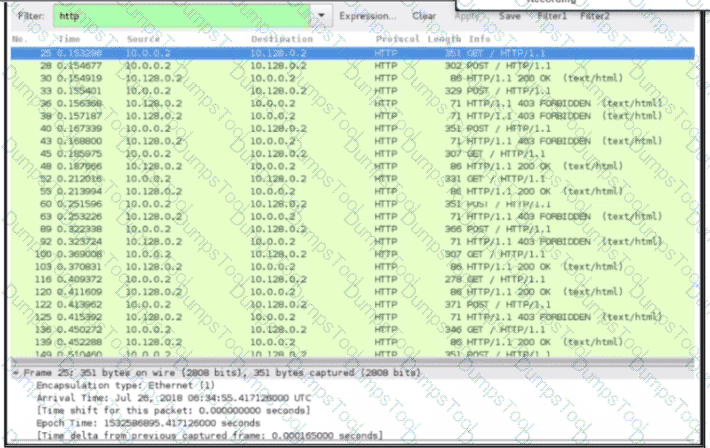
Full Access
Question # 15

What are the two differences between vulnerability and exploit? (Choose two.)

A.

Known vulnerabilities are assigned special CVE numbers, and exploits are using process to take advantage of vulnerabilities.

B.

Vulnerabilities can be found in hardware and software, and exploits can be used only for software-based vulnerabilities.

C.

Zero-day exploit can be used to take advantage of a vulnerability until the vulnerable software or hardware is patched.

D.

Vulnerabilities are usually populated in the dark web, and exploit tools and methods can be found in the public web.

E.

Zero-day exploit can be used for taking advantage of a known vulnerability, and cyber-attack can be performed on company assets.

Full Access
Question # 16

Refer to the exhibit

An engineer is analyzing DNS response packets that are larger than expected The engineer looks closer and notices a lack of appropriate DNS queries What is occurring?

A.

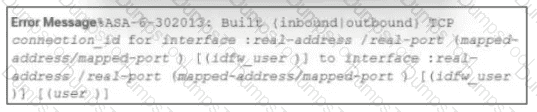
DNS hijack attack

B.

DNS amplification attack

C.

DNS tunneling

D.

DNS cache poisoning

Full Access
Question # 17

Which two elements are used for profiling a network? (Choose two.)

A.

session duration

B.

total throughput

C.

running processes

D.

listening ports

E.

OS fingerprint

Full Access
Question # 18

How is symmetric encryption used for HTTPS connections?

A.

The symmetric encryption algorithm uses public-private certificates

B.

Encryption is based on RSA-2048

C.

The symmetric key is used for encryption

D.

The key exchange process is reliable and secure

Full Access
Question # 19

A vulnerability analyst is performing the monthly scan data review Output data is very big and getting bigger each month The analyst decides to create a more efficient process to complete the task on time All false positives and true positives are excluded from the results The remaining findings will be assigned to a technical team for further remediation What is the result of such activity?

A.

False negatives must also be excluded from the data

B.

Data is filtered property and contains only valid results

C.

Exclusion is not needed and all data must be remediated

D.

Analysis is not performed correctly, and it is missing correct data

Full Access
Question # 20

An engineer received an alert affecting the degraded performance of a critical server. Analysis showed a heavy CPU and memory load. What is the next step the engineer should take to investigate this resource usage?

A.

Run "ps -d" to decrease the priority state of high load processes to avoid resource exhaustion.

B.

Run "ps -u" to find out who executed additional processes that caused a high load on a server.

C.

Run "ps -ef" to understand which processes are taking a high amount of resources.

D.

Run "ps -m" to capture the existing state of daemons and map required processes to find the gap.

Full Access
Question # 21

What is a description of "phishing" as a social engineering attack"?

A.

Someone without the proper authentication follows an authenticated employee into a restricted area The attacker might impersonate a delivery driver and wait outside a building to get things started

B.

A hacker masquerading as a trusted entity, dupes a victim into opening an email, instant message, or text message The recipient is then tricked into clicking a malicious link.

C.

The attacker focuses on creating a good pretext or a fabricated scenario that is used to try and steal victims' personal information

D.

Fake Social Security Administration personnel contact random individuals inform them that there has been a computer problem on their end and ask that those individuals confirm their Social Security Number, all for the purpose of committing identity theft.

Full Access
Question # 22

What is session data used for in network security?

A.

It is the transaction log between monitoring software.

B.

It contains the set of parameters used for fetching logs.

C.

It is the summary of the transmission between two network devices.

D.

It tracks cookies within each session initiated from a user.

Full Access
Question # 23

A system administrator is ensuring that specific registry information is accurate.

Which type of configuration information does the HKEY_LOCAL_MACHINE hive contain?

A.

file extension associations

B.

hardware, software, and security settings for the system

C.

currently logged in users, including folders and control panel settings

D.

all users on the system, including visual settings

Full Access
Question # 24

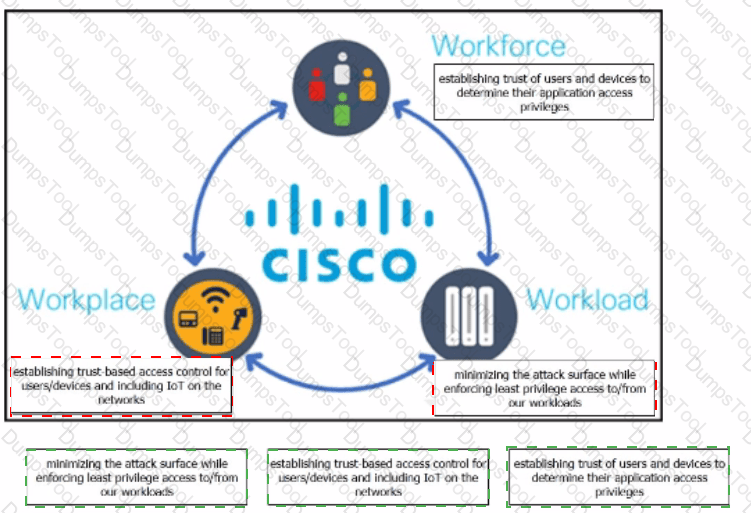
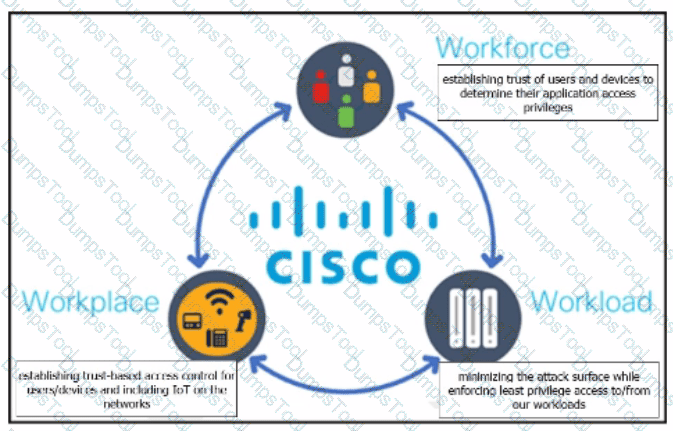
The Cisco Zero Trust Architecture simplifies the zero trust journey into three critical areas. Drag and drop the definitions onto the graphic to describe zero trust from the Cisco perspective.
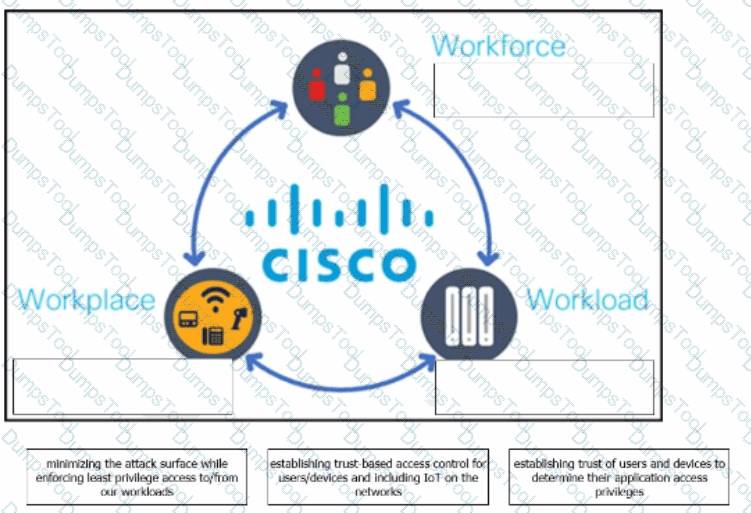
Full Access
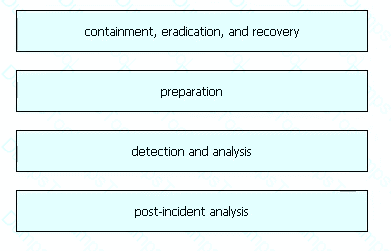
Question # 25

Drag and drop the elements from the left into the correct order for incident handling on the right.

Full Access
Question # 26

The SOC team has confirmed a potential indicator of compromise on an endpoint. The team has narrowed the executable file's type to a new trojan family. According to the NIST Computer Security Incident Handling Guide, what is the next step in handling this event?

A.

Isolate the infected endpoint from the network.

B.

Perform forensics analysis on the infected endpoint.

C.

Collect public information on the malware behavior.

D.

Prioritize incident handling based on the impact.

Full Access
Question # 27

A compliance analyst receives a complaint from a customer regarding personal data being unlawfully retained despite a deletion request. The company is based in Europe and must comply with GDPR. The only data collected is the email address 0524l9i75@gmail.com. How should the compliance analyst act?

A.

Do not delete the data — the email address is not considered PII

B.

Delete the data regardless of where the customer is from

C.

Delete the data if the customer is from the EU

D.

Notify the legal team about a data compliance breach

Full Access
Question # 28

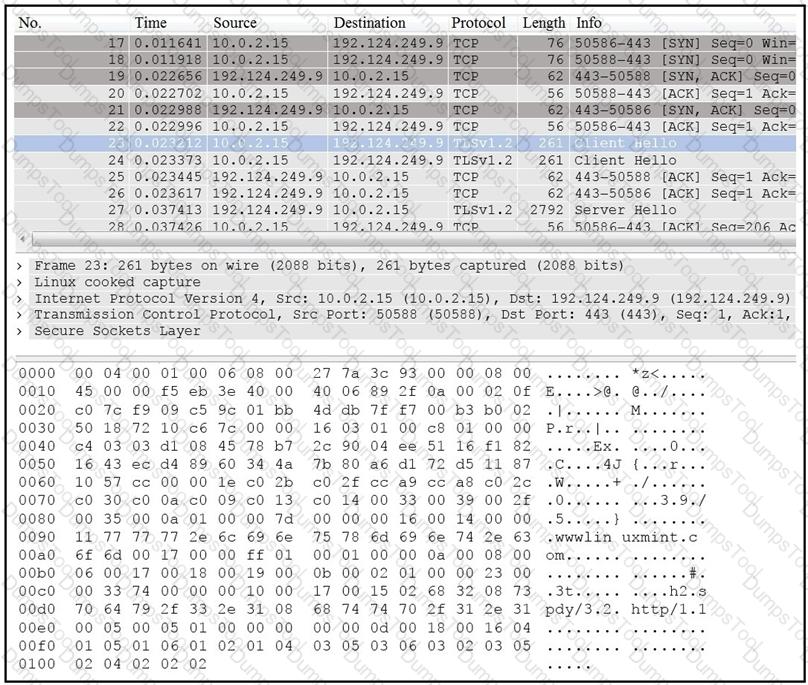
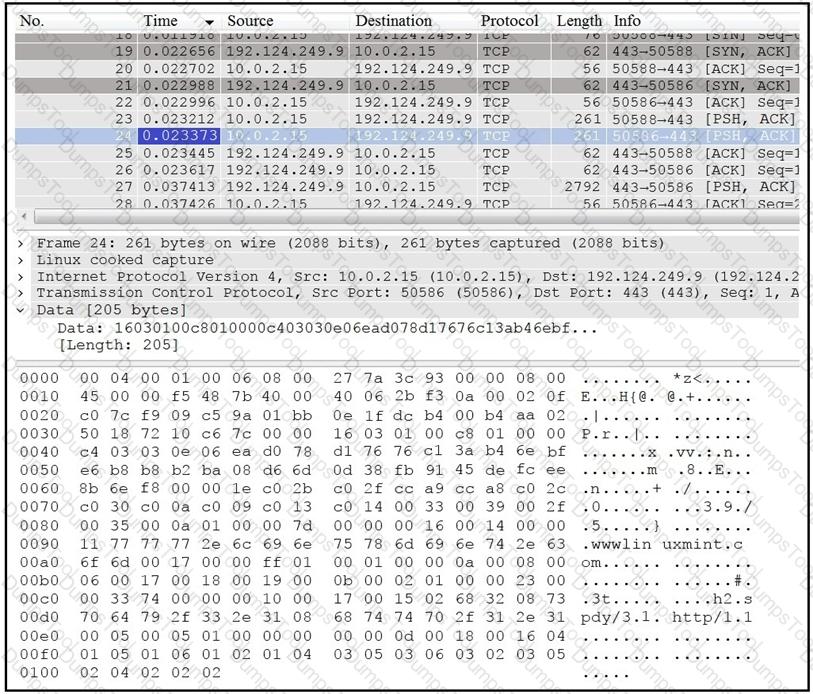
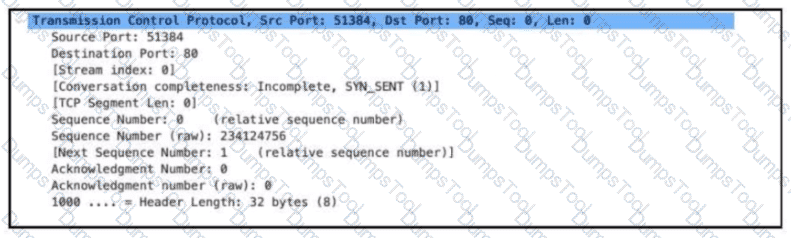
Refer to the exhibit.

Which application protocol is in this PCAP file?

A.

SSH

B.

TCP

C.

TLS

D.

HTTP

Full Access
Question # 29

Which action should be taken if the system is overwhelmed with alerts when false positives and false negatives are compared?

A.

Modify the settings of the intrusion detection system.

B.

Design criteria for reviewing alerts.

C.

Redefine signature rules.

D.

Adjust the alerts schedule.

Full Access
Question # 30

Which are two denial-of-service attacks? (Choose two.)

A.

TCP connections

B.

ping of death

C.

man-in-the-middle

D.

code-red

E.

UDP flooding

Full Access
Question # 31

What is the difference between an attack vector and an attack surface?

A.

Attack vectors are flaws in configuration, and the attack surface is the system or software that has such flaws.

B.

The attack vector targets security weaknesses, and the attack surface is where an adversary attempts to gain entry across those weaknesses.

C.

The attack surface is tactics, techniques, and procedures used by the threat actor, and the attack vector is the system hardware.

D.

The attack surface defines the number of existing vulnerabilities available, and the attack vector determines the difficulty of available exploits.

Full Access
Question # 32

A security engineer notices confidential data being exfiltrated to a domain "Ranso4134-mware31-895" address that is attributed to a known advanced persistent threat group The engineer discovers that the activity is part of a real attack and not a network misconfiguration. Which category does this event fall under as defined in the Cyber Kill Chain?

A.

reconnaissance

B.

delivery

C.

action on objectives

D.

weaponization

Full Access
Question # 33

What is the impact of encryption?

A.

Confidentiality of the data is kept secure and permissions are validated

B.

Data is accessible and available to permitted individuals

C.

Data is unaltered and its integrity is preserved

D.

Data is secure and unreadable without decrypting it

Full Access
Question # 34

What is the difference between attack surface and vulnerability?

A.

An attack surface is a way of taking advantage of a system or resource, and a vulnerability is a specific technique utilized by the vulnerability.

B.

A vulnerability describes how software or a system is exposed to potential attacks, and an attack surface is an actual weakness that exposes the potential risk.

C.

A vulnerability is a way of taking advantage of a system or resource, and an attack surface is a specific technique utilized by the vulnerability.

D.

An attack surface describes how software or a system is exposed to potential attacks, and a vulnerability is an actual weakness that exposes the potential risk.

Full Access
Question # 35

Which HTTP header field is used in forensics to identify the type of browser used?

A.

referrer

B.

host

C.

user-agent

D.

accept-language

Full Access
Question # 36

A security consultant must change the identity access management model fof their organization The new approach will put responsibility on the owner, who will decide whichusers will have access to which resources Which low-cost model must be used for this purpose?

A.

mandatory access control, due to automate scaling

B.

discretionary access control due to easy maintenance

C.

discretionary access control, due to high security

D.

mandatory access control, due to low granularity

Full Access
Question # 37

An organization has recently adjusted its security stance in response to online threats made by a known hacktivist group.

What is the initial event called in the NIST SP800-61?

A.

online assault

B.

precursor

C.

trigger

D.

instigator

Full Access
Question # 38

Which two measures are used by the defense-m-depth strategy? (Choose two)

A.

Bridge the single connection into multiple.

B.

Divide the network into parts

C.

Split packets into pieces.

D.

Reduce the load on network devices.

E.

Implement the patch management process

Full Access
Question # 39

How does an attack surface differ from an attack vector?

A.

An attack vector recognizes the potential outcomes of an attack, and the attack surface is choosing a method of an attack.

B.

An attack surface identifies vulnerable parts for an attack, and an attack vector specifies which attacks are feasible to those parts.

C.

An attack surface mitigates external vulnerabilities, and an attack vector identifies mitigation techniques and possible workarounds.

D.

An attack vector matches components that can be exploited, and an attack surface classifies the potential path for exploitation

Full Access
Question # 40

What matches the regular expression c(rgr)+e?

A.

crgrrgre

B.

np+e

C.

c(rgr)e

D.

ce

Full Access
Question # 41

Which piece of information is needed for attribution in an investigation?

A.

proxy logs showing the source RFC 1918 IP addresses

B.

RDP allowed from the Internet

C.

known threat actor behavior

D.

802.1x RADIUS authentication pass arid fail logs

Full Access
Question # 42

How can TOR impact data visibility inside an organization?

A.

increases data integrity

B.

increases security

C.

decreases visibility

D.

no impact

Full Access
Question # 43

Why is encryption challenging to security monitoring?

A.

Encryption analysis is used by attackers to monitor VPN tunnels.

B.

Encryption is used by threat actors as a method of evasion and obfuscation.

C.

Encryption introduces additional processing requirements by the CPU.

D.

Encryption introduces larger packet sizes to analyze and store.

Full Access
Question # 44

What is a difference between a threat and a risk?

A.

A threat is a sum of risks and a risk itself represents a specific danger toward the asset

B.

A threat can be people property, or information, and risk is a probability by which these threats may bring harm to the business

C.

A risk is a flaw or hole in security, and a threat is what is being used against that flaw

D.

A risk is an intersection between threat and vulnerabilities, and a threat is what a security engineer is trying to protect against

Full Access
Question # 45

Which of these describes volatile evidence?

A.

registers and cache

B.

logs

C.

usernames

D.

disk and removable drives

Full Access
Question # 46

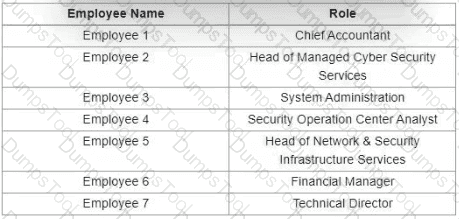
Refer to the exhibit.

Which stakeholders must be involved when a company workstation is compromised?

A.

Employee 1 Employee 2, Employee 3, Employee 4, Employee 5, Employee 7

B.

Employee 1, Employee 2, Employee 4, Employee 5

C.

Employee 4, Employee 6, Employee 7

D.

Employee 2, Employee 3, Employee 4, Employee 5

Full Access
Question # 47

An organization's security team has detected network spikes coming from the internal network. An investigation has concluded that the spike in traffic was from intensive network scanning How should the analyst collect the traffic to isolate the suspicious host?

A.

by most active source IP

B.

by most used ports

C.

based on the protocols used

D.

based on the most used applications

Full Access
Question # 48

Syslog collecting software is installed on the server For the log containment, a disk with FAT type partition is used An engineer determined that log files are being corrupted when the 4 GB tile size is exceeded. Which action resolves the issue?

A.

Add space to the existing partition and lower the retention period.

B.

Use FAT32 to exceed the limit of 4 GB.

C.

Use the Ext4 partition because it can hold files up to 16 TB.

D.

Use NTFS partition for log file containment

Full Access
Question # 49

An engineer received an alert affecting the degraded performance of a critical server Analysis showed a heavy CPU and memory load What is the next step the engineer should take to investigate this resource usage7

A.

Run "ps -ef to understand which processes are taking a high amount of resources

B.

Run "ps -u" to find out who executed additional processes that caused a high load on a server

C.

Run "ps -m" to capture the existing state of daemons and map the required processes to find the gap

D.

Run "ps -d" to decrease the priority state of high-load processes to avoid resource exhaustion

Full Access
Question # 50

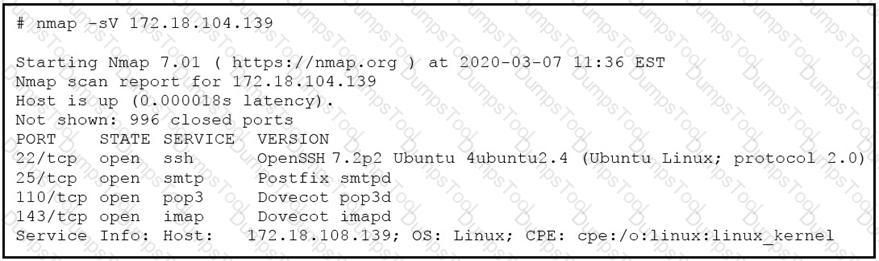
Refer to the exhibit.

What does the output indicate about the server with the IP address 172.18.104.139?

A.

open ports of a web server

B.

open port of an FTP server

C.

open ports of an email server

D.

running processes of the server

Full Access
Question # 51

Which artifact is used to uniquely identify a detected file?

A.

file timestamp

B.

file extension

C.

file size

D.

file hash

Full Access
Question # 52

What is the impact of false positive alerts on business compared to true positive?

A.

True positives affect security as no alarm is raised when an attack has taken place, while false positives are alerts raised appropriately to detect and further mitigate them.

B.

True-positive alerts are blocked by mistake as potential attacks, while False-positives are actual attacks Identified as harmless.

C.

False-positive alerts are detected by confusion as potential attacks, while true positives are attack attempts identified appropriately.

D.

False positives alerts are manually ignored signatures to avoid warnings that are already acknowledged, while true positives are warnings that are not yet acknowledged.

Full Access
Question # 53

What describes the defense-m-depth principle?

A.

defining precise guidelines for new workstation installations

B.

categorizing critical assets within the organization

C.

isolating guest Wi-Fi from the focal network

D.

implementing alerts for unexpected asset malfunctions

Full Access
Question # 54

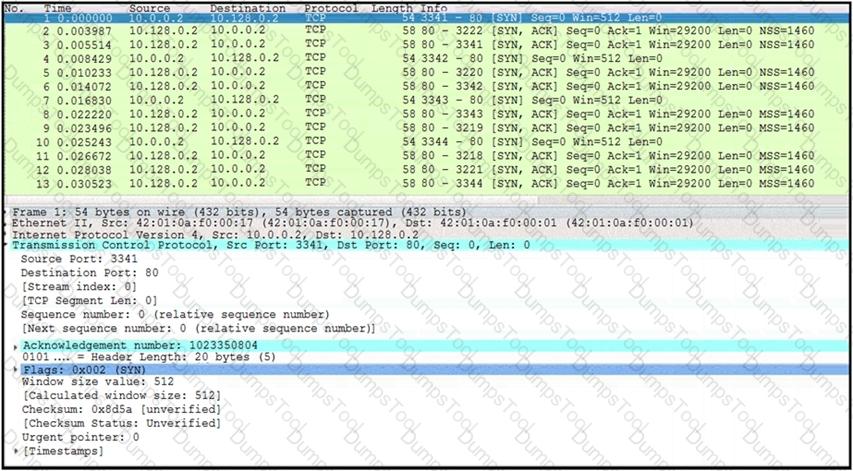
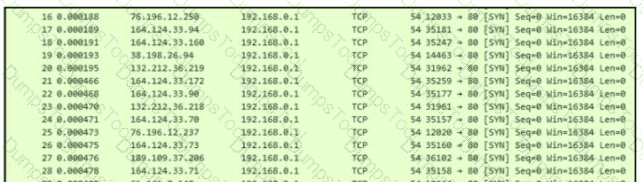
Refer to the exhibit.

What is occurring in this network traffic?

A.

High rate of SYN packets being sent from a multiple source towards a single destination IP.

B.

High rate of ACK packets being sent from a single source IP towards multiple destination IPs.

C.

Flood of ACK packets coming from a single source IP to multiple destination IPs.

D.

Flood of SYN packets coming from a single source IP to a single destination IP.

Full Access
Question # 55

Refer to the exhibit. A SOC team member receives a case from his colleague with notes attached. The artifacts and alerts associated with the case must be analyzed and a conclusion must be provided. What is the cause of the alert?

A.

An insider threat compromised the service account to delete sensitive data.

B.

External attackers gained access and are exfiltrating data stealthily.

C.

A ransomware attack is underway, encrypting files and deleting originals.

D.

A misconfigured backup process malfunctioned, causing unexpected file changes.

Full Access
Question # 56

What are the two characteristics of the full packet captures? (Choose two.)

A.

Identifying network loops and collision domains.

B.

Troubleshooting the cause of security and performance issues.

C.

Reassembling fragmented traffic from raw data.

D.

Detecting common hardware faults and identify faulty assets.

E.

Providing a historical record of a network transaction.

Full Access
Question # 57

In digital communications, which method is recommended for securely exchanging public keys between users T0n2262144790 and D4n4126220794?

A.

Hardware Security Module

B.

Automated Certificate Management Environment

C.

Pretty Good Privacy

D.

Secure Multipurpose Internet Mail Extensions

Full Access
Question # 58

A SOC analyst is investigating an incident that involves a Linux system that is identifying specific sessions. Which identifier tracks an active program?

A.

application identification number

B.

active process identification number

C.

runtime identification number

D.

process identification number

Full Access
Question # 59

What are two differences in how tampered and untampered disk images affect a security incident? (Choose two.)

A.

Untampered images are used in the security investigation process

B.

Tampered images are used in the security investigation process

C.

The image is tampered if the stored hash and the computed hash match

D.

Tampered images are used in the incident recovery process

E.

The image is untampered if the stored hash and the computed hash match

Full Access
Question # 60

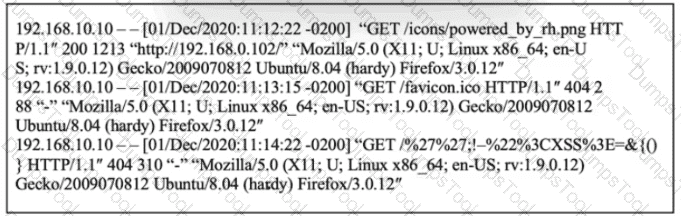
Refer to the exhibit.

What is occurring?

A.

Cross-Site Scripting attack

B.

XML External Entitles attack

C.

Insecure Deserialization

D.

Regular GET requests

Full Access
Question # 61

What is the practice of giving employees only those permissions necessary to perform their specific role within an organization?

A.

least privilege

B.

need to know

C.

integrity validation

D.

due diligence

Full Access
Question # 62

Which type of data is used to detect anomalies in the network?

A.

statistical data

B.

alert data

C.

transaction data

D.

metadata

Full Access
Question # 63

Drag and drop the event term from the left onto the description on the right.
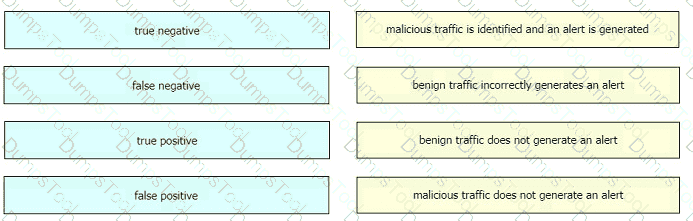
Full Access
Question # 64

Which of these describes SOC metrics in relation to security incidents?

A.

time it takes to detect the incident

B.

time it takes to assess the risks of the incident

C.

probability of outage caused by the incident

D.

probability of compromise and impact caused by the incident

Full Access
Question # 65

An analyst received a ticket about degraded processing capability for one of the HR department's servers. On the same day, an engineer noticed disabled antivirus software and could not determine when or why it occurred. According to the NIST Incident Handling Guide, what is the next phase of this investigation?

A.

Detection

B.

Analysis

C.

Eradication

D.

Recovery

Full Access
Question # 66

What is a comparison between rule-based and statistical detection?

A.

Statistical is based on measured data while rule-based uses the evaluated probability approach.

B.

Rule-based Is based on assumptions and statistical uses data Known beforehand.

C.

Rule-based uses data known beforehand and statistical is based on assumptions.

D.

Statistical uses the probability approach while rule-based Is based on measured data.

Full Access
Question # 67

Which security principle requires more than one person is required to perform a critical task?

A.

least privilege

B.

need to know

C.

separation of duties

D.

due diligence

Full Access
Question # 68

Which management concept best describes developing, operating, maintaining, upgrading, and disposing of all resources?

A.

configuration

B.

vulnerability

C.

asset

D.

patch

Full Access
Question # 69

What is a difference between rule-based and role-based access control mechanisms?

A.

Rule-based are simple and easy to execute, and role-based are well-defined.

B.

Role-based are an appropriate choice in geographically diverse workgroups, and rule-based are for simply structured workgroups.

C.

Rule-based are less granular, and role-based have time constraints.

D.

Role-based are efficient in small workgroups, and rule-based are preferred in time-defined workgroups.

Full Access
Question # 70

Which access control should a chief information security officer select to protect extremely sensitive data categorized at various levels of confidentiality?

A.

MAC; each object owner is responsible to provide access only to authorized users.

B.

MAC; access control decisions are centrally managed and minimize the human error probability.

C.

DAC; access control decisions are centrally managed and minimize the human error probability.

D.

DAC; each object owner is responsible to provide access only to authorized users.

Full Access
Question # 71

Why is HTTPS traffic difficult to screen?

A.

HTTPS is used internally and screening traffic (or external parties is hard due to isolation.

B.

The communication is encrypted and the data in transit is secured.

C.

Digital certificates secure the session, and the data is sent at random intervals.

D.

Traffic is tunneled to a specific destination and is inaccessible to others except for the receiver.

Full Access
Question # 72

Refer to the exhibit.

Which type of attack is represented?

A.

TCP/SYN flooding

B.

UDP flooding

C.

IP flooding

D.

MAC flooding

Full Access
Question # 73

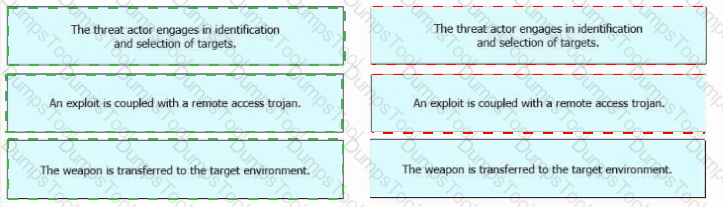
Drag and drop the definition from the left onto the phase on the right to classify intrusion events according to the Cyber Kill Chain model.
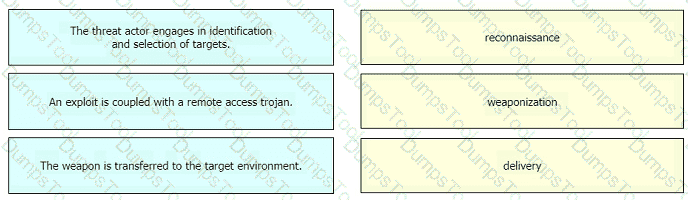
Full Access
Question # 74

Refer to the exhibit.

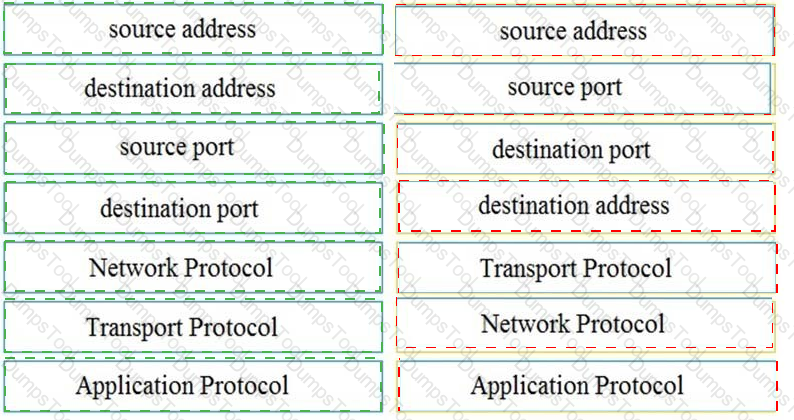
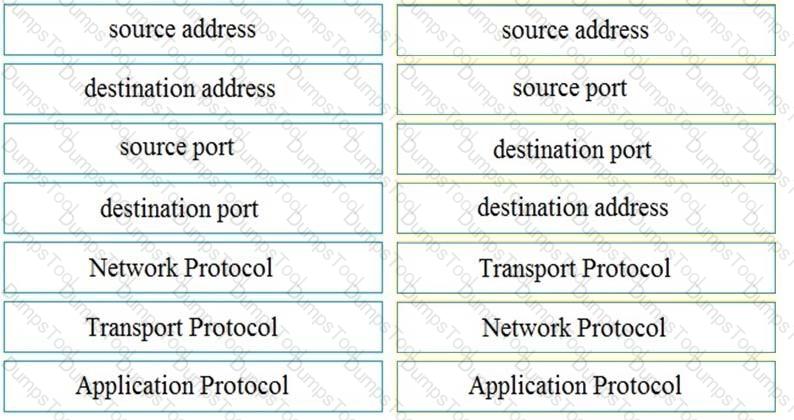
Drag and drop the element name from the left onto the correct piece of the PCAP file on the right.
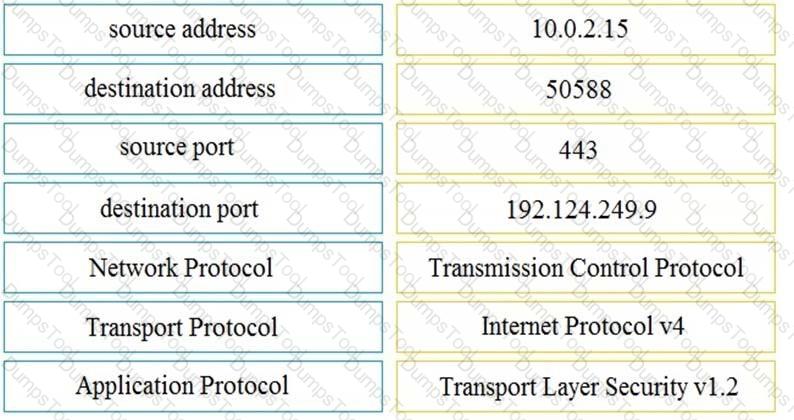
Full Access
Question # 75

Which event artifact is used to identify HTTP GET requests for a specific file?

A.

destination IP address

B.

TCP ACK

C.

HTTP status code

D.

URI

Full Access
Question # 76

Which step in the incident response process researches an attacking host through logs in a SIEM?
A.

detection and analysis

B.

preparation

C.

eradication

D.

containment

Full Access
Question # 77

Which statement describes threat hunting?

A.

It is an activity by an entity to deliberately bring down critical internal servers.

B.

It is a prevention activity to detect signs of intrusion, compromise, data theft, abnormalities, or malicious activity.

C.

It includes any activity that might go after competitors and adversaries to infiltrate their systems.

D.

It is a vulnerability assessment conducted by cyber professionals.

Full Access
Question # 78

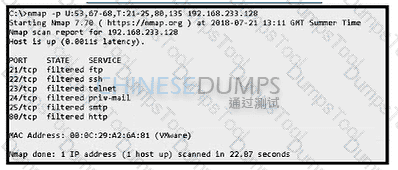
Refer to the exhibit. An attacker scanned the server using Nmap. What did the attacker obtain from this scan?

A.

Identified a firewall device preventing the pert state from being returned.

B.

Identified open SMB ports on the server

C.

Gathered information on processes running on the server

D.

Gathered a list of Active Directory users

Full Access
Question # 79

What is vulnerability management?

A.

A security practice focused on clarifying and narrowing intrusion points.

B.

A security practice of performing actions rather than acknowledging the threats.

C.

A process to identify and remediate existing weaknesses.

D.

A process to recover from service interruptions and restore business-critical applications

Full Access
Question # 80

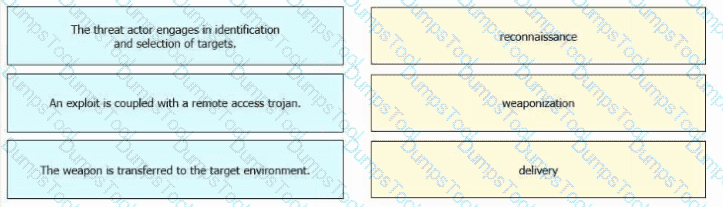
Drag and drop the definitions from the left onto the phases on the right to classify intrusion events according to the Cyber Kill Chain model.
Full Access
Question # 81

Which technique obtains information about how the system works without knowing it's design details?

A.

DDOS attack

B.

reverse engineering

C.

DNS spoofing

D.

malware analysis

Full Access
Question # 82

An analyst discovers that a legitimate security alert has been dismissed. Which signature caused this impact on network traffic?

A.

true negative

B.

false negative

C.

false positive

D.

true positive

Full Access
Question # 83

Which type of data must an engineer capture to analyze payload and header information?

A.

frame check sequence

B.

alert data

C.

full packet

D.

session logs

Full Access
Question # 84

Which of these is a defense-in-depth strategy principle?

A.

identify the minimum resource required per employee.

B.

Assign the least network privileges to segment network permissions.

C.

Provide the minimum permissions needed to perform Job functions.

D.

Disable administrative accounts to avoid unauthorized changes.

Full Access
Question # 85

A security engineer must protect the company from known issues that trigger adware. Recently new incident has been raised that could harm the system. Which security concepts are present in this scenario?

A.

exploit and patching

B.

risk and evidence

C.

analysis and remediation

D.

vulnerability and threat

Full Access
Question # 86

What are two denial-of-service (DoS) attacks? (Choose two)

A.

port scan

B.

SYN flood

C.

man-in-the-middle

D.

phishing

E.

teardrop

Full Access
Question # 87

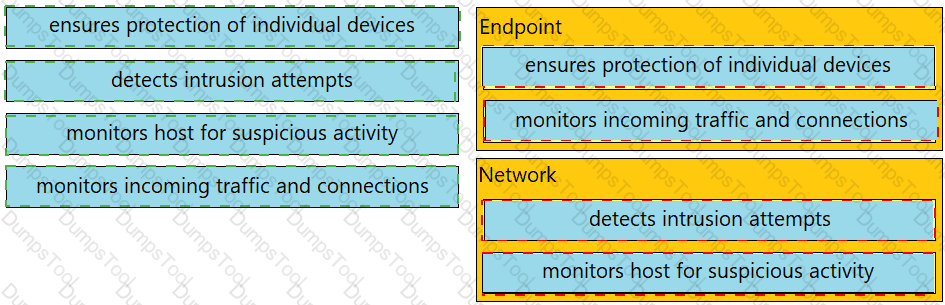
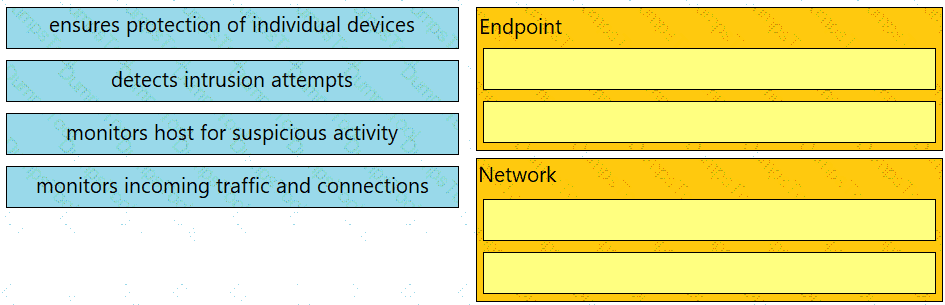
Drag and drop the uses on the left onto the type of security system on the right.
Full Access
Question # 88

An analyst performs traffic analysis to detect data exfiltration and identifies a high frequency of DNS requests in a small period of time Which technology makes this behavior feasible?

A.

access control list

B.

NAT

C.

tunneling

D.

encryption

Full Access
Question # 89

How is attacking a vulnerability categorized?

A.

action on objectives

B.

delivery

C.

exploitation

D.

installation

Full Access
Question # 90

What describes the public key infrastructure (PKI)?

A.

PKI verifies the identity of the user and sender and creates secure communication channels using asymmetric encryption.

B.

PKI ensures packet loss prevention and creates secure communication channels using symmetric encryption.

C.

PKI verifies the identity of the user and sender and creates secure communication channels using symmetric encryption.

D.

PKI ensures packet loss prevention and creates secure communication channels using asymmetric encryption.

Full Access
Question # 91

What should a security analyst consider when comparing inline traffic interrogation with traffic tapping to determine which approach to use in the network?

A.

Tapping interrogation replicates signals to a separate port for analyzing traffic

B.

Tapping interrogations detect and block malicious traffic

C.

Inline interrogation enables viewing a copy of traffic to ensure traffic is in compliance with security policies

D.

Inline interrogation detects malicious traffic but does not block the traffic

Full Access
Question # 92

An engineer must investigate suspicious connections. Data has been gathered using a tcpdump command on a Linux device and saved as sandboxmatware2022-12-22.pcaps file.The engineer is trying to open the tcpdump in the Wireshark tool. What is the expected result?

A.

The tool does not support Linux.

B.

The file is opened.

C.

The file has an incorrect extension.

D.

The file does not support the"-" character.

Full Access
Question # 93

Which evasion technique is a function of ransomware?

A.

extended sleep calls

B.

encryption

C.

resource exhaustion

D.

encoding

Full Access
Question # 94

What is a ransomware attack?

A.

It is a component of a malware attack used to establish a remote covert channel.

B.

It is malicious software that steals confidential data.

C.

It encrypts a victim’s data and prevents access to it.

D.

The volume of data exceeds storage capacity.

Full Access
Question # 95

Which information must an organization use to understand the threats currently targeting the organization?

A.

threat intelligence

B.

risk scores

C.

vendor suggestions

D.

vulnerability exposure

Full Access
Question # 96

Exhibit.

An engineer received a ticket about a slowdown of a web application, Drug analysis of traffic, the engineer suspects a possible attack on a web server. How should the engineer interpret the Wiresharat traffic capture?

A.

10.0.0.2 sends GET/ HTTP/1.1 And Post request and the target responds with HTTP/1.1. 200 OC and HTTP/1.1 403 accordingly. This is an HTTP flood attempt.

B.

10.0.0.2 sends HTTP FORBIDDEN /1.1 And Post request, while the target responds with HTTP/1.1 200 Get and HTTP/1.1 403. This is an HTTP GET flood attack.

C.

10.128.0.2 sends POST/1.1 And POST requests, and the target responds with HTTP/1.1 200 Ok and HTTP/1.1 403 accordingly. This is an HTTP Reserve Bandwidth flood.

D.

10.128.0.2 sends HTTP/FORBIDDEN/ 1.1 and Get requests, and the target responds with HTTP/1.1 200 OK and HTTP/1.1 403. This is an HTTP cache bypass attack.

Full Access
Question # 97

A user reports difficulties accessing certain external web pages. When an engineer examines traffic to and from the external domain in full packet captures, they notice that many SYNs have the same sequence number, source, and destination IP address, but they have different payloads. What is causing this situation?

A.

TCP injection

B.

misconfiguration of a web filter

C.

Failure of the full packet capture solution

D.

insufficient network resources

Full Access
Question # 98

A company receptionist received a threatening call referencing stealing assets and did not take any action assuming it was a social engineering attempt. Within 48 hours, multiple assets were breached, affecting the confidentiality of sensitive information. What is the threat actor in this incident?

A.

companyassets that are threatened

B.

customer assets that are threatened

C.

perpetrators of the attack

D.

victims of the attack

Full Access
Question # 99

What are two denial of service attacks? (Choose two.)

A.

MITM

B.

TCP connections

C.

ping of death

D.

UDP flooding

E.

code red

Full Access
Question # 100

What is a difference between SIEM and SOAR?

A.

SOAR predicts and prevents security alerts, while SIEM checks attack patterns and applies the mitigation.

B.

SlEM's primary function is to collect and detect anomalies, while SOAR is more focused on security operations automation and response.

C.

SIEM predicts and prevents security alerts, while SOAR checks attack patterns and applies the mitigation.

D.

SOAR's primary function is to collect and detect anomalies, while SIEM is more focused on security operations automation and response.

Full Access
Question # 101

How does the approach of a behavioral detection system to identifying security threats compare to that of a rule-based detection system?

A.

Rule-based detection is effective with fewer false positives, and behavioral adapts over time.

B.

Behavioral detection is easier to deploy without rules, and rule-based needs historical data.

C.

Behavioral detection is adaptive to deviations, and rule-based detection uses static rules.

D.

Rule-based detection excels at APT hunts with updates, and behavioral focuses on anomalies.

Full Access
Question # 102

Which action matches the weaponization step of the Cyber Kill Chain model?
A.

Scan a host to find open ports and vulnerabilities

B.

Construct the appropriate malware and deliver it to the victim.

C.

Test and construct the appropriate malware to launch the attack

D.

Research data on a specific vulnerability

Full Access
Question # 103

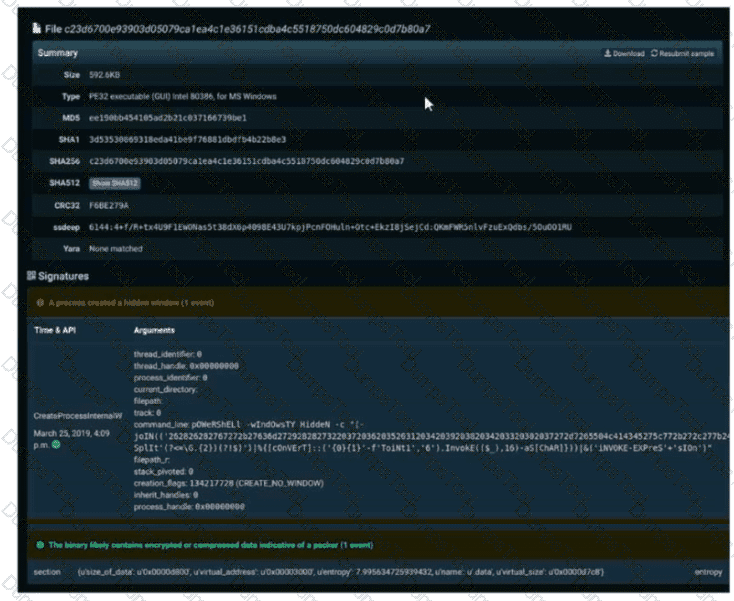
Refer to the exhibit. A SOC engineer is analyzing Cuckoo Sandbox report for a file that has been identified as suspicious by the endpoint security system. What is the state of the file?

A.

The file was identified as PE32 executable with a high level of entropy to bypass AV via encryption.

B.

The file was detected as an executable binary file, but no suspicious activity was detected and it is false positive.

C.

The file was detected as executable and was marked by the SSDeep hashing algorithm as suspicious.

D.

The file identified as an executable binary for Microsoft Word with macros creating hidden process via PowerShell.

Full Access
Question # 104

What is a description of a social engineering attack?

A.

fake offer for free music download to trick the user into providing sensitive data

B.

package deliberately sent to the wrong receiver to advertise a new product

C.

mistakenly received valuable order destined for another person and hidden on purpose

D.

email offering last-minute deals on various vacations around the world with a due date and a counter

Full Access
Question # 105

Which two protocols are used for DDoS amplification attacks? (Choose two.)

A.

ICMPv6

B.

DNS

C.

NTP

D.

TCP

E.

HTTP

Full Access
Question # 106

A user received a targeted spear-phishing email and identified it as suspicious before opening the content. To which category of the Cyber Kill Chain model does to this type of event belong?

A.

weaponization

B.

delivery

C.

exploitation

D.

reconnaissance

Full Access
Question # 107

Which statement describes indicators of attack?

A.

internal hosts communicate with countries outside of the business range.

B.

Phishing attempts on an organization are blocked by mall AV.

C.

Critical patches are missing.

D.

A malicious file is detected by the AV software.

Full Access
Question # 108

A network engineer noticed in the NetFlow report that internal hosts are sending many DNS requests to external DNS servers A SOC analyst checked the endpoints and discovered that they are infected and became part of the botnet Endpoints are sending multiple DNS requests but with spoofed IP addresses of valid external sources What kind of attack are infected endpoints involved in1?

A.

DNS hijacking

B.

DNS tunneling

C.

DNS flooding

D.

DNS amplification

Full Access
Question # 109

What is the role of indicator of compromise in an investigation?

A.

It helps answer the question of why the attack took place.

B.

It identifies potentially malicious activity on a system or network.

C.

It is nonforensic data, which is easy to detect.

D.

It describes what and why something happened.

Full Access
Question # 110

What is corroborating evidence?

A.

Evidence that can be provided to cyber police for further restrictive actions over threat actors

B.

Evidence that can be presented in court in the original form, such as an exact copy of a hard drive

C.

Evidence that tends to support a theory or an assumption deduced by some initial evidence

D.

Evidence that relies on an extrapolation to a conclusion of fact, such as fingerprints

Full Access
Question # 111

Which principle reduces the risk of attackers gaining access to sensitive data by compromising a low-level user account?

A.

least privilege

B.

privilege separation

C.

limited access

D.

separation of duties

Full Access
Question # 112

What is a difference between inline traffic interrogation and traffic mirroring?

A.

Inline inspection acts on the original traffic data flow

B.

Traffic mirroring passes live traffic to a tool for blocking

C.

Traffic mirroring inspects live traffic for analysis and mitigation

D.

Inline traffic copies packets for analysis and security

Full Access
Question # 113

An engineer discovered a breach, identified the threat’s entry point, and removed access. The engineer was able to identify the host, the IP address of the threat actor, and the application the threat actor targeted. What is the next step the engineer should take according to the NIST SP 800-61 Incident handling guide?

A.

Recover from the threat.

B.

Analyze the threat.

C.

Identify lessons learned from the threat.

D.

Reduce the probability of similar threats.

Full Access
Question # 114

Refer to the exhibit.

During the analysis of a suspicious scanning activity incident, an analyst discovered multiple local TCP connection events Which technology provided these logs?

A.

antivirus

B.

proxy

C.

IDS/IPS

D.

firewall

Full Access
Question # 115

Which security model assumes an attacker within and outside of the network and enforces strict verification before connecting to any system or resource within the organization?

A.

Biba

B.

Object-capability

C.

Take-Grant

D.

Zero Trust

Full Access
Question # 116

How does statistical detection differ from rule-based detection?

A.

Statistical detection involves the evaluation of events, and rule-based detection requires an evaluated set of events to function.

B.

Statistical detection defines legitimate data over time, and rule-based detection works on a predefined set of rules

C.

Rule-based detection involves the evaluation of events, and statistical detection requires an evaluated set of events to function Rule-based detection defines

D.

legitimate data over a period of time, and statistical detection works on a predefined set of rules

Full Access
Question # 117

What describes the concept of data consistently and readily being accessible for legitimate users?

A.

integrity

B.

availability

C.

accessibility

D.

confidentiality

Full Access
Question # 118

What is the virtual address space for a Windows process?

A.

physical location of an object in memory

B.

set of pages that reside in the physical memory

C.

system-level memory protection feature built into the operating system

D.

set of virtual memory addresses that can be used

Full Access
Question # 119

Refer to the exhibit. Which alert is identified from this packet?

A.

SYN flood

B.

SSDP amplification

C.

Fraggle attack

D.

TCP fragmentation attack

Full Access
Question # 120

Refer to the exhibit. An engineer must map these events to the source technology that generated the event logs. To which technology do the generated logs belong?

A.

proxy

B.

antivirus

C.

IPS

D.

firewall

Full Access
Question # 121

Which difficulty occurs when log messages are compared from two devices separated by a Layer 3 device that performs Network Address Translation?
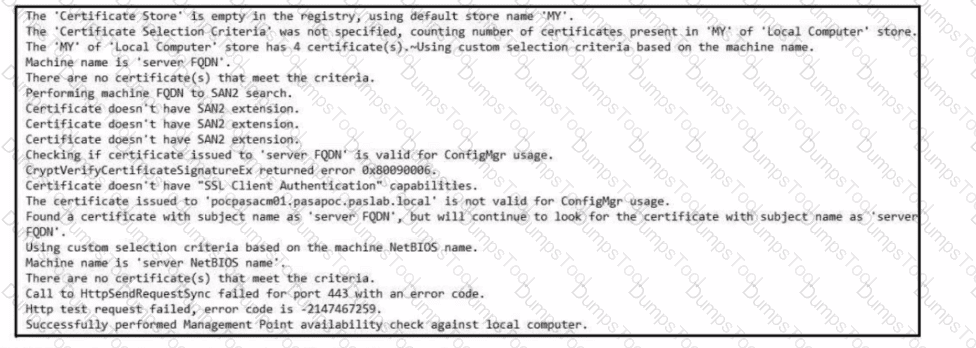
A.

IP addresses in the log messages match

B.

Timestamps of the log messages are different.

C.

Log messages contain incorrect information

D.

IP addresses in the log messages do not match

Full Access
Question # 122

Refer to the exhibit. Which set of actions must an engineer perform to identify and fix this issue?

A.

Reinstall the IIS server to reset certificate details to default and try to connect to the server.

B.

Remove the intermediate certificates and install the CA root certificate on each server.

C.

Implement a different version of CA authority and install intermediate certificates.

D.

Add client authentication to the certificate template, reissue, and apply the certificate.

Full Access
Question # 123

Which principle is being followed when an analyst gathers information relevant to a security incident to determine the appropriate course of action?

A.

decision making

B.

rapid response

C.

data mining

D.

due diligence

Full Access
Question # 124

What are two differences between tampered disk images and untampered disk images'? (Choose two.)

A.

Tampered Images are used in a security investigation process

B.

Untampered images can be used as law enforcement evidence.

C.

The image is untampered if the existing stored hash matches the computed one

D.

The image is tampered if the stored hash and the computed hash are identical

E.

Tampered images are used as an element for the root cause analysis report

Full Access
Question # 125

Refer to the exhibit.

Which application-level protocol is being targeted?

A.

HTTPS

B.

FTP

C.

HTTP

D.

TCP

Full Access
Question # 126

A data privacy officer at a marketing firm has received a request from a former client to delete all personally sensitive information held by the company. The firm operates globally and follows international data protection standards. The only information retained about the client is a unique customer ID, "051473912", which is not directly tied to the name, address, or any other identifiable details. Which action should the data privacy officer take?

A.

Delete the data immediately to comply with all global privacy regulations.

B.

Retain the data, as a customer ID by itself does not qualify as PSI under international standards.

C.

Consult the legal team, as customer IDs are always considered PSI and cannot be retained.

D.

Delete the data if the customer ID is stored alongside additional information that can identify the client.

Full Access
Question # 127

Which attack represents the evasion technique of resource exhaustion?

A.

SQL injection

B.

man-in-the-middle

C.

bluesnarfing

D.

denial-of-service

Full Access
Question # 128

When an event is investigated, which type of data provides the investigate capability to determine if data exfiltration has occurred?

A.

full packet capture

B.

NetFlow data

C.

session data

D.

firewall logs

Full Access
Question # 129

How does a certificate authority impact security?

A.

It validates client identity when communicating with the server.

B.

It authenticates client identity when requesting an SSL certificate.

C.

It authenticates domain identity when requesting an SSL certificate.

D.

It validates the domain identity of the SSL certificate.

Full Access
Question # 130

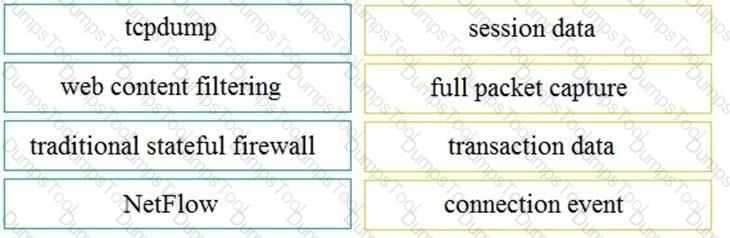
Drag and drop the technology on the left onto the data type the technology provides on the right.
Full Access
Question # 131

Refer to the exhibit.

Which component is identifiable in this exhibit?

A.

Trusted Root Certificate store on the local machine

B.

Windows PowerShell verb

C.

Windows Registry hive

D.

local service in the Windows Services Manager

Full Access
Question # 132

In a SOC environment, what is a vulnerability management metric?

A.

code signing enforcement

B.

full assets scan

C.

internet exposed devices

D.

single factor authentication

Full Access
Question # 133

Refer to the exhibit.

What does the message indicate?

A.

an access attempt was made from the Mosaic web browser

B.

a successful access attempt was made to retrieve the password file

C.

a successful access attempt was made to retrieve the root of the website

D.

a denied access attempt was made to retrieve the password file

Full Access
Question # 134

What is the purpose of command and control for network-aware malware?

A.

It contacts a remote server for commands and updates

B.

It takes over the user account for analysis

C.

It controls and shuts down services on the infected host.

D.

It helps the malware to profile the host

Full Access
Question # 135

What is an attack surface as compared to a vulnerability?

A.

any potential danger to an asset

B.

the sum of all paths for data into and out of the environment

C.

an exploitable weakness in a system or its design

D.

the individuals who perform an attack

Full Access
Question # 136

What is the difference between the ACK flag and the RST flag in the NetFlow log session?

A.

The RST flag confirms the beginning of the TCP connection, and the ACK flag responds when the data for the payload is complete

B.

The ACK flag confirms the beginning of the TCP connection, and the RST flag responds when the data for the payload is complete

C.

The RST flag confirms the receipt of the prior segment, and the ACK flag allows for the spontaneous termination of a connection

D.

The ACK flag confirms the receipt of the prior segment, and the RST flag allows for the spontaneous termination of a connection

Full Access
Question # 137

What is the difference between the ACK flag and the RST flag?

A.

The RST flag approves the connection, and the ACK flag terminates spontaneous connections.

B.

The ACK flag confirms the received segment, and the RST flag terminates the connection.

C.

The RST flag approves the connection, and the ACK flag indicates that a packet needs to be resent

D.

The ACK flag marks the connection as reliable, and the RST flag indicates the failure within TCP Handshake

Full Access
Question # 138

Which process represents the application-level allow list?

A.

allowing everything and denying specific applications protocols

B.

allowing everything and denying specific executable files

C.

allowing specific format files and deny executable files

D.

allowing specific files and deny everything else

Full Access
Question # 139

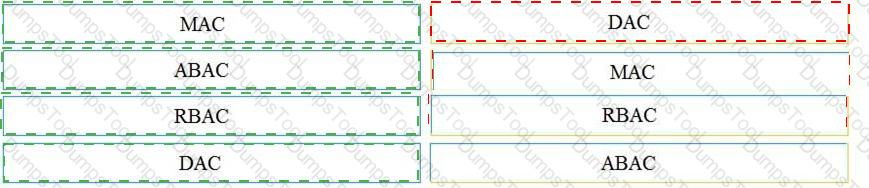
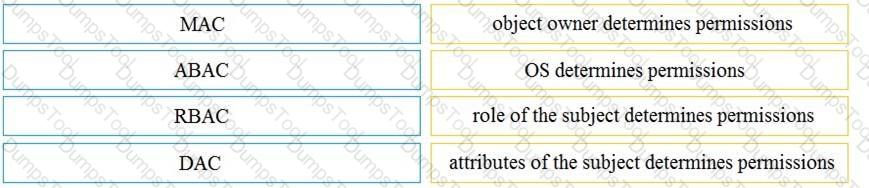
Drag and drop the access control models from the left onto the correct descriptions on the right.
Full Access
Question # 140

An engineer receives a security alert that traffic with a known TOR exit node has occurred on the network. What is the impact of this traffic?

A.

ransomware communicating after infection

B.

users downloading copyrighted content

C.

data exfiltration

D.

user circumvention of the firewall

Full Access
Question # 141

What is the benefit of processing statistical data for security systems?

A.

detects suspicious behavior based on traffic baselining trends

B.

uses less CPU and RAM resources than metadata-based monitoring

C.

provides fewer false negative events than full packet capture

D.

provides full visibility based on capture of packet traffic data

Full Access
Question # 142

Which metric is used to capture the level of access needed to launch a successful attack?

A.

privileges required

B.

user interaction

C.

attack complexity

D.

attack vector

Full Access