Activate Your Black Friday Offer: 80% Discount on Exam Bundles! Use coupon code below! - Ends in 0d 00h 00m 00s - Coupon code: SAVE80BF

 CCDV-F Dumps with Practice Exam Questions Answers

Questions: 95 Questions and Answers With Step-by-Step Explanation

Last Update: Nov 23, 2026

CCDV-F Question Includes: Single Choice Questions: 95,

CCDV-F Questions and Answers

Question # 1

You are setting up a Claude application that requires API keys for several external services.

What is the best way to store the keys?

A.

Put the keys in the application's configuration file and check the configuration file into the team's repository alongside the rest of the source code.

B.

Store the keys in a secrets manager or environment-specific configuration that is not checked into source code, and load them at runtime.

C.

Use a single shared key across all external services, so any developer working on the application can find the keys easily during development.

D.

Email the keys to each developer as needed and have each developer paste the keys into their local environment when they begin working on the application's code.

Question # 2

You are reviewing an architectural diagram for a Claude-powered travel-booking system. The diagram shows a top-level component that interprets user requests and three subordinate components that handle flights, hotels, and ground transportation. The top-level component is responsible for routing each request, sequencing the subordinate components, and reconciling their outputs into a final itinerary. The diagram also shows that each subordinate component has its own tool list and own short conversation history that is not shared with the others.

Which architectural pattern does this diagram most closely describe?

A.

A manager and supervisor pattern with isolated context per subagent, where the top-level agent coordinates specialized subagents that each maintain their own conversation history and tool list.

B.

A manager and supervisor pattern with shared context, where the top-level agent and the subagents all share a single conversation history that grows as the request flows through the system.

C.

A pipeline pattern, where each component processes the user request in sequence and passes the full conversation history along with the request to the next component in the pipeline.

D.

A retrieval-augmented pattern, where the top-level component retrieves relevant context from the subordinate components' indexed data stores before generating each response.

Question # 3

Your Claude application's prompt was written months ago and has not been updated. The team has discovered through evals that the prompt produces good results on common cases but underperforms on a specific category of inputs that has grown in volume.

How would you respond?

A.

Iterate on the prompt to address the underperforming category, validate the change with evals, and continue refining as needed.

B.

Tell users to avoid the underperforming category by adding warnings in the application's user interface about handled inputs.

C.

Replace the prompt with a new one aligned to the underperforming category, treating any common-case performance change as a known tradeoff.

D.

Add the underperforming category to a separate Claude application with its own prompt so the original prompt does not change.

Question # 4

Your Claude agent performs database operations. A recent incident occurred where the agent ran a destructive query that affected production data. The team wants to add deterministic controls to prevent similar incidents.

How would you prevent similar incidents?

A.

Run the agent only during business hours when humans are available to monitor its activity, treating the schedule as the primary control mechanism for destructive operations.

B.

Add Claude hooks that intercept database operations and apply deterministic checks, such as blocking destructive queries or requiring approval, before the queries execute.

C.

Switch to a higher-capability Claude model on the grounds that a more capable model is less likely to run destructive queries during normal operation across all requests.

D.

Add a system prompt instruction telling the agent to be careful with database operations on every request the application handles during normal operation across all incoming traffic.

Question # 5

You are designing a Claude application that will process customer support tickets in two stages: a triage stage that classifies tickets and a response stage that drafts replies. The team is debating whether to use a single Claude call that handles both stages or separate Claude calls for each stage.

How would you structure the application?

A.

Use a single Claude call for triage and then use a non-Claude rule-based system for response generation, on the grounds that rule-based systems are more reliable for drafting replies.

B.

Use multiple Claude calls in parallel that each draft a complete ticket reply, then have a fourth Claude call select the best one to send to the customer.

C.

Use separate Claude calls for triage and response, because each stage has distinct inputs, outputs, and success criteria that benefit from focused prompts.

D.

Use a single Claude call for both stages, on the grounds that a single call is cheaper than multiple calls in any production Claude application setup.

CCDV-F Exam Last Week Results!

20

Customers Passed
Anthropic CCDV-F

92%

Average Score In Real
Exam At Testing Centre

88%

Questions came word by
word from this dump

An Innovative Pathway to Ensure Success in CCDV-F

DumpsTool Practice Questions provide you with the ultimate pathway to achieve your targeted Anthropic Exam CCDV-F IT certification. The innovative questions with their interactive and to the point content make your learning of the syllabus far easier than you could ever imagine.

Intensive Individual support and Guidance for CCDV-F

DumpsTool Practice Questions are information-packed and prove to be the best supportive study material for all exam candidates. They have been designed especially keeping in view your actual exam requirements. Hence they prove to be the best individual support and guidance to ace exam in first go!

CCDV-F Downloadable on All Devices and Systems

Anthropic Claude Certified Developer CCDV-F PDF file of Practice Questions is easily downloadable on all devices and systems. This you can continue your studies as per your convenience and preferred schedule. Where as testing engine can be downloaded and install to any windows based machine.

CCDV-F Exam Success with Money Back Guarantee

DumpsTool Practice Questions ensure your exam success with 100% money back guarantee. There virtually no possibility of losing Anthropic Claude Certified Developer CCDV-F Exam, if you grasp the information contained in the questions.

24/7 Customer Support

DumpsTool professional guidance is always available to its worthy clients on all issues related to exam and DumpsTool products. Feel free to contact us at your own preferred time. Your queries will be responded with prompt response.

Anthropic CCDV-F Exam Materials with Affordable Price!

DumpsTool tires its level best to entertain its clients with the most affordable products. They are never a burden on your budget. The prices are far less than the vendor tutorials, online coaching and study material. With their lower price, the advantage of DumpsTool CCDV-F Claude Certified Developer-Foundations Practice Questions is enormous and unmatched!

Anthropic CCDV-F Practice Exam FAQs

1. What is the Anthropic CCDV-F Exam?


The CCDV-F (Claude Certified Developer - Foundations) exam validates your technical competence in building and scaling production applications using the Claude API, SDKs, and agent frameworks.

2. Who should take the CCDV-F certification?


Software engineers, developers, and technical professionals looking to prove their core skills in prompt engineering, tool integration, and model optimization with Anthropic's Claude models.

3. How long is the Anthropic CCDV-F certification valid?


Once passed, the Claude Certified Developer Foundations credential remains valid for 1 year before requiring recertification.

4. What is the format of the official CCDV-F test?


The proctored exam consists of 53 questions to be completed within 120 minutes, requiring a scaled passing score of 720 out of 1000.

5. What are the retake rules if I fail the exam?


Anthropic requires a waiting period of 14 days after a first failure, 30 days after a second, and 90 days after a third.

6. What learning formats are included in the study guide?


We provide a complete multi-format package containing a comprehensive CCDV-F study guide, interactive testing engine simulators, and portable PDF questions for flexible learning.

7. Are the questions on Dumpstool authentic?


Yes, we provide comprehensive CCDV-F real questions and verified practice questions modeled precisely after the actual certification exam format and difficulty level.

8. How does the money-back guarantee apply on failure?


If you use our comprehensive study materials and fail the official exam, you are eligible for our hassle-free money-back guarantee following our refund terms.

Our Satisfied Customers CCDV-F

Live Exam Success from Dumpstool Platform Users

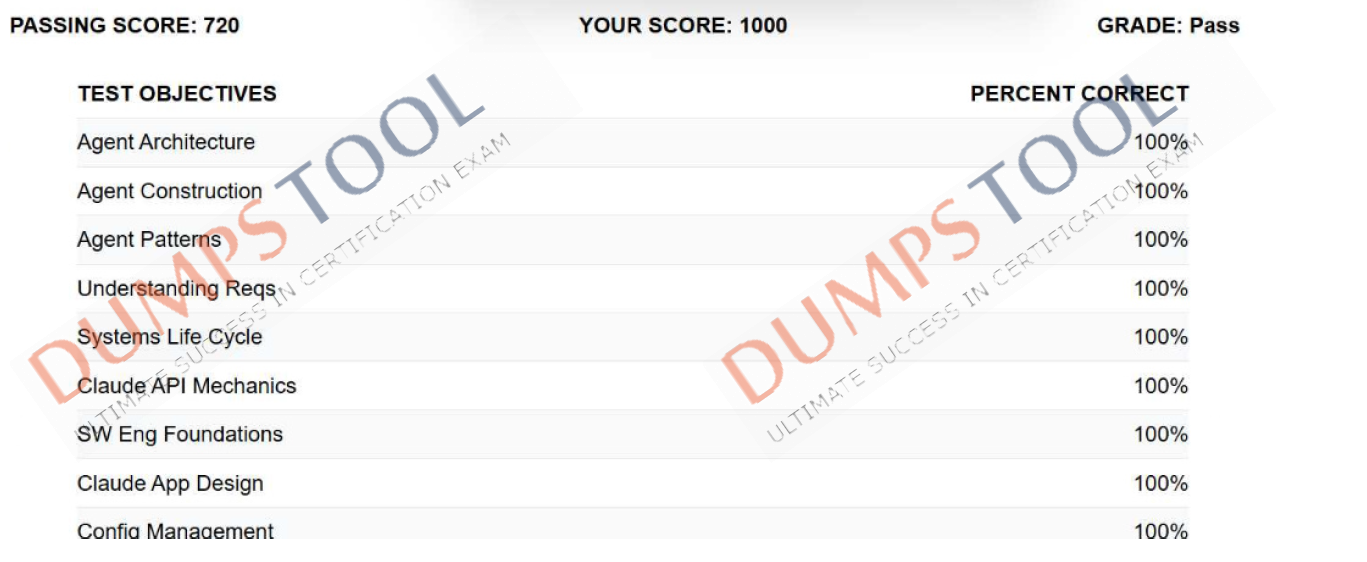
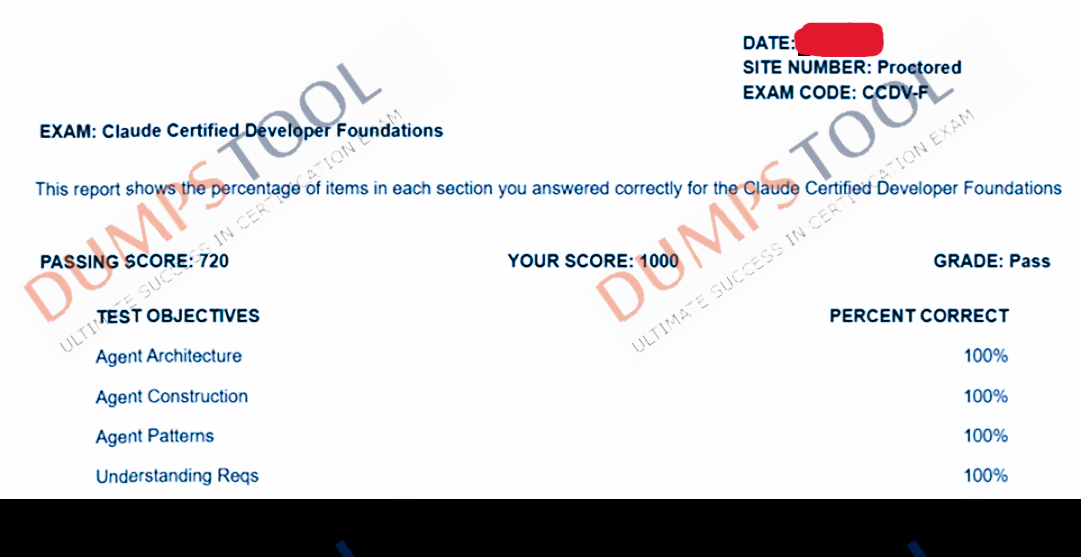
Fresh exam score sheets highlighting the real-world success rate of our platform's training.
Certified
Verified passing score report for the Anthropic CCDV-F exam 1
CLICK FOR FULL REPORT
Certified
Verified passing score report for the Anthropic CCDV-F exam 2
CLICK FOR FULL REPORT