dumpstool logo

CCAR-F Question Includes: Single Choice Questions: 152,
You are building a customer support resolution agent using the Claude Agent SDK. The agent handles high-ambiguity requests like returns, billing disputes, and account issues. It has access to your backend systems through custom Model Context Protocol (MCP) tools (get_customer, lookup_order, process_refund, escalate_to_human). Your target is 80%+ first-contact resolution while knowing when to escalate.
A customer returns 4 hours after their initial session about the same billing dispute. The previous 32-turn session contains lookup_order results showing “Status: PENDING, Expected resolution: 24–48 hours.” In testing, you observe that when resuming sessions with stale tool results, the agent often references the outdated data in responses (e.g., “I see your refund is still being processed”) even after subsequent fresh tool calls return different information.
What approach most reliably handles returning customers?
You are integrating Claude Code into your Continuous Integration/Continuous Deployment (CI/CD) pipeline. The system runs automated code reviews, generates test cases, and provides feedback on pull requests. You need to design prompts that provide actionable feedback and minimize false positives.
Your test generation produces unit tests for new code, but reviews show that 55% are low-value: trivial assertions that only verify functions do not throw exceptions, tests duplicating existing coverage, or tests ignoring your team’s fixture conventions.
How do you reduce the rate of low-value tests being generated in the first place?
You are using Claude Code to accelerate software development. Your team uses it for code generation, refactoring, debugging, and documentation. You need to integrate it into your development workflow with custom slash commands, CLAUDE.md configurations, and understand when to use plan mode vs direct execution.
You’re implementing a caching layer for API responses to speed up the /products endpoint. You have a rough idea—Redis with a 5-minute TTL—but you’re new to production caching and aren’t sure what other considerations a robust implementation requires.
What’s the most effective way to start your iterative workflow?
You are building developer-productivity tools using the Claude Agent SDK. The agent helps engineers explore unfamiliar codebases, understand legacy systems, generate boilerplate code, and automate repetitive tasks. It uses the built-in tools—Read, Write, Bash, Grep, and Glob—and integrates with Model Context Protocol (MCP) servers.
An engineer who recently joined the team asks the agent to explain the authentication and authorization architecture before making security improvements. The codebase contains more than 800 files across multiple services.
What exploration strategy will most effectively build understanding while respecting context limits?
A user expands the research system beyond its original web-search agent by adding specialized data sources. A financial API agent returns structured JSON containing revenue, margins, and growth rates. A news-monitoring agent returns prose summaries of recent developments. A patent-analysis agent returns structured lists of technology areas. The synthesis agent combines these results into executive briefings. Currently, it converts everything into bullet points, causing financial comparisons to lose tabular clarity and news summaries to lose their narrative flow. What change would most improve briefing quality?
Customers Passed
Anthropic CCAR-F
Average Score In Real
Exam At Testing Centre
Questions came word by
word from this dump
DumpsTool Practice Questions provide you with the ultimate pathway to achieve your targeted Anthropic Exam CCAR-F IT certification. The innovative questions with their interactive and to the point content make your learning of the syllabus far easier than you could ever imagine.
DumpsTool Practice Questions are information-packed and prove to be the best supportive study material for all exam candidates. They have been designed especially keeping in view your actual exam requirements. Hence they prove to be the best individual support and guidance to ace exam in first go!
Anthropic Claude Certified Architect CCAR-F PDF file of Practice Questions is easily downloadable on all devices and systems. This you can continue your studies as per your convenience and preferred schedule. Where as testing engine can be downloaded and install to any windows based machine.
DumpsTool Practice Questions ensure your exam success with 100% money back guarantee. There virtually no possibility of losing Anthropic Claude Certified Architect CCAR-F Exam, if you grasp the information contained in the questions.
DumpsTool professional guidance is always available to its worthy clients on all issues related to exam and DumpsTool products. Feel free to contact us at your own preferred time. Your queries will be responded with prompt response.
DumpsTool tires its level best to entertain its clients with the most affordable products. They are never a burden on your budget. The prices are far less than the vendor tutorials, online coaching and study material. With their lower price, the advantage of DumpsTool CCAR-F Claude Certified Architect – Foundations Practice Questions is enormous and unmatched!

DumpsTool products focus each and every aspect of the CCAR-F certification exam. You’ll find them absolutely relevant to your needs.
DumpsTool’s products are absolutely exam-oriented. They contain CCAR-F study material that is Q&As based and comprises only the information that can be asked in actual exam. The information is abridged and up to the task, devoid of all irrelevant and unnecessary detail. This outstanding content is easy to learn and memorize.
DumpsTool offers a variety of products to its clients to cater to their individual needs. DumpsTool Study Guides, CCAR-F Exam Dumps, Practice Questions answers in pdf and Testing Engine are the products that have been created by the best industry professionals.
The money back guarantee is the best proof of our most relevant and rewarding products. DumpsTool’s claim is the 100% success of its clients. If they don’t succeed, they can take back their money.
DumpsTool CCAR-F Testing Engine delivers you practice tests that have been made to introduce you to the real exam format. Taking these tests also helps you to revise the syllabus and maximize your success prospects.
Yes. DumpsTool’s concentration is to provide you with the state of the art products at affordable prices. Round the year, special packages and discounted prices are also introduced.
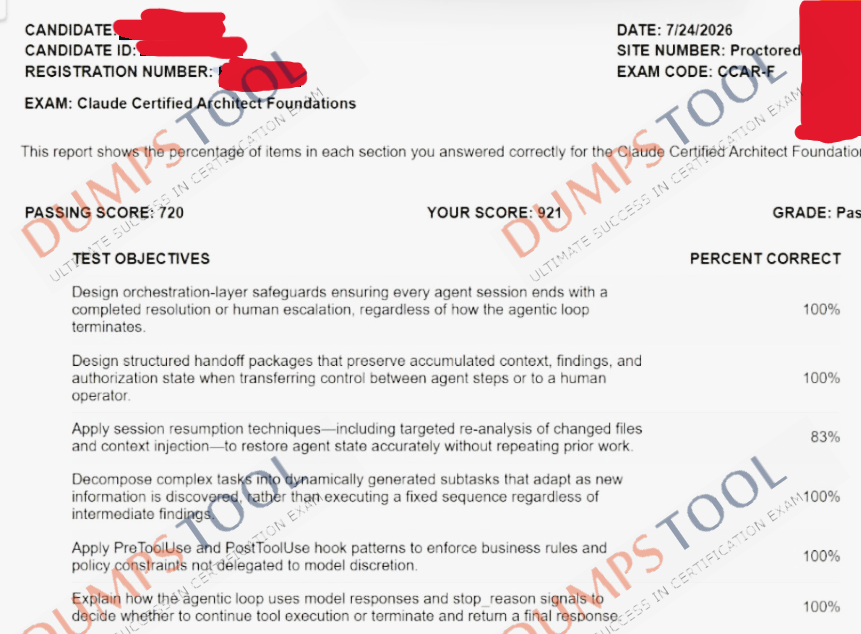
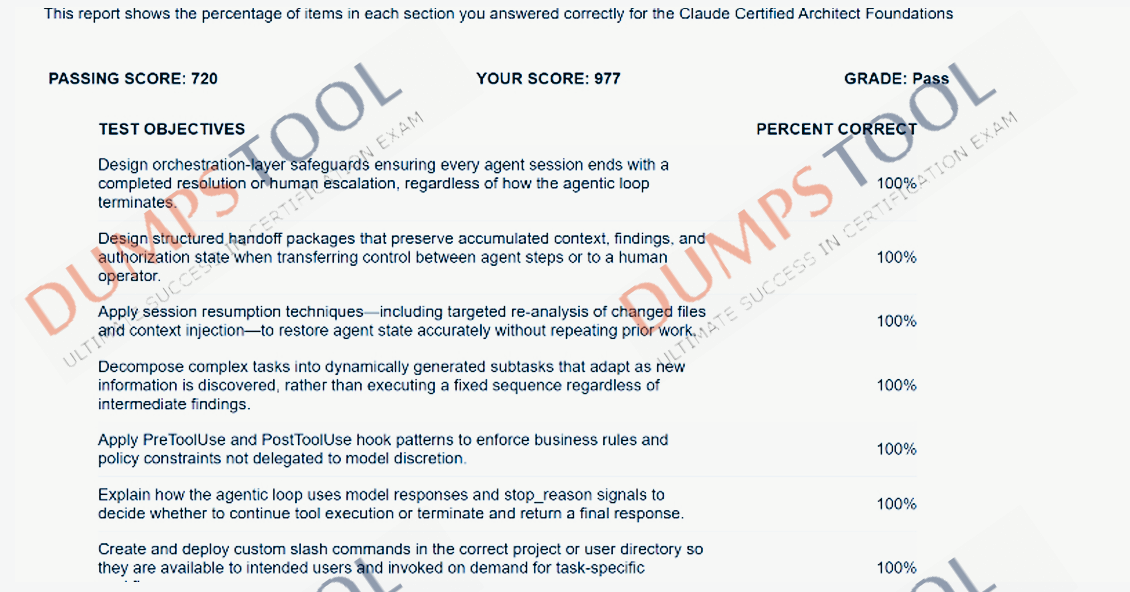
Fresh exam score sheets highlighting the real-world success rate of our platform's training.

TESTED 10 Oct 2026