Spring Sale - Special 70% Discount Offer - Ends in 0d 00h 00m 00s - Coupon code: 70dumps

ACD201 Questions and Answers

Question # 6

You're conducting a design review.

You identify slow-performing expression rules querying a specific data store, and need to understand the "number of operations against data stores."

Which metric from the data_store_details.csv file is helpful to you?

A.

Execute Count

B.

Query Count

C.

TCCCotal Count

Full Access
Question # 7

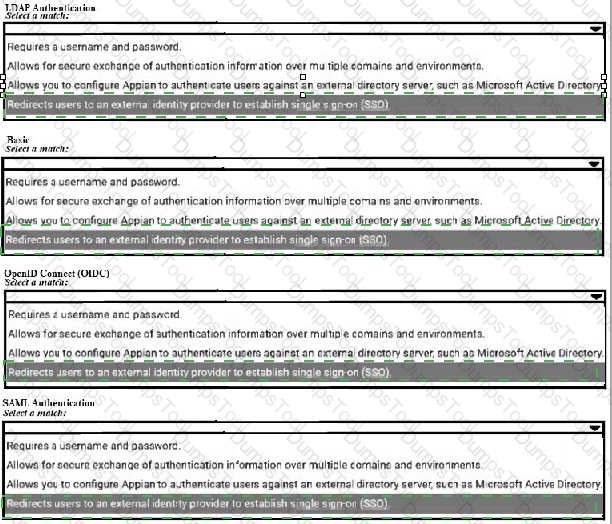
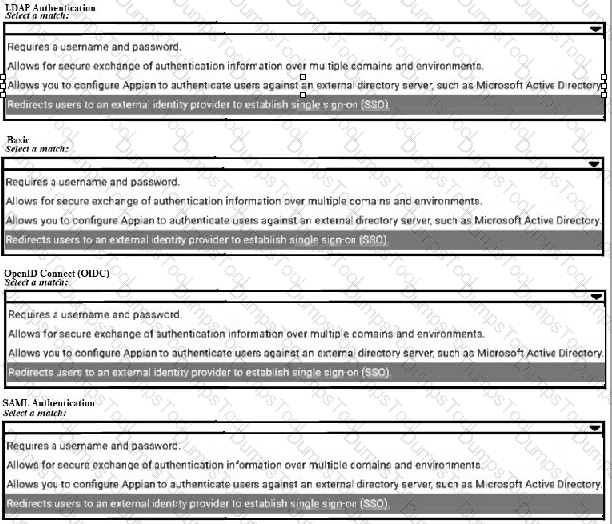
Match each authentication type to the correct authentication characteristic description.

Note: Each description will be used once. To change your responses, you may deselect your response by clicking the blank space at the top of the selection list.
Full Access
Question # 8

You're in the process of deploying a package to the client's TEST environment at the end of a sprint. This package is only relating to changes to a single application.

Which two statements best describes the practices you should follow for automated testing for expression rules either before or after deploying the package? (Choose two.)

A.

Before using Compare and Deploy, individually evaluate the test cases in the expression rules you intend to deploy. For any failed test case, adjust the expression rule so that it passes.

B.

After deploying the package, you should perform regression testing by running the Start Rule Tests (Applications) smart service to automatically run the test cases. This indicates whether there are any impacts caused by changes to the application.

C.

During Compare and Deploy, the Inspect Deployment tab automatically runs the test cases in each of the expression rules. Review these findings, and either adjust the expression rule or delete outdated test cases.

D.

After deploying the package, you should perform regression testing by running the Start Rule Tests (All) smart service to automatically run the test cases. This indicates whether there are any impacts caused by the changes across multiple applications.

Full Access
Question # 9

Your client reported that a form in the application is very slow to load.

You investigate and find a query entity which is nor performing well.

Which action should you perform to improve query performance for the query entity?

A.

Change the data source of the query entity to a view with a WHERE clause.

B.

Apply indices on all the fields referred in the query.

C.

Apply the appropriate filters and indices in both Appian and the database.

Full Access
Question # 10

Your client wants to configure user authentication using single sign-on (SSO) in their cloud environment.

Which two authentication types should you use to support this requirement? (Choose two.)

A.

PIEE user authentication

B.

LDAP authentication

C.

OpenID Connect authentication

D.

Appian authentication

Full Access
Question # 11

You're designing a process used to notify multiple users of marketing campaigns. These campaigns occur infrequently, but are sent out to the hundreds of customers that are stored in your app.

How should you best design your process model to send the emails whilst using a common email process model (CMN_SendEmail), to be most performant?

The outputs of this node are not required for the main process.

A.

Set “CMN_SendEmail” as a “Start Process” process node and select “Automatically run multiple instances of this node” for all the users that are on the mailing list.

B.

Set “CMN_SendEmair” as an asynchronous “ Subprocess" node and select "Automatically run multiple instances of this node" for all the users that are on the mailing list.

C.

Set “CMN-SendEmail” as a synchronous "Subprocess" node and select “Automatically run multiple instances of this node” for all the users that are on the mailing list.

Full Access
Question # 12

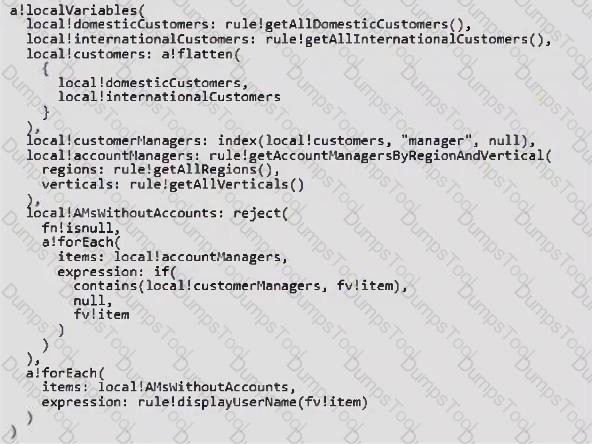
You need to write an expression to retrieve a list of all account managers who don't currently have an active customer account.

Which code snippet should you use?

A)
B)
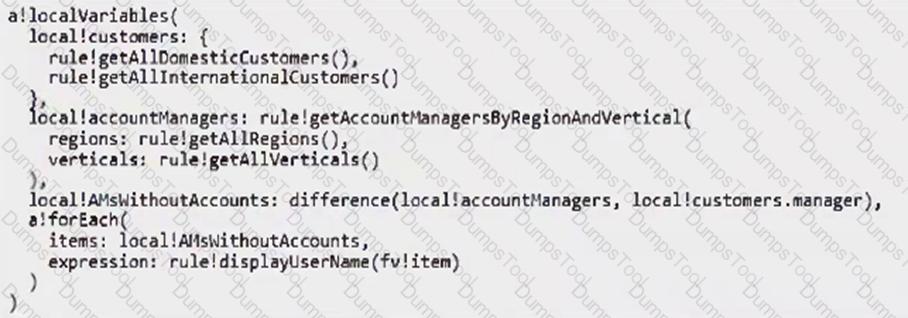
C)
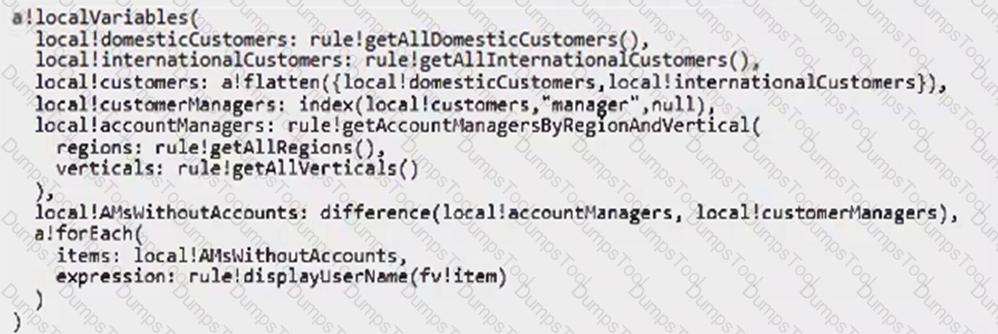
A.

Option A

B.

Option B

C.

Option C

Full Access
Question # 13

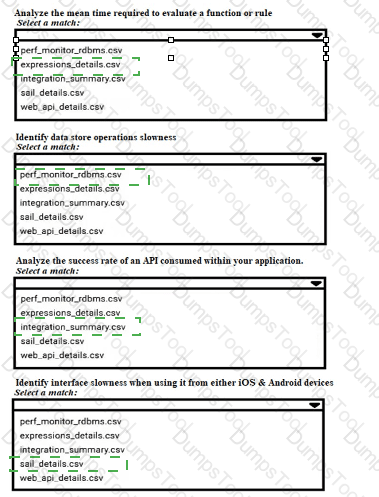
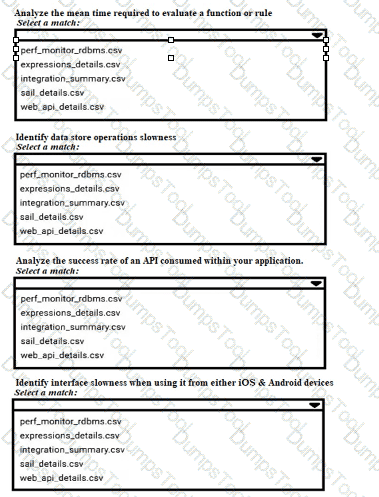
Match each action you want to perform to the appropriate log type.

Each log type will be used once or not at all. To change your responses, you may deselect your

response by clicking the blank space at the top of the selection list.
Full Access
Question # 14

You have set up SAML for single sign-on (SSO) in your cloud environment.

Which three options could you enable in the Attribute Mapping section of the Admin Console to sync with a user's profile in Appian? (Choose three.)

A.

"Create new users upon sign in."

B.

"Group Membership Synchronization."

C.

"Remember Me on web and mobile.'

D.

"Reactivate deactivated users upon sign in."

E.

"Update user attributes upon sign in."

Full Access
Question # 15

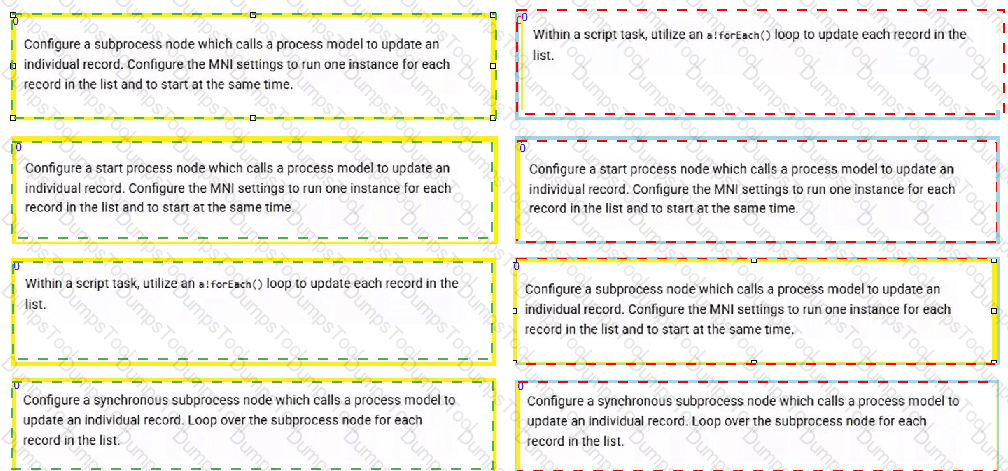
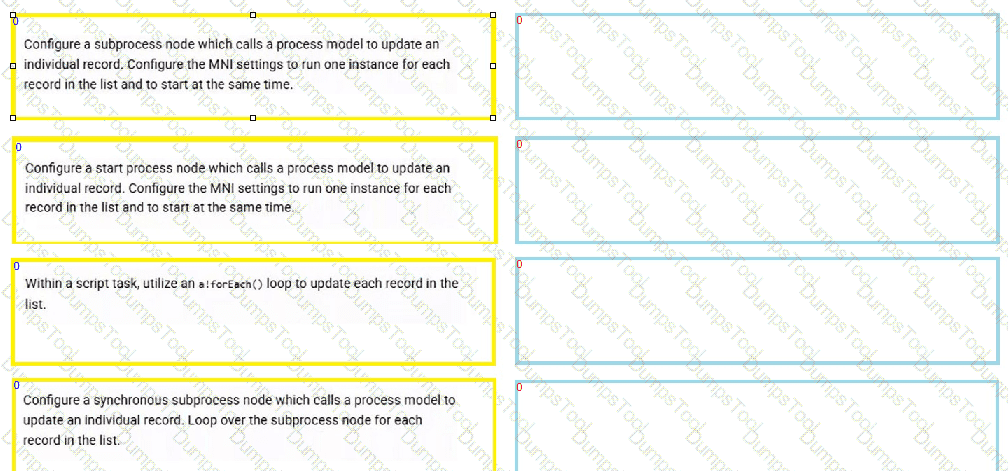
You're creating a process to update specific fields in a list of records and you save the updated records to the database.

You're given the following performance considerations:

Execution time

Process instance memory usage

Process execution engine load balancing

Based on these performance metrics, rank the options from best to worst.

Note: To answer, move all steps from the Options list to the Answer List area and arrange them in the correct ranking order (best at the top, and worst at the bottom).
Full Access
Question # 16

The synced record Task has a self-referential relationship defined in the column parentTaskId. There is a many-to-one record relationship between the id and parentTaskId called parentTask.

For a given task ID, you need to return the task name and the parent task name.

What should you do?

A.

Create a sync-time custom record field on the Task record called parentName. Specify this field to return in the query field selection.

B.

Use a!queryRecordType() with a filter on the task id, with fields specified to return recordType!Task.name and recordType!Task.parentTask.name.

C.

Use a!queryRecordType() filtered on the task id once to return the task name and parent task ID. Query the record again to return the parent task name.

Full Access
Question # 17

You're refining a story regarding a highly regulated form, where information needs to be sent to a regulatory body at the end of each month to ensure that the business complies with laws and legislation. The story only concerns the creation of the form.

You need to create a form that captures information to comply with the regulatory requirements.

Which two questions should you ask the business? (Choose two.)

A.

What information does the regulatory body require?

B.

How often is the information sent to the regulatory body?

C.

Is the information sent to the regulatory body via an integration?

D.

What is the maximum length of each field?

Full Access
Question # 18

Which two items are configured in the Admin Console when you create a web API? (Choose two.)

A.

API Key

B.

Access Control Policies

C.

Service Account

D.

LDAP Authentication

Full Access
Question # 19

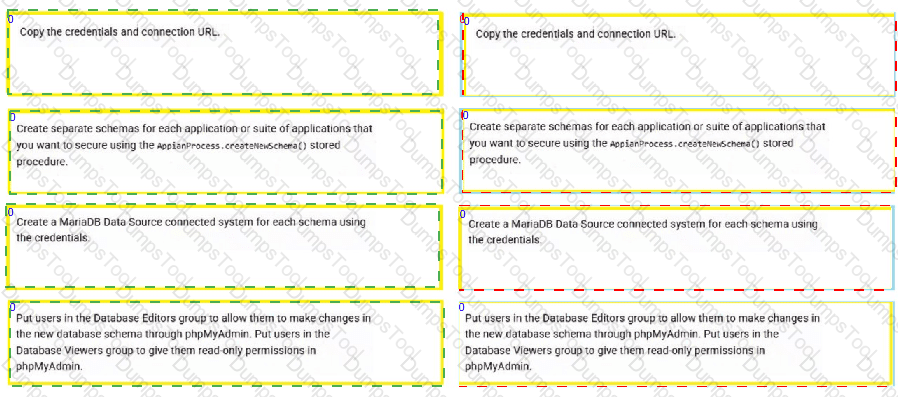
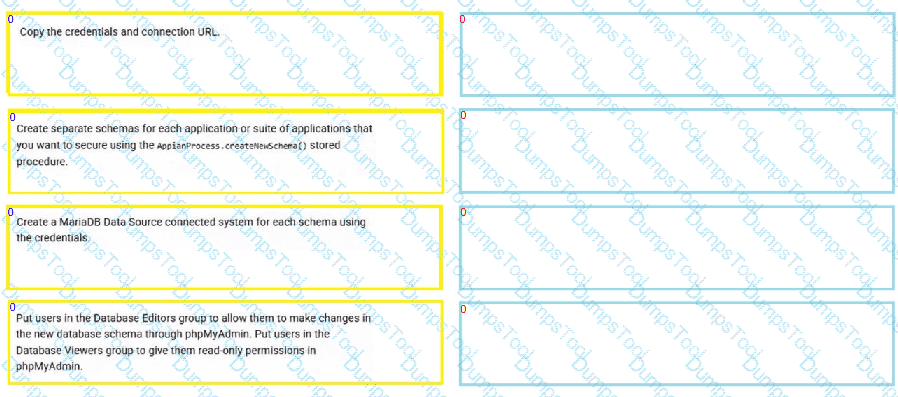
You need to create a new database schema using a connected data source system.

What should you do?

Note: To answer, move all steps from the Options list to the Answer List area and arrange them in the correct order.
Full Access
Question # 20

You need to implement a Gender dropdown, where the choice labels may need to be altered in the future. The transactional database tables rely on this data for reporting, so the data must be accurate.

What is the recommended action?

A.

Create these entries in a table and reference them through a query entity rule as per the business requirement.

B.

Create a constant and modify it as needed per the business requirement.

C.

Create an expression rule and modify it as per the business requirement.

Full Access
Question # 21

You have designed a three-step 'Wizard' form interaction using user input tasks in the process model. The second step of the Wizard must utilize another process model which contains a user input task inside.

Which two methods should be implemented for a seamless Wizard-like interaction for the user? (Choose two.)

A.

Enable activity-chaining between all nodes on the main process model.

B.

Enable activity chaining between all nodes in the second process model, and activity chain between all user input tasks.

C.

Use a subprocess to call the second process model.

D.

Use the Start Process smart service to call the second process model.

Full Access
Question # 22

A recent Health Check report of your application indicates an increased risk of large context size in the interfaces.

What are two possible contributors to this risk? (Choose two.)

A.

Data transformation is performed inside the interface rather than delegated to the source system.

B.

Multiple local variables hold duplicate data.

C.

The load variable has a web service response as JSON.

D.

Local variables are set to refresh every five minutes.

Full Access
Question # 23

An application consists of a record type with sync enabled. This record type is used as a source to create a read-only grid.

A field "Number of days since created" is configured in the interface and a logic is implemented to calculate the number of days since a record is created in the application.

You need to implement sorting on this field.

What should you do?

A.

Sorting is not possible on custom record type fields. Instead, create a view with a custom field and use the field from the view for sorting.

B.

Create a custom record type field and use it in the sorting configuration.

C.

Add sortField: "Number of days since created" configuration for the gridColumn that needs to be sorted.

Full Access
Question # 24

You need to configure Appian user authentication against an external directory server. The requirement is to use the same corporate logon information without single sign-on (SSO).

Which authentication type should you use?

A.

PIEE user authentication

B.

OpenID Connect authentication

C.

LDAP authentication

Full Access
Question # 25

What are three locations to call an Integration that changes the source data? (Choose three.)

A.

Rule

B.

Web API (GET)

C.

Process model (Call Integration Smart Service]

D.

Web API (POST, PUT, DELETE)

E.

Interface component savelnto parameter

Full Access
Question # 26

You have a requirement to implement an audit trail for any modifications to a record.

You need to select the most efficient design option that has the least impact on your Appian application.

What should you do?

A.

Create a trigger on the database table to capture the audit trail to a table

B.

Create an Appian process to capture the change history and write the audit trail to the database

C.

Create a custom plug in that can write an audit trail to a log file.

Full Access
Question # 27

You're designing a report to show the total number of cases per month grouped by region. A synced record exists for the data source.

Which design pattern is most appropriate in this case?

A.

Configure a!columnChartFieid() using a!columnChartConfig() with the case creation date as the primaryGrouping and the region as the secondaryGrouping.

B.

Use a!queryRecordType() with a!aggregationFieids() to group the case creation date by region into a local variable. Pass the local variable value into the data input of a!columnChartField()

C.

Configure a!pieChartFieid() using a!pieChartConfig() with the case creation date as the primaryGrouping and the region as the secondaryGrouping.

Full Access
Question # 28

You're developing a user input form for a financial services application.

One component of this form requires you to embed an external site (in the form of a URL) that can receive inputs from Appian and return updates as the user interacts with it.

What should you do?

A.

Use an integration to achieve interaction with the embedded site while displaying information in the Appian out-of-the-box Web Content Component. That way you can refresh for updates and interact with the site.

B.

Use the Appian out-of-the-box Web Content Component. It can display content from a URL and provide both additional inputs, or receive updates as the user interacts with the embedded site.

C.

Use a component plug-in to achieve interaction with the embedded site, because this use case requires input-output or event parameters.

Full Access
Question # 29

You’re designing a file upload process that integrates with an external document management system.

Part of this process is to develop a start form with a file upload component, so that the user can upload multiple files.

The business has requested that the maximum file size that can be uploaded through this process is 1GB. Additionally, you’re aware that the integration's API can accept files with a maximum file size of 3GB, but recommends no larger than 1GB.

Can the process be more performant without straining the application or integration?

A.

Yes. Request the business allows for these files to be uploaded as an overnight process by storing large files in a staging table, so that adequate resources are available.

B.

No. The file upload component is capable of accepting 1 GB files and the integration can handle this.

C.

Yes. Request the business reconsiders its requirements and find manual workarounds as it is not recommended to upload files of this size in both Appian and the integration.

Full Access
Question # 30

You're creating a new entity-backed record type without data sync enabled. Users in the "ACME Supervisors" group must be able to access the Delete Case related action on the record summary view.

What are two valid steps that you should perform to grant users the appropriate access?

A.

Grant Viewer permissions to the underlying interface object for the Summary view.

B.

Add the "ACME Supervisors" group as a member of the "Database Editors" group and grant DELETE privileges.

C.

Update the record action security for "Delete Case" and include the "ACME Supervisors" group within the visibility settings.

D.

Add the "ACME Supervisors" group as a Viewer to the data store mapped to the record.

Full Access
Question # 31

You're creating a point-of-sale (POS) system for a customer which can associate the items in a transaction to a customer based on a membership number. The item stock table and the customer sales record are hosted elsewhere and need to be written to via POST APIs from an Appian process model. This all occurs within a transaction process model that you're creating.

Which two steps should you perform to design your process model to improve process memory? (Choose two.)

A.

Ensure that the entire process is activity-chained so that the person entering the transaction knows when the process is completed.

B.

Create the two POST APIs as asynchronous subprocesses.

C.

Create the two POST APIs as synchronous subprocesses.

D.

Add a terminate process node to the end of the process.

Full Access