
Spring Sale - Special 70% Discount Offer - Ends in 0d 00h 00m 00s - Coupon code: 70dumps

CPHRM Questions and Answers

Question # 6

Which of the following is a program of the Food and Drug Administration FDA post market surveillance system for medical devices that requires healthcare facilities to report patient deaths or injuries related to a medical device?

A.

Safe Medical Devices Act SMDA

B.

Emergency Medical Treatment and Active Labor Act EMTALA

C.

Occupational Safety and Health Act of 1970 OSHA

D.

Patient Safety Organization PSO

Full Access
Question # 7

Root Cause Analyses most often reveal that mistakes are a result of:

A.

A series of small events and system flaws aligning

B.

A single reckless person in most cases

C.

Random chance with no patterns

D.

Only equipment malfunction

Full Access
Question # 8

Which of the following are common techniques used to include patients and families in programs to educate patients about their safety?

    lay persons on select committees

    patient education opportunities

    patient events referred for peer review

    event reporting by patients and families

A.

1, 2, and 3 only

B.

1, 2, and 4 only

C.

1, 3, and 4 only

D.

2, 3, and 4 only

Full Access
Question # 9

What is one advantage of avoluntaryerror reporting system over amandatoryerror reporting system?

A.

Voluntary systems guarantee legal privilege in all states

B.

Voluntary systems typically elicit more frontline reports and near-misses

C.

Voluntary systems eliminate the need for root cause analysis

D.

Voluntary systems replace peer review and credentialing

Full Access
Question # 10

Which type of information was associated with the former HIPDB (now within NPDB) but not the original NPDB focus?

A.

Fraud/abuse-related actions and exclusions involving providers/suppliers (HIPDB purpose)

B.

Restaurant health inspections

C.

Public voter registration files

D.

School disciplinary actions

Full Access
Question # 11

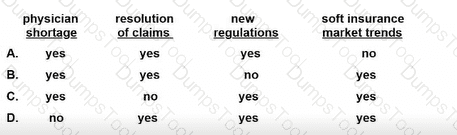
In enterprise risk management, which of the following are external factors that may affect risk?
A.

Option A

B.

Option B

C.

Option C

D.

Option D

Full Access
Question # 12

An interrogatory requests insurance policy information. A risk manager should

A.

provide the specifically requested information.

B.

provide excess limits as well as primary limits.

C.

attach a certificate of insurance.

D.

object to the interrogatory.

Full Access
Question # 13

Generally, an incident is defined as:

A.

Any happening not consistent with routine care/operations (including near-misses)

B.

Only events that cause death

C.

Only patient complaints

D.

Only billing disputes

Full Access
Question # 14

When an FDA inspector comes to a facility, the risk manager should:

A.

Accompany the inspector and verify credentials

B.

Deny entry automatically

C.

Tell staff to hide documents

D.

Send the inspector to public relations only

Full Access
Question # 15

The due diligence process in acquisitions is undertaken to:

A.

Reduce unanticipated costs and risks; support valuation and post-acquisition performance

B.

Hide liabilities

C.

Avoid reviewing contracts

D.

Remove compliance requirements

Full Access
Question # 16

According to The Joint Commission, which of the following should be done to patient-owned electrical devices entering the facility?

A.

inventory with patient belongings

B.

sequester the electrical device

C.

conduct an electrical safety inspection

D.

tag by biomedical engineering

Full Access
Question # 17

What factors are included in a calculation of Risk Priority Number (RPN) in FMEA?

A.

Severity, occurrence (probability), detection

B.

Cost, staff satisfaction, marketing risk

C.

Legal privilege, media attention, reputation

D.

Insurance premiums, deductibles, coinsurance

Full Access
Question # 18

Which of the following wouldnotbe considered an emergency condition for EMTALA purposes (as a general example set)?

A.

Myocardial infarction

B.

Ruptured appendix

C.

Active labor with complications

D.

Stable chronic kidney failure without acute destabilization

Full Access
Question # 19

What is the voluntary relinquishment by the insurer or self-insurer of the right to recover from a third party?

A.

Waiver of subrogation

B.

Coinsurance

C.

Underwriting

D.

Experience rating

Full Access
Question # 20

For a liability claim to succeed, the claimant must establish duty owed, duty breached, proximate cause, and

A.

contributory negligence.

B.

injury sustained.

C.

punitive damages.

D.

gross negligence.

Full Access
Question # 21

Per The Joint Commission and CMS patient visitation standards, a hospital may restrict an individual's ability to visit a patient if the visitor

A.

is not the patient's immediate family member.

B.

is known to be a drug seeker in the community.

C.

administered the patient an unknown drug via IV.

D.

is not the patient's designated healthcare surrogate.

Full Access
Question # 22

What is the difference between a deductible and a self-insured retention?

A.

A deductible is subtracted from any amounts paid by a commercial carrier.

B.

A deductible has to be paid before coverage is available.

C.

A self-insured retention is paid from operational fund.

D.

A self-insured retention pays after carrier limits are exhausted.

Full Access
Question # 23

The Joint Commission requires that after a healthcare organization becomes aware of a sentinel event, it must complete a root cause analysis and action plan within how many days?

A.

30

B.

45

C.

60

D.

75

Full Access
Question # 24

A hospital's Ethics Committee is seeking advice on a case involving the elective sterilization of an adolescent patient who is developmentally disabled. One of the parents is refusing consent. The risk manager should evaluate which of the following?

    who has consent authority

    competency level of the patient

    diagnosis of the patient

    state statutes and laws

A.

1, 2, and 3 only

B.

1, 2, and 4 only

C.

1, 3, and 4 only

D.

2, 3, and 4 only

Full Access
Question # 25

When considering the proper insurance to purchase for an organization and its practitioners, a risk manager should understand which of the following about specific types of coverage?

A.

Occurrence coverage provides coverage for incidents that occur prior to initiation date of the policy as long as the event is reported to the insurer before signing.

B.

Occurrence coverage provides coverage for incidents that occur while the policy is in effect.

C.

With claims-made coverage, the retroactive date does not impact the coverage of the insured.

D.

With claims-made coverage, the nose period has no significance to the coverage of the insured.

Full Access
Question # 26

Which of the following isnotone of the patient rights enumerated in the Patient Self-Determination Act (PSDA)?

A.

The right to receive information about advance directives

B.

The right to participate in decisions about medical care

C.

The right to refuse treatment through an advance directive (where applicable)

D.

The right to select any medication the patient wants

Full Access
Question # 27

What group reports information (historically HIPDB content; now within NPDB) related to fraud/abuse oversight?

A.

Peer review organizations (for certain state/federal reporting categories)

B.

Any patient advocacy blog

C.

Restaurant inspectors

D.

School boards

Full Access
Question # 28

People make fewer errors when:

A.

Staff work as a coordinated team with shared communication tools

B.

Individuals work alone to avoid distraction

C.

Speed is prioritized over verification

D.

Errors are hidden to protect reputations

Full Access
Question # 29

What are risk treatment strategies?

A.

Risk avoidance, risk retention, risk transfer (and risk reduction/mitigation)

B.

Public relations, branding, advertising

C.

Litigation, denial, delay

D.

Staff vacation scheduling

Full Access
Question # 30

All of the following are valid reasons for performing risk management review of policies and procedures EXCEPT

A.

ensuring consistency between practice and policy.

B.

identifying potential risk exposures.

C.

monitoring compliance with standards.

D.

maintaining staff competency.

Full Access
Question # 31

An organization's chief of orthopedics has scheduled an implant of a new artificial hip for the next day. The chief developed the artificial hip while working as a consultant for a medical device company. The device has not yet been approved by the FDA or the Institutional Review Board. The risk manager's best immediate course of action is to

A.

contact the FDA to clarify the status of the device.

B.

verify the informed consent for the procedure.

C.

call a special meeting of the Institutional Review Board.

D.

call the chief of surgery to discuss canceling the procedure.

Full Access
Question # 32

When a hospital notes that most errors are occurring at the “sharp end,” what does that mean?

A.

Errors are occurring in billing and contracting

B.

Errors occur during direct caregiver–patient interaction (frontline care)

C.

Errors occur only in device manufacturing

D.

Errors are exclusively leadership decisions

Full Access
Question # 33

All of the following are examples of an adverse drug event EXCEPT

A.

administration of a drug by the wrong route.

B.

a drug reaction experienced by the patient.

C.

controlled substance inventory discrepancy.

D.

an error in ordering or dispensing a drug.

Full Access
Question # 34

A healthcare entity has a large fleet of vehicles driven by employees. What is the minimum required documentation the entity should obtain for each driver on an annual basis?

A.

mileage log

B.

driving record

C.

driver training

D.

proof of insurance

Full Access
Question # 35

Who are most likelynotto report errors in typical incident reporting systems?

A.

Physicians (compared with nurses/other staff)

B.

Pharmacists

C.

Quality officers

D.

Risk managers

Full Access