dumpstool logo

You are performing system integration testing to verify that two systems can exchange data properly. What type of testing are you performing?
Which of the following BEST demonstrates a test analyst’s contribution to flexibility testing?
Your project is developing an application to generate quotes for motor insurance. The calculation requires a wide range of input data and a reliable model of it has been built in a spreadsheet. There will not be enough time to get adequate functional correctness coverage from the base choice or pairwise techniques, so you have decided to do some random testing based on a probability distribution of variable values that is weighted towards their business criticality.
Which limitation of random testing should you be MOST concerned about?
A pricing system for determining the postage cost of a company’s letters examines two input variables, representing the length (L) of the envelope in centimeters and the weight (W) of the letter in grams. Envelopes can only have three lengths, 15cm (Small), 20cm (Standard) and 25cm (Large).
For standard length envelopes (20 cm), a premium postage rate is applied if the weight is equal or greater than 50 grams. This is represented as:
IF L = 20 AND W > 50 then RETURN Cost ‘Premium rate’
Which set of test points (each represented as variables L, W) achieves 100% SIMPLIFIED domain coverage for the Standard letter postage cost domain?
You are a TA in the development of a road traffic control application, which will be installed at busy road junctions, to control the operation of traffic signal lights according to sensors that detect traffic volume. This safety-critical project is still in the early stages of test planning and the project schedule is tight.
The Test Manager has asked you if crowd testing should be included in the project’s test strategy. You do NOT think it should. Which limitation of crowd testing MOST influences your view?
You are applying reliable coverage for domain testing. The software checks students’ exam scores, specifically identifying anyone who scored below 100 (whole numbers only).
Which of the following value sets for x must be tested to achieve 100% reliable coverage?
You intend to test a computer game across various configurations. A configuration consists of:
operating system (2 possible values: Windows 10, Windows 11)
browser (4 possible values: Edge, Chrome, Firefox, Opera)
RAM type (4 possible values: 8 GB, 16 GB, 32 GB, 64 GB)
Market research indicates that 90% of gamers use the same configuration: Windows 11, Chrome, 32 GB.
You apply combinatorial testing with base choice coverage.
What is the MINIMUM number of configurations that must be tested to achieve 100% base choice coverage?
You are testing a program which should calculate the area of a trapezium and have decided to use metamorphic testing. The formula
Area = (((a + b) / 2) * h)
where a and b are the lengths of the two parallel sides, and h is the height when the parallel sides are horizontal.
Which ONE of the following would be an appropriate metamorphic relation?
As a test analyst, you have been asked to perform a role-based usability review of the electronic banking system’s user interface. The interface enables the user to select a language from English, Spanish, or Italian. The system is protected by a multi-factor authentication mechanism. After logging in, the user can manage their loans.
During the review, you assume the role described by the following persona:
Name: Maria Rossi
Age: 64
Occupation: Retired Italian language teacher
Knowledge of technology: Basic; she is afraid of technology
Hardware: Windows laptop, Android phone
Place of residence: Rome, Italy
Language skills: Italian (native), Spanish (basic)
What could MOST likely be reported during this review?
You are conducting a system test of an airline’s flight reservation system and have written a series of test conditions to address the following requirement specification:
• RS-BK14 - Upon successful processing of payment for a new flight booking, the system shall complete the process by displaying a message notifying the customer that the booking reservation has been applied, appended by the booking reference number and, where applicable, the pre-paid seat numbers.
Which test condition is an example of functional appropriateness testing for this requirement?
Below is a state transition diagram modelling the behaviour of the component that verifies whether the PIN entered by the user is correct. The system starts operating in the “Welcome screen” state and finishes in the “End” state.
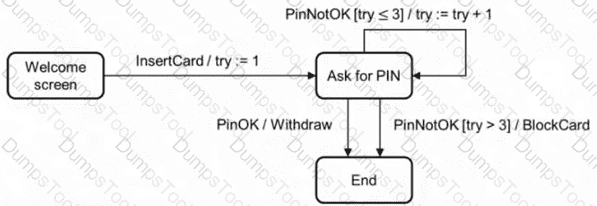
The system should permit three attempts to enter the PIN. If the user enters the correct PIN on any of these attempts, the system performs a withdrawal and ends the operation. If the third attempt is incorrect, the system blocks the card and ends the operation. As a test analyst, you review this diagram for potential defects that could be introduced into the system created from this model.
What should be the conclusion of your analysis?
You are working on a project to build a purchasing system. The main requirements for the system are that it shall:
1. Allow users to enter details of items that they wish to have purchased and, from these details, create a purchase request.
2. Take each purchase request through a workflow that will allow the requestor’s line manager to approve the request, reject it or return it for clarification / modification.
3. Forward approved requests to the Purchasing Department.
4. Allow purchasers to find the best available supplier for each approved request and place the request on that supplier as a purchase order.
The solution is being developed according to the company’s traditional V-model methodology. The requirements are clearly documented and include a business process model.
System testing has finished and the test manager has asked you, the senior TA, to identify any parts of the product that should be focused on during acceptance testing. The results of this may be used to adjust the acceptance test plan.
You are using defect cluster analysis, only counting defects with severity levels 1 to 3, ignoring low severity levels 4 and 5. Function point analysis was used for estimating, so you have used function points as the unit of size for the various functional areas of the product. No numeric estimates of expected defect quantities were made for them individually but, as a result of product risk analysis, these functional areas have been ranked according to the amount of product risk that was predicted in them, with risk ranking 1 being the highest and 5 the lowest; the thoroughness of the testing performed so far has been proportional to that. The results are presented in the table below.
Functional area
Total function points
Product risk ranking
Defects found
Purchase Request entry
2000
2
30
Purchase Request workflow
1500
4
15
Purchase Request authorisation
1000
5
25
Supplier identification
2000
1
30
Purchase Order creation
1000
3
30
Which functional areas would you recommend for more test focus in acceptance testing?
a) Purchase Request entry
b) Purchase Request workflow
c) Purchase Request authorization
d) Supplier Identification
e) Purchase Order creation
You are working on a project to replace an old sales and merchandising system with a new system that will be based on modern platforms. The old system is still in production but is poorly documented and expensive to maintain. The new version will be developed using modern technology. The main requirements for the system are that it shall:
1. Load sales data, sent electronically from the stores each evening, into a central database.
2. Produce actual sales reports for the merchandisers, whose job is to manage stock levels in stores.
3. Produce sales forecast reports based on a combination of sales history and forecasting parameters. The parameters will be entered by the merchandisers into a browser-based front end and the reports will be produced overnight. The users will be able to see the reports next day, on screen or in print, by requesting this through the browser.
Requirements 1 and 2 are satisfied by the existing system and will be rewritten with no significant functional changes. Requirement 3 is new and has been clearly specified.
Because of the poor test basis you have decided to perform experience-based functional correctness testing for requirements 1 and 2 with the support of checklists. Which would be the BEST items to include in the checklist for testing Requirement 2?
a) Does the sales quantity in the database for any one product in a particular store, equal the sales data input for that product / store?
b) Does the total sales value in the report for all products in a particular store, equal the sales data input for that store?
c) Does the sales quantity in the report for any one product in a particular store, equal the sales data input for that product / store?
d) Does successful login allow access to the report parameter entry features?
e) Does the total sales value in the database for all products in a particular store, equal the sales data input for that store?
You are testing the functional correctness of an application which allows the driver of a car to control if the air that enters the passenger compartment is fresh or recycled. The car may be ordered in various configurations:
• Engine Size (can be: 1500cc, 1900cc, 2200cc, 2500cc)
• Gearbox type (can be: automatic, manual 5-speed, manual 6-speed)
• Cruise control (can be: yes or no)
• Electric sunroof (can be: yes or no)
It is expected that the most popular configuration will have a 1900cc engine and a manual 5-speed gearbox with cruise control and no electric sunroof. In order to achieve full BASE CHOICE coverage, how many configurations must be tested?
Which activity is an example of FUNCTIONAL CORRECTNESS testing for a food-ordering app?
You are working on a project to build a purchasing system. The main requirements for the system are that it shall:
1. Allow users to enter details of items that they wish to have purchased and, from these details, create a purchase request.
2. Take each purchase request through a workflow that will allow the requestor’s line manager to approve the request, reject it or return it for clarification / modification.
3. Forward approved requests to the Purchasing Department.
4. Allow purchasers to find the best available supplier for each approved request and place the request on that supplier as a purchase order.
The solution is being developed according to the company ' s traditional V-model methodology. The requirements are clearly documented and include a business process model.
The main release has now been live for three months and you are working on the first maintenance release. The test manager has asked you, the senior TA, to identify those parts of the test process which were most and least effective at finding defects in the main release.
You have collected statistics for the independent test activities, i.e. excluding developers’ testing, including only the 178 defects in the three highest of your five defect severity levels. The results are presented in the table below:
Phase of defect Introduction
Test analysis, including requirements review
Test design, including solution design review
System testing
Acceptance testing
Live operation 1st 3 months
Total quantity of defects introduced
Requirements
13
12
20
10
10
65
Solution design
28
5
5
10
48
Implementation
50
10
5
65
Total quantity of defects found
13
40
75
25
25
178
Assume that all defects not found at the first opportunity could have been, e.g. that all defects that escaped into acceptance testing were within the scope and objectives of system testing. By applying Defect detection percentage (DDP) analysis, which test activity was LEAST effective?
A Customer Relationship Management (CRM) system will be developed for a company that runs a chain of hotels. These are some of the requirements relating to staff in the call center.
• R1. High. An operator shall be able to find and see the details of a customer’s booking. The data that may be used for the search include customer name, customer registration number (in the company’s loyalty enrolment scheme) and booking reference.
• R2. High. An operator shall be able to amend a customer’s booking. The data that may be amended include check-in and check-out dates, hotel, room type and tariff (with / without breakfast).
• R3. High. Before a booking amendment is accepted, the system shall display to the operator any difference in price with respect to the original booking. The operator shall confirm that the customer accepts the revised price and then the system shall record the accepted amendment.
• R4. Medium. Details of the amended booking shall be sent to the customer (see requirements for original customer booking for details).
• R5. High. Details of the extra amount payable shall be sent to the billing system for customer invoicing (see requirements for invoicing of the original customer booking for details).
You have been asked to review these requirements using this checklist:
1. Specific - does each requirement deal with only a single aspect of the solution?
2. Clear - is each requirement expressed in an unambiguous way with no possibility of interpretation or uncertainty about its meaning?
3. Complete - does the set of requirements cover all of the stakeholders’ reasonable needs?
4. Unique - does each requirement address something that no other requirement also covers?
Assume that the other requirements referred to by R4 and R5 have been reviewed with a satisfactory outcome. Considering these five requirements, to which checklist items would you answer ‘No’?
You are testing an ATM application. The existing solution has been in production for several years, and it always required users to return to the menu between transaction types. A new requirement has just been introduced allowing users to go directly from Deposit to Withdraw. You have found the following state diagram in the requirements documentation:
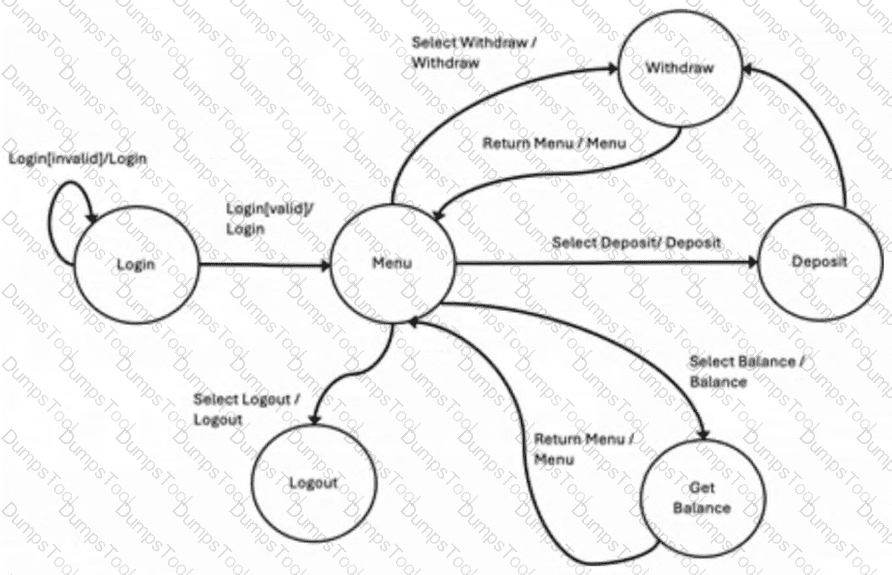
Given this change in requirements, there is an error in the diagram that could lead to an incorrect implementation of the software. What is that error?
Your organization is implementing a food-ordering application that is intended to have an intuitive user interface (easy navigation and fast search) and to offer functions such as:
personalization of the order (the ability to modify ingredients and add comments for the restaurant)
verification of order correctness before it is sent
real-time order tracking
viewing order history
Management has decided to test the requirements listed above with a checklist and has asked you to prepare one. Consider the following four checklists.
Checklist 1 -
[ ] Does the system reject an order with an incorrect zip code?
[ ] Does the system reject an order with an unfilled mandatory field?
Checklist 2 -
The interface allows the user to easily navigate the application (YES / NO / PARTIALLY)
The search function allows the user to quickly search for restaurants (YES / NO / PARTIALLY)
Checklist 3 -
[ ] Is the time from order placement to order confirmation less than 10s?
[ ] Is the user interface free of grammatical errors?
Checklist 4 -
The application works properly on the Android operating system (YES / NO)
The application works properly on the iOS operating system (YES / NO)
Which of the following is an example of a read-do checklist that is useful for testing the application described in the scenario?
Which of the following is an activity that a Test Analyst should perform as part of Risk Identification?
You are defining key words to test an application which will create a Purchase Request (PR) from details of goods that a Merchandiser wants their organization to buy. When valid details have been entered, the resulting PR will be sent to the Merchandise Manager for authorization.
You have a diagram in Business Process Modeling Notation and this section shows the initial steps in this process:
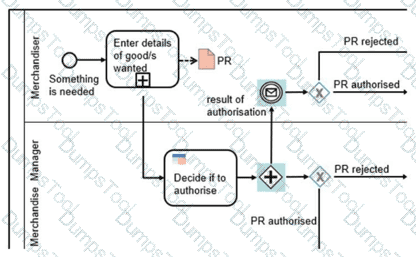
• The process starts when Something is needed.
• The Merchandiser performs the action Enter details of goods wanted.
• This creates a PR.
• The process then continues toward the Merchandise Manager, who will Decide if to authorise the PR.
• The PR may then be authorised or rejected.
For the first process, when “Something is needed”, which option contains the MOST appropriate keywords for action and verification?
Your regression test suite contains five test cases, TC1–TC5. They cover use-case scenarios UC1–UC10 as follows:
TC1 covers UC1, UC2, UC3, UC4, UC5, UC6, UC7, UC8
TC2 covers UC7, UC8
TC3 covers UC2, UC4, UC6, UC7
TC4 covers UC10
TC5 covers UC5, UC8, UC9
The system has three components: C1, C2, and C3.
C1 implements UC1, UC2, UC3, and UC4.
C2 implements UC5, UC6, and UC7.
C3 implements UC8, UC9, and UC10.
The latest project iteration refactored component C3. Your organization follows a scenario-coverage-based regression test-selection strategy.
Because of time constraints, only two regression tests can be run. Which TWO test cases should be executed?
Choose two
Your organization has been conducting detailed requirements reviews, but a problem has emerged: the author of the requirements becomes defensive during these reviews. On a couple of occasions, the author felt personally targeted and left the meeting very upset.
What type of review could you implement to help de-personalize the reviews?
A credit risk scoring system accepts two integer inputs, L and E, representing credit scores calculated by two independent systems. The system assesses credit risk using the following business logic:
IF L > = 50 OR E > = 50 THEN the risk is high
IF L < = 49 AND E < = 49 THEN the risk is low
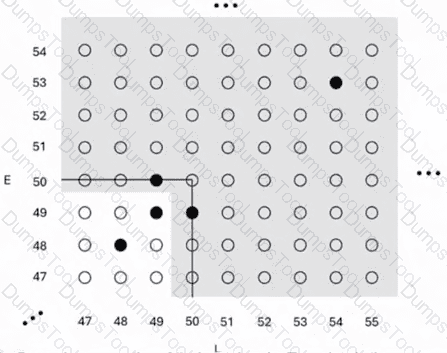
The figure displays a section of the input domain. Points in the gray area are part of the “high risk” equivalence partition, and points outside it are part of the “low risk” equivalence partition. The lines indicate the closed boundary of the “high risk” equivalence partition.
You use domain-based testing to verify the correct implementation of the above requirement. The test set contains the five black points in the figure: (L=48, E=48), (L=49, E=49), (L=49, E=50), (L=50, E=49), and (L=54, E=53).
What level of RELIABLE domain coverage does this set of test points achieve?
Which of the following is a way to ensure your synthetic data is reflective of production data?
Your root cause analysis has revealed that most of the defects found in production occurred in areas of the system that received little or no testing. These areas had been treated as low priority by the testing team because there was no expectation that they would ever change. Further investigation showed that these areas actually were changed by developers while they were implementing features in other parts of the system and fixing other defects.
What action can you take to help prevent this situation from recurring in the future?
Your organization has been conducting requirements reviews. Participation has been good, but many participants tend to report the same defects. You are concerned that some parts of the requirements are receiving good review coverage while other parts are being missed. Which of the following is a good way to broaden the viewpoints of the reviewers?
As an experienced Test Analyst, you have been asked to collaborate in usability test sessions for a new shopping cart application. In which way would you BEST contribute to this activity?
Consider the following use case steps that make up the main scenario for an airline check-in application:
1. Login
2. Select flight
3. Select Passenger
4. Confirm check-in
5. Request boarding pass
6. Print boarding pass
7. Select to check-in luggage
8. Print luggage tags
9. Exit
You need to create extension and exception sequences based on this main scenario. Which of the following is a valid extension from this scenario?
You are developing test cases for an application which performs complex calculations and have decided to model these calculations on a spreadsheet, to determine expected results from inputs.
Which solution to the test oracle problem BEST describes the approach you are using?

TESTED 28 Nov 2026