dumpstool logo

An administrator is troubleshooting BGP flapping in a VMware Cloud Foundation (VCF) 9 environment. A Tier-0 Gateway is running in Active/Active mode with two Edge nodes. BFD is enabled on the eBGP sessions to the upstream routers. Each Edge node uses its own uplink IP for BGP. After some network maintenance, one BGP session starts flapping every few minutes. The other BGP sessions stay stable. On the affected Edge node, the command get bfd-sessions shows:
• State: Down
• Diag: Detect Time Expired
Symptoms:
• The upstream router also shows the BFD session as Down with control Detection Time Expired.
• There are no interface errors, no packet loss for normal traffic, and clearing the BFD session temporarily brings it back up - but it flaps again after few minutes.
What is the root cause?
During a design review, the administrator is asked to explain which underlying technology enables the NSX Edge to perform fast packet processing and achieve near line-rate performance for Virtual Network Functions (VNFs). Which technology is leveraged in the NSX Edge for fast packet processing?
An administrator is troubleshooting intermittent connectivity failures between two workloads connected to NSX VLAN segments using Traceflow. In-band Network Telemetry (INT) has been enabled in the NSX Global Configuration. How does Traceflow identify issues in a VLAN network?
An administrator has deployed a new VMware Cloud Foundation (VCF) management domain. To be compliant with company policy, backups must be configured to occur anytime a change is made to the NSX configuration. How can the administrator ensure that complete configuration backups are captured every time a change occurs?
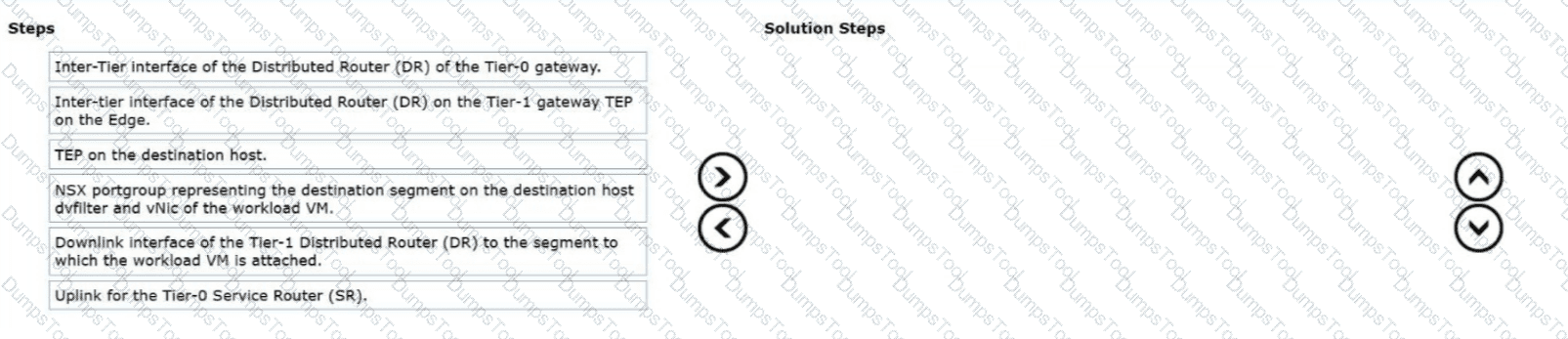
An administrator is responsible for a VMware Cloud Foundation (VCF) Private Cloud. The administrator has been tasked with identifying why there is no data ingress into a
workload domain.
The workload domain has been configured with:
. A dedicated NSX Edge Cluster.
. A Tier 0 gateway.
. A Tier-1 gateway that is configured for Distributed Routing only.
. An NSX segment where a test virtual machine is located.
As part of the exercise, the administrator must map the traffic flow for data ingress into the workload domain to identify the steps that external network traffic will take to
ingress into the workload domain and reach the virtual machine.
Drag and drop the six steps from the Steps list on the right and place them in order in the Solution Steps. (Choose six.)
An administrator needs to prevent the datacenter from advertising any internal prefixes toward a new VPC, while still ensuring the VPC receives a default route learned from the datacenter's upstream network. Where should the routing policy be applied?
An administrator has a vSphere 8 Update 1a with NSX 4.1.0.2 environment. What option can the administrator use to converge this vSphere with NSX environment into a VMware Cloud Foundation (VCF) Workload Domain?
An administrator is upgrading an existing VMware Cloud Foundation (VCF) environment. An NSX Edge Cluster is required to support north-south traffic for a workload domain. How would the administrator initiate the edge cluster deployment?
When attempting to deploy or expand an edge cluster from an administrator encounters a failure: "Failed to validate the BGP Route Distribution". Prior to calling support, the administrator attempts to troubleshoot the issue. How should the administrator troubleshoot this issue?
An administrator is configuring NSX resource sharing to allow shared access to multiple resources in the default space.
By default, which user role owns the shared resources for the default space?
Which two statements describe the recommended strategy for configuring and synchronizing security policies across Federated NSX sites? (Choose two.)
An administrator is preparing to deploy a new workload domain that will host vSphere Kubernetes Service (VKS) clusters. Before configuring the network for the Kubernetes clusters, the administrator needs to create a Tier-0 Gateway to handle North/South connectivity. What is the requirement for creating a Tier-0 Gateway for use with a workload domain that is running the vSphere Kubernetes service (VKS) with VPC?
An administrator has deployed a workload domain in VMware Cloud Foundation (VCF). The workload domain was deployed with NSX managers using the XL form factor. After deployment, the administrator realizes the NSX manager is oversized and needs to change to a smaller form factor. What should the administrator do to accomplish this task?

TESTED 08 Oct 2026