Pre-Summer Sale - Special 70% Discount Offer - Ends in 0d 00h 00m 00s - Coupon code: 70dumps

3V0-24.25 Questions and Answers

Question # 6

A VKS administrator is tasked to leverage day-2 controls to monitor, scale, and optimize Kubernetes clusters across multiple operating systems and workload characteristics.

What two steps should the administrator take? (Choose two.)

A.

Configure namespace quotas to set resource limits for CPU, memory, and storage.

B.

Disable Cluster Autoscaler to ensure resources in the pool are not depleted.

C.

Deploy Prometheus and Grafana to collect and display scrapeable metrics on nodes, pods, and applications.

D.

Set all VM Class limits to Compute Heavy to ensure worker nodes get all the resources needed.

E.

Ensure all node pools use the same Machine Deployment configuration for different workload characteristics.

Full Access
Question # 7

An administrator is maintaining several Kubernetes clusters deployed through a Supervisor Namespace in a vSphere Kubernetes Service environment. One of the micro-services (a containerized API gateway) is failing intermittently after a recent configuration update. The pod is entering aCrashLoopBackOffstate. The administrator needs to collect detailed runtime information directly from the pod, including both thestandard output (STDOUT)andstandard error (STDERR)streams, to analyze the application ' s behavior before the crash.

Which command produces the required output?

A.

kubectl describe

B.

kubectl get all

C.

kubectl events

D.

kubectl logs

Full Access
Question # 8

An administrator is building a secure, multi-tenant container registry strategy for their vSphere Kubernetes Services deployment running on VMware Cloud Foundation. Each workload domain hosts a Supervisor Cluster, and multiple development teams require private repositories to store and distribute container images for Kubernetes clusters. The organization enforces strict image security posture due to compliance requirements. The operations team deploys Harbor as an add-on service through the Supervisor control plane, and developers push/pull images from Harbor through Kubernetes manifests.

What requirement describes the role and purpose of Harbor?

A.

Harbor, formerly known as Bitnami, is an image catalog used for downloading verified open-source packages.

B.

Harbor is an image scanner used to verify that images are free from known vulnerabilities and patches as necessary.

C.

Harbor is an open-source registry that secures artifacts with policies and role-based access control, ensures images are scanned and free from vulnerabilities, and signs images as trusted.

D.

Harbor is an image repository that pulls all images from GitHub.

Full Access
Question # 9

An administrator set the following value: ENABLE_AUDIT_LOGGING=true during cluster deployment. Which statement explains the benefit of this setting?

A.

Activate the kubectl describe command for Custom Resource Definitions (CRDs) introduced by Cluster API.

B.

Enable log redirection to external logging server by Fluent Bit.

C.

Log metadata about all requests made to the Kubernetes API server.

D.

Run scripts that collect Kubernetes API output, node logs, and node command-line output.

Full Access
Question # 10

What Kubernetes object is used to grant permissions to acluster-wideresource?

A.

RoleReference

B.

RoleBinding

C.

ClusterRoleBinding

D.

ClusterRoleAccess

Full Access
Question # 11

An administrator must assign a storage policy to a VMware vSphere Kubernetes Service (VKS) Cluster. Which step satisfies the requirement?

A.

Create a storage policy in vSphere UI, and assign it to the Supervisor.

B.

Create a storage policy in vSphere UI, and assign it to the vSphere Namespace.

C.

Create a storage policy in vSphere UI, and assign it to the cluster directly.

D.

Create a storage policy using kubectl vSphere CLI plugin, and assign it to the cluster directly.

Full Access
Question # 12

What are three resource limitations defined on a vSphere Namespace? (Choose three.)

A.

Containers

B.

Services

C.

Memory

D.

CPU

E.

Storage

Full Access
Question # 13

Which object type does the Kubernetes RBAC API declare?

A.

ClusterRole and ClusterRoleBinding

B.

ClusterObject and ClusterNode

C.

ValidatingAdmissionPolicy and ResourceQuotas

D.

Container and Deployment

Full Access
Question # 14

An administrator must create amulti-zone vSphere Supervisor deployment in a VMware Cloud Foundation (VCF) environment. What is the primary purpose of this configuration?

A.

To create isolated security domains using NSX micro-segmentation.

B.

To enable cross-site vSAN stretched clusters for data replication between data centers.

C.

To provide high availability for the Supervisor Cluster and vSphere Kubernetes clusters.

D.

To simplify the management of network pools and IP address ranges.

Full Access
Question # 15

What tool can be used to back up and restore workloads on clusters provisioned by vSphere Supervisor?

A.

Velero

B.

VMware Live Recovery

C.

Restic

D.

Site Recovery Manager

Full Access
Question # 16

Which two resources can be configured in a VM Class in VMware vSphere with vSphere Supervisor? (Choose two.)

A.

CPU

B.

Memory

C.

Storage

D.

Network interface

E.

PCI devices

Full Access
Question # 17

An architect is meeting with a customer to deploy a mission-critical application using the vSphere Kubernetes Service. The architect learns that the ticketing application runs at a steady state 80% of the time but has significant spikes when an event is announced. The application is unable to meet demand even though resources are available.

What will address the issue of peak demand?

A.

Install cluster autoscaling.

B.

Enable Foundation Load Balancer to manage the network traffic during peak demand.

C.

Oversubscribe the vSphere Kubernetes environment so that adequate resources are always available.

D.

Install the Contour Supervisor Services package.

Full Access
Question # 18

What is the purpose of the VMware vSphere Kubernetes Service (VKS) Service Mesh?

A.

Provides service discovery across multiple clusters.

B.

Provides an infrastructure layer that makes communication between applications possible, structured, and observable.

C.

Provides dynamic application load balancing and autoscaling across multiple clusters and multiple sites.

D.

Provides a centralized, global routing table to simplify and optimize traffic management.

Full Access
Question # 19

What is a characteristic of a Kubernetes pod?

A.

A pod is the smallest deployable unit in Kubernetes.

B.

A pod can contain only one container.

C.

A pod is the smallest entity managed by Docker.

D.

A pod is deployed directly on the virtual machine.

Full Access
Question # 20

An administrator is operating a sovereign private cloud built on VMware Cloud Foundation (VCF) and is providing isolated Supervisor Namespaces as well as associated Kubernetes clusters. The architecture must ensure consistent provisioning, management, and monitoring of these clusters across tenants while maintaining compliance with internal governance and automation frameworks, considering:

• Deploying and scaling Kubernetes clusters

• Managing Supervisor Namespaces and configurations

• Monitoring cluster health, workloads, and resources across tenants

What three clients are supported for provisioning, managing, and monitoring VMware vSphere Kubernetes Service (VKS) clusters? (Choose three.)

A.

kubectl

B.

Cluster API

C.

vSphere UI

D.

esxtop

E.

VCF CLI

F.

esxcli

Full Access
Question # 21

An administrator is updating a VMware vSphere Kubernetes Service (VKS) cluster by editing the cluster manifest. When saving, there is no indication that the edit was successful.

Based on the scenario, what action should the administrator take to edit and apply changes to the manifest?

A.

Define the KUBE_EDITOR or EDITOR environment variable.

B.

Verify the account editing the cluster manifest has appropriate permissions.

C.

Ensure the file permissions are set to read-write.

D.

Restart the VKS services and edit the file again.

Full Access
Question # 22

An administrator is configuring the Supervisor Service in vCenter.

Click the option an administrator uses to begin creating a vSphere Supervisor Zone.

Question # 22

Full Access
Question # 23

What statement describes the vSphere Supervisor in VMware Cloud Foundation (VCF)?

A.

vSphere Supervisor provides vSphere services to a platform administrator.

B.

vSphere Supervisor supports running Kubernetes pods on any hyperscaler.

C.

vSphere Supervisor delivers a consistent Service consumption experience with an embedded Declarative Kubernetes API.

D.

vSphere Supervisor runs a proprietary version of the Kubernetes scheduler.

Full Access
Question # 24

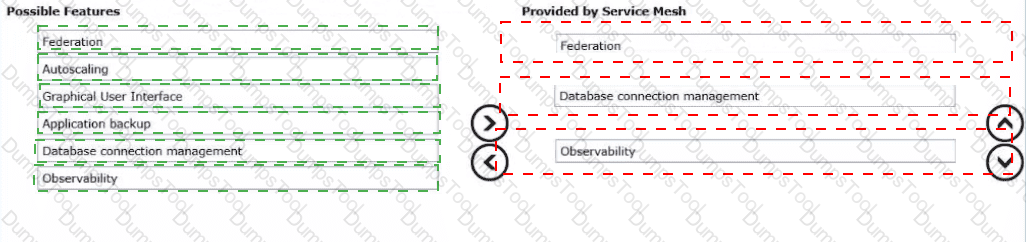
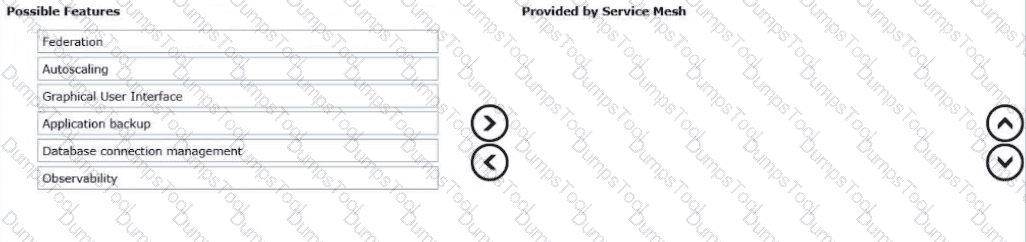
Drag and drop the three features into the correct order from Possible Features list on the left and place them into the Provided by Service Mesh on the right side. (Choose three.)

Question # 24

Full Access