Big Cyber Monday Sale - Special 70% Discount Offer - Ends in 0d 00h 00m 00s - Coupon code: 70dumps

MuleSoft-Integration-Architect-I Questions and Answers

Question # 6

An API has been updated in Anypoint Exchange by its API producer from version 3.1.1 to 3.2.0 following accepted semantic versioning practices and the changes have been communicated via the API's public portal. The API endpoint does NOT change in the new version. How should the developer of an API client respond to this change?

A.

The update should be identified as a project risk and full regression testing of the functionality that uses this API should be run.

B.

The API producer should be contacted to understand the change to existing functionality.

C.

The API producer should be requested to run the old version in parallel with the new one.

D.

The API client code ONLY needs to be changed if it needs to take advantage of new features.

Full Access
Question # 7

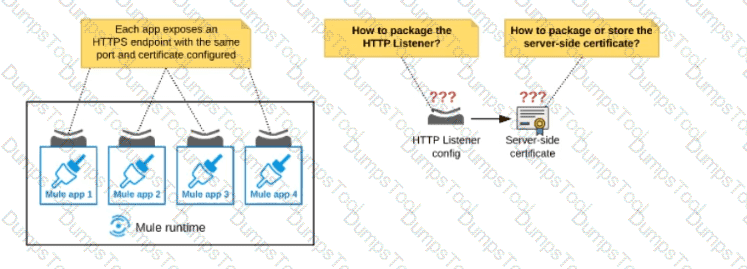
Refer to the exhibit.

An organization deploys multiple Mule applications to the same customer -hosted Mule runtime. Many of these Mule applications must expose an HTTPS endpoint on the same port using a server-side certificate that rotates often.

What is the most effective way to package the HTTP Listener and package or store the server-side certificate when deploying these Mule applications, so the disruption caused by certificate rotation is minimized?

A.

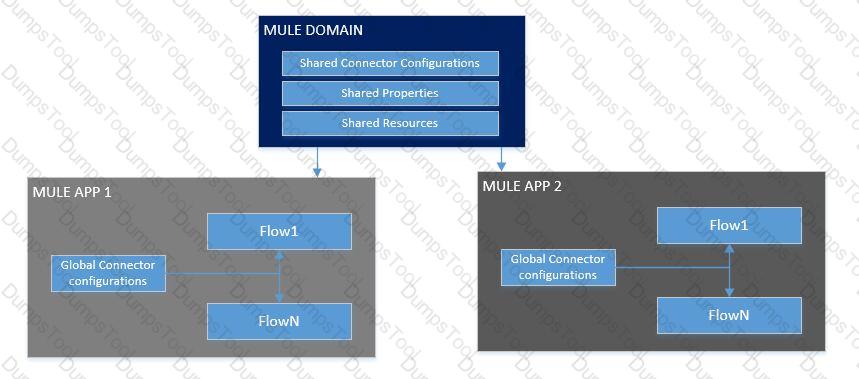
Package the HTTPS Listener configuration in a Mule DOMAIN project, referencing it from all Mule applications that need to expose an HTTPS endpoint Package the server-side certificate in ALL Mule APPLICATIONS that need to expose an HTTPS endpoint

B.

Package the HTTPS Listener configuration in a Mule DOMAIN project, referencing it from all Mule applications that need to expose an HTTPS endpoint. Store the server-side certificate in a shared filesystem location in the Mule runtime's classpath, OUTSIDE the Mule DOMAIN or any Mule APPLICATION

C.

Package an HTTPS Listener configuration In all Mule APPLICATIONS that need to expose an HTTPS endpoint Package the server-side certificate in a NEW Mule DOMAIN project

D.

Package the HTTPS Listener configuration in a Mule DOMAIN project, referencing It from all Mule applications that need to expose an HTTPS endpoint. Package the server-side certificate in the SAME Mule DOMAIN project Go to Set

Full Access
Question # 8

What is true about automating interactions with Anypoint Platform using tools such as Anypoint Platform REST API's, Anypoint CLI or the Mule Maven plugin?

A.

By default, the Anypoint CLI and Mule Maven plugin are not included in the Mule runtime

B.

Access to Anypoint Platform API;s and Anypoint CLI can be controlled separately thruough the roles and permissions in Anypoint platform, so that specific users can get access to Anypoint CLI while others get access to the platform API's

C.

Anypoint Platform API's can only automate interactions with CloudHub while the Mule maven plugin is required for deployment to customer hosted Mule runtimes

D.

API policies can be applied to the Anypoint platform API's so that only certain LOS's has access to specific functions

Full Access
Question # 9

A finance giant is planning to migrate all its Mule applications to Runtime fabric (RTF). Currently all Mule applications are deployed cloud hub using automated CI/CD scripts.

As an integration architect, which of the below step would you suggest to ensure that the applications from cloudhub are migrated properly to Runtime Fabric (RTF) with an assumption that organization is keen on keeping the same deployment strategy.

A.

No changes need to be made to POM.xml file and CI/CD script should be modified as per the RTF configurations

B.

runtimeFabric dependency should be added as a mule plug-in to POM.xml file and CI/CD script should be modified as per the RTF configurations

C.

runtimeFabric deployment should be added to POM.xml file in allthe mule applications and CI/CD script should be modified as per the RTF configurations

D.

runtimeFabric profile should be added mule configuration files in the mule applications and CI/CD script should be modified as per the RTF configurations

Full Access
Question # 10

As part of a growth strategy, a supplier signs a trading agreement with a large customer. The customer sends purchase orders to the supplier according to the ANSI X12 EDI standard, and the supplier creates the orders in its ERP system using the information in the EDI document.

The agreement also requires that the supplier provide a new RESTful API to process request from the customer for current product inventory level from the supplier’ s ERP system.

Which two fundamental integration use cases does the supplier need to deliver to provide an end-to-end solution for this business scenario? (Choose two.)

A.

Synchronized data transfer

B.

Sharing data with external partners

C.

User interface integration

D.

Streaming data ingestion

E.

Data mashups

Full Access
Question # 11

Following MuleSoft best practices, what MuleSoft runtime deployment option best meets the company's goals to begin its digital transformation journey?

A.

Runtime Fabric on VMs/bare metal

B.

CloudHub runtimes

C.

Customer-hosted runtimes provisioned by a MuleSoft services partner

D.

Customer-hosted self-provisioned runtimes

Full Access
Question # 12

An application load balancer routes requests to a RESTful web API secured by Anypoint Flex Gateway.

Which protocol is involved in the communication between the load balancer and the Gateway?

A.

SFTP

B.

HTTPS

C.

LDAP

D.

SMTP

Full Access
Question # 13

What is an advantage of using OAuth 2.0 client credentials and access tokens over only API keys for API authentication?

A.

If the access token is compromised, the client credentials do not to be reissued.

B.

If the access token is compromised, I can be exchanged for an API key.

C.

If the client ID is compromised, it can be exchanged for an API key

D.

If the client secret is compromised, the client credentials do not have to be reissued.

Full Access
Question # 14

When using Anypoint Platform across various lines of business with their own Anypoint Platform business groups, what configuration of Anypoint Platform is always performed at the organization level as opposed to at the business group level?

A.

Environment setup

B.

Identity management setup

C.

Role and permission setup

D.

Dedicated Load Balancer setup

Full Access
Question # 15

The ABC company has an Anypoint Runtime Fabric on VMs/Bare Metal (RTF-VM) appliance installed on its own customer-hosted AWS infrastructure.

Mule applications are deployed to this RTF-VM appliance. As part of the company standards, the Mule application logs must be forwarded to an external log management tool (LMT).

Given the company's current setup and requirements, what is the most idiomatic (used for its intended purpose) way to send Mule application logs to the external LMT?

A.

In RTF-VM, install and configure the external LTM's log-forwarding agent

B.

In RTF-VM, edit the pod configuration to automatically install and configure an Anypoint Monitoring agent

C.

In each Mule application, configure custom Log4j settings

D.

In RTF-VM. configure the out-of-the-box external log forwarder

Full Access
Question # 16

A retail company is implementing a MuleSoft API to get inventory details from two vendors by Invoking each vendor's online applications. Due to network issues, the invocations to the vendor applications are timing out intermittently, but the requests are successful after re-invoking each

vendor application.

What is the most performant way of implementing the API to invoke each vendor application and to retry invocations that generate timeout errors?

A.

Use a For-Each scope to invoke the two vendor applications in series, one after the other.Place the For-Each scope inside an Until-Successful scope to retry requests that raise timeout errors.

B.

Use a Choice scope to Invoke each vendor application on a separate route.Place the Choice scope inside an Until-Successful scope to retry requests that raisetimeout errors.

C.

Use a Scatter-Gather scope to invoke each vendor application on a separate route.Use an Until-Successful scope in each route to retry requests that raise timeout errors.

D.

Use a Round-Robin scope to invoke each vendor application on a separate route.Use a Try-Catch scope in each route to retry requests that raise timeout errors.

Full Access
Question # 17

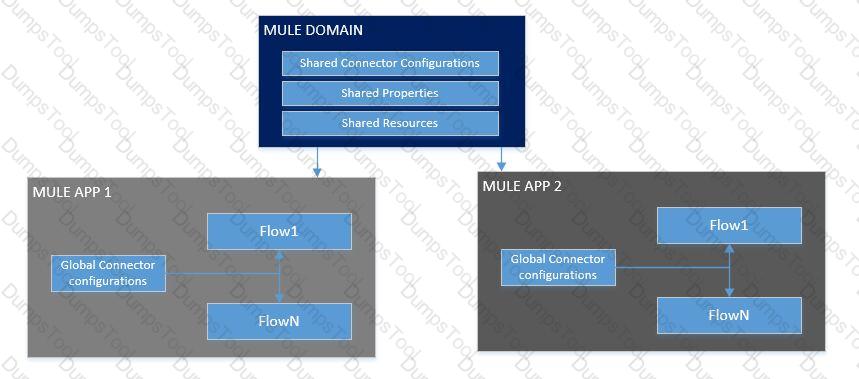
What is not true about Mule Domain Project?

A.

This allows Mule applications to share resources

B.

Expose multiple services within the Mule domain on the same port

C.

Only available Anypoint Runtime Fabric

D.

Send events (messages) to other Mule applications using VM queues

Full Access
Question # 18

A developer is examining the responses from a RESTful web service that is compliant with the Mypertext Transfer Protocol (HTTP/1.1) a8 defined by the Internet Engineering Task Force (IETF).

In this HTTP/1.1-compliant web service, which class of HTTP response status codes should be specified to indicate when client requests are successfully received, understood, and accepted by the web service?

A.

3xx

B.

2xx

C.

4xx

D.

5xx

Full Access
Question # 19

A system API EmployeeSAPI is used to fetch employee's data from an underlying SQL database.

The architect must design a caching strategy to query the database only when there is an update to the employees stable or else return a cached response in order to minimize the number of redundant transactions being handled by the database.

What must the architect do to achieve the caching objective?

A.

Use an On Table Row on employees table and call invalidate cacheUse an object store caching strategy and expiration interval to empty

B.

Use a Scheduler with a fixed frequency every hour triggering an invalidate cache flowUse an object store caching strategy and expiration interval to empty

C.

Use a Scheduler with a fixed frequency every hour triggering an invalidate cache flowUse an object store caching strategy and set expiration interval to 1-hour

D.

Use an on table rule on employees table call invalidate cache and said new employees data to cacheUse an object store caching strategy and set expiration interval to 1-hour

Full Access
Question # 20

An airline is architecting an API connectivity project to integrate its flight data into an online aggregation website. The interface must allow for secure communication high-performance and asynchronous message exchange.

What are suitable interface technologies for this integration assuming that Mulesoft fully supports these technologies and that Anypoint connectors exist for these interfaces?

A.

AsyncAPI over HTTPSAMQP with RabbitMQ JSON/REST over HTTPS

B.

XML over ActiveMQ XML over SFTP XML/REST over HTTPS

C.

CSV over FTP YAM L over TLS JSON over HTTPS

D.

SOAP over HTTPS HOP over TLS gRPC over HTTPS

Full Access
Question # 21

What best describes the Fully Qualified Domain Names (FQDNs), also known as DNS entries, created when a Mule application is deployed to the CloudHub Shared Worker Cloud?

A.

A fixed number of FQDNs are created, IRRESPECTIVE of the environment and VPC design

B.

The FQDNs are determined by the application name chosen, IRRESPECTIVE of the region

C.

The FQDNs are determined by the application name, but can be modified by an administrator after deployment

D.

The FQDNs are determined by both the application name and the region

Full Access
Question # 22

In Anypoint Platform, a company wants to configure multiple identity providers(Idps) for various lines of business (LOBs) Multiple business groups and environments have been defined for the these LOBs. What Anypoint Platform feature can use multiple Idps access the company’s business groups and environment?

A.

User management

B.

Roles and permissions

C.

Dedicated load balancers

D.

Client Management

Full Access
Question # 23

An organization's IT team follows an API-led connectivity approach and must use Anypoint Platform to implement a System AP\ that securely accesses customer data. The organization uses Salesforce as the system of record for all customer data, and its most important objective is to reduce the overall development time to release the System API.

The team's integration architect has identified four different approaches to access the customer data from within the implementation of the System API by using different Anypoint Connectors that all meet the technical requirements of the project.

A.

Use the Anypoint Connector for Database to connect to a MySQL database to access a copy of the customer data

B.

Use the Anypoint Connector for HTTP to connect to the Salesforce APIs to directly access the customer data

C.

Use the Anypoint Connector for Salesforce to connect to the Salesforce APIs to directly access the customer data

D.

Use the Anypoint Connector tor FTP to download a file containing a recent near-real time extract of the customer data

Full Access
Question # 24

An API client makes an HTTP request to an API gateway with an Accept header containing the value’’ application’’.

What is a valid HTTP response payload for this request in the client requested data format?

A.

healthy

B.

{"status" "healthy"}

C.

status(‘healthy")

D.

status: healthy

Full Access
Question # 25

Mule application A receives a request Anypoint MQ message REQU with a payload containing a variable-length list of request objects. Application A uses the For Each scope to split the list into individual objects and sends each object as a message to an Anypoint MQ queue.

Service S listens on that queue, processes each message independently of all other messages, and sends a response message to a response queue.

Application A listens on that response queue and must in turn create and publish a response Anypoint MQ message RESP with a payload containing the list of responses sent by service S in the same order as the request objects originally sent in REQU.

Assume successful response messages are returned by service S for all request messages.

What is required so that application A can ensure that the length and order of the list of objects in RESP and REQU match, while at the same time maximizing message throughput?

A.

Use a Scatter-Gather within the For Each scope to ensure response message order Configure the Scatter-Gather with a persistent object store

B.

Perform all communication involving service S synchronously from within the For Each scope, so objects in RESP are in the exact same order as request objects in REQU

C.

Use an Async scope within the For Each scope and collect response messages in a second For Each scope in the order In which they arrive, then send RESP using this list of responses

D.

Keep track of the list length and all object indices in REQU, both in the For Each scope and in all communication involving service Use persistent storage when creating RESP

Full Access
Question # 26

How should the developer update the logging configuration in order to enable this package specific debugging?

A.

In Anypoint Monitoring, define a logging search query with class property set to org.apache.cxf and level set to DEBUG

B.

In the Mule application's log4j2.xml file, add an AsyncLogger element with name property set to org.apache.cxf and level set to DEBUG, then redeploy the Mule application in the CloudHub production environment

C.

In the Mule application's log4j2.xmI file, change the root logger's level property to DEBUG, then redeploy the Mule application to the CloudHub production environment

D.

In Anypoint Runtime Manager, in the Deployed Application Properties tab for the Mule application, add a line item with DEBUG level for package org.apache.cxf and apply the changes

Full Access
Question # 27

An organization is designing an integration solution to replicate financial transaction data from a legacy system into a data warehouse (DWH).

The DWH must contain a daily snapshot of financial transactions, to be delivered as a CSV file. Daily transaction volume exceeds tens of millions of records, with significant spikes in volume during popular shopping periods.

What is the most appropriate integration style for an integration solution that meets the organization's current requirements?

A.

Event-driven architecture

B.

Microservice architecture

C.

API-led connectivity

D.

Batch-triggered ETL

Full Access
Question # 28

A stock broking company makes use of CloudHub VPC to deploy Mule applications. Mule application needs to connect to a database application in the customers on-premises corporate data center and also to a Kafka cluster running in AWS VPC.

How is access enabled for the API to connect to the database application and Kafka cluster securely?

A.

Set up a transit gateway to the customers on-premises corporate datacenter to AWS VPC

B.

Setup AnyPoint VPN to the customer's on-premise corporate datacenter and VPC peering with AWS VPC

C.

Setup VPC peering with AWS VPC and the customers devices corporate data center

D.

Setup VPC peering with the customers onto my service corporate data center and Anypoint VPN to AWS VPC

Full Access
Question # 29

A leading eCommerce giant will use MuleSoft APIs on Runtime Fabric (RTF) to process customer orders. Some customer-sensitive information, such as credit card information, is required in request payloads or is included in response payloads in some of the APIs. Other API requests and responses are not authorized to access some of this customer-sensitive information but have been implemented to validate and transform based on the structure and format of this customer-sensitive information (such as account IDs, phone numbers, and postal codes).

What approach configures an API gateway to hide sensitive data exchanged between API consumers and API implementations, but can convert tokenized fields back to their original value for other API requests or responses, without having to recode the API implementations?

Later, the project team requires all API specifications to be augmented with an additional non-functional requirement (NFR) to protect the backend services from a high rate of requests, according to defined service-level

agreements (SLAs). The NFR's SLAs are based on a new tiered subscription level "Gold", "Silver", or "Platinum" that must be tied to a new parameter that is being added to the Accounts object in their enterprise data model.

Following MuleSoft's recommended best practices, how should the project team now convey the necessary non-functional requirement to stakeholders?

A.

Create and deploy API proxies in API Manager for the NFR, change the baseurl in eachAPI specification to the corresponding API proxy implementation endpoint, and publish each modified API specification to Exchange

B.

Update each API specification with comments about the NFR's SLAs and publish each modified API specification to Exchange

C.

Update each API specification with a shared RAML fragment required to implement the NFR and publish the RAML fragment and each modified API specification to Exchange

D.

Create a shared RAML fragment required to implement the NFR, list each API implementation endpoint in the RAML fragment, and publish the RAML fragment to Exchange

Full Access
Question # 30

A new Mule application has been deployed through Runtime Manager to CloudHub 1.0 using a CI/CD pipeline with sensitive properties set as cleartext. The Runtime Manager Administrator opened a high priority incident ticket about this violation of their security requirements indicating

these sensitive properties values must not be stored or visible in Runtime Manager but should be changeable in Runtime Manager by Administrators with proper permissions.

How can the Mule application be deployed while safely hiding the sensitive properties?

A.

Add an ArrayList of all the sensitive properties’ names in the mule-artifact.json file ofthe application

B.

Add encrypted versions of the sensitive properties as global configuration properties inthe Mule application

C.

Add a new wrapper.java.additional.xx parameter for each sensitive property in thewrapper.conf file used by the CI/CD pipeline scripts

D.

Create a variable for each sensitive property and declare them as hidden in the CI/CDpipeline scripts

Full Access
Question # 31

An insurance provider is implementing Anypoint platform to manage its application infrastructure and is using the customer hosted runtime for its business due to certain financial requirements it must meet. It has built a number of synchronous API's and is currently hosting these on a mule runtime on one server

These applications make use of a number of components including heavy use of object stores and VM queues.

Business has grown rapidly in the last year and the insurance provider is starting to receive reports of reliability issues from its applications.

The DevOps team indicates that the API's are currently handling too many requests and this is over loading the server. The team has also mentioned that there is a significant downtime when the server is down for maintenance.

As an integration architect, which option would you suggest to mitigate these issues?

A.

Add a load balancer and add additional servers in a server group configuration

B.

Add a load balancer and add additional servers in a cluster configuration

C.

Increase physical specifications of server CPU memory and network

D.

Change applications by use an event-driven model

Full Access
Question # 32

Cloud Hub is an example of which cloud computing service model?

A.

Platform as a Service (PaaS)

B.

Software as a Service (SaaS)

C.

Monitoring as a Service (MaaS)

D.

Infrastructure as a Service (laaS)

Full Access
Question # 33

One of the backend systems involved by the API implementation enforces rate limits on the number of request a particle client can make.

Both the back-end system and API implementation are deployed to several non-production environments including the staging environment and to a particular production environment. Rate limiting of the back-end system applies to all non-production environments.

The production environment however does not have any rate limiting.

What is the cost-effective approach to conduct performance test of the API implementation in the non-production staging environment?

A.

Including logic within the API implementation that bypasses in locations of the back-end system in the staging environment and invoke a Mocking service that replicates typical back-end system responsesThen conduct performance test using this API implementation

B.

Use MUnit to simulate standard responses from the back-end system.Then conduct performance test to identify other bottlenecks in the system

C.

Create a Mocking service that replicates the back-end system'sproduction performance characteristicsThen configure the API implementation to use the mockingservice and conduct the performance test

D.

Conduct scaled-down performance tests in the staging environment against rate-limiting back-end system. Then upscale performance results to full production scale

Full Access
Question # 34

According to MuleSoft, which deployment characteristic applies to a microservices application architecture?

A.

Services exist as independent deployment artifacts and can be scaled -independently of other services

B.

All services of an application can be deployed together as single Java WAR file

C.

A deployment to enhance one capability requires a redeployment of all capabilities

D.

Core business capabilities are encapsulated in a single, deployable application

Full Access
Question # 35

A Mule application is built to support a local transaction for a series of operations on a single database. The Mule application has a Scatter-Gather that participates in the local transaction.

What is the behavior of the Scatter-Gather when running within this local transaction?

A.

Execution of each route within the Scatter-Gather occurs sequentiallyAny error that occurs inside the Scatter-Gather will result in a rollback of all the database operations

B.

Execution of all routes within the Scatter-Gather occurs in parallelAny error that occurs inside the Scatter-Gather will result in a rollback of all the database operations

C.

Execution of each route within the Scatter-Gather occurs sequentiallyAny error that occurs inside the Scatter-Gather will NOT result in a rollback of any of the database operations

D.

Execution of each route within the Scatter-Gather occurs in parallelAny error that occurs inside the Scatter-Gather will NOT result in a rollback of any of the database operations

Full Access
Question # 36

A company is building an application network and has deployed four Mule APIs: one experience API, one process API, and two system APIs. The logs from all the APIs are aggregated in an external log aggregation tool. The company wants to trace messages that are exchanged between multiple API implementations. What is the most idiomatic (based on its intended use) identifier that should be used to implement Mule event tracing across the multiple API implementations?

A.

Mule event ID

B.

Mule correlation ID

C.

Client's IP address

D.

DataWeave UUID

Full Access
Question # 37

An organization is designing a mule application to support an all or nothing transaction between serval database operations and some other connectors so that they all roll back if there is a problem with any of the connectors

Besides the database connector , what other connector can be used in the transaction.

A.

VM

B.

Anypoint MQ

C.

SFTP

D.

ObjectStore

Full Access
Question # 38

An organization is designing Mule application which connects to a legacy backend. It has been reported that backend services are not highly available and experience downtime quite often. As an integration architect which of the below approach you would propose to achieve high reliability goals?

A.

Alerts can be configured in Mule runtime so that backend team can be communicated when services are down

B.

Until Successful scope can be implemented while calling backend API's

C.

On Error Continue scope to be used to call in case of error again

D.

Create a batch job with all requests being sent to backend using that job as per the availability of backend API's

Full Access
Question # 39

A mule application designed to fulfil two requirements

a) Processing files are synchronously from an FTPS server to a back-end database using VM intermediary queues for load balancing VM events

b) Processing a medium rate of records from a source to a target system using batch job scope

Considering the processing reliability requirements for FTPS files, how should VM queues be configured for processing files as well as for the batch job scope if the application is deployed to Cloudhub workers?

A.

Use Cloud hub persistent queues for FTPS files processingThere is no need to configure VM queues for the batch jobs scope as it uses by default the worker's disc for VM queueing

B.

Use Cloud hub persistent VM queue for FTPS file processingThere is no need to configure VM queues for the batch jobs scope as it uses by default the worker's JVM memory for VM queueing

C.

Use Cloud hub persistent VM queues for FTPS file processingDisable VM queue for the batch job scope

D.

Use VM connector persistent queues for FTPS file processing Disable VM queue for the batch job scope

Full Access
Question # 40

An organization is implementing a Quote of the Day API that caches today's quote. What scenario can use the CloudHub Object Store connector to persist the cache's state?

A.

When there is one deployment of the API implementation to CloudHub and another one to customer hosted mule runtime that must share the cache state.

B.

When there are two CloudHub deployments of the API implementation by two Anypoint Platform business groups to the same CloudHub region that must share the cache state.

C.

When there is one CloudHub deployment of the API implementation to three workers that must share the cache state.

D.

When there are three CloudHub deployments of the API implementation to three separate CloudHub regions that must share the cache state.

Full Access
Question # 41

An organization has defined a common object model in Java to mediate the communication between different Mule applications in a consistent way. A Mule application is being built to use this common object model to process responses from a SOAP API and a REST API and then write the processed results to an order management system.

The developers want Anypoint Studio to utilize these common objects to assist in creating mappings for various transformation steps in the Mule application.

What is the most idiomatic (used for its intended purpose) and performant way to utilize these common objects to map between the inbound and outbound systems in the Mule application?

A.

Use JAXB (XML) and Jackson (JSON) data bindings

B.

Use the WSS module

C.

Use the Java module

D.

Use the Transform Message component

Full Access
Question # 42

An ABC Farms project team is planning to build a new API that is required to work with data from different domains across the organization.

The organization has a policy that all project teams should leverage existing investments by reusing existing APIs and related resources and documentation that other project teams have already developed and deployed.

To support reuse, where on Anypoint Platform should the project team go to discover and read existing APIs, discover related resources and documentation, and interact with mocked versions of those APIs?

A.

Design Center

B.

API Manager

C.

Runtime Manager

D.

Anypoint Exchange

Full Access
Question # 43

A trading company handles millions of requests a day. Due to nature of its business, it requires excellent

performance and reliability within its application.

For this purpose, company uses a number of event-based API's hosted on various mule clusters that communicate across a shared message queue sitting within its network.

Which method should be used to meet the company's requirement for its system?

A.

XA transactions and XA connected components

B.

JMS transactions

C.

JMS manual acknowledgements with a reliability pattern

D.

VM queues with reliability pattern

Full Access
Question # 44

An IT integration tram followed an API-led connectivity approach to implement an order-fulfillment business process. It created an order processing AP that coordinates stateful interactions with a variety of microservices that validate, create, and fulfill new product orders

Which interaction composition pattern did the integration architect who designed this order processing AP| use?

A.

Orchestration

B.

Streaming

C.

Aggregation

D.

Multicasting

Full Access
Question # 45

What are two reasons why a typical MuleSoft customer favors a MuleSoft-hosted Anypoint Platform runtime plane over a customer-hosted runtime for its Mule application deployments? (Choose two.)

A.

Reduced application latency

B.

Increased application isolation

C.

Reduced time-to-market for the first application

D.

Increased application throughput

E.

Reduced IT operations effort

Full Access
Question # 46

In one of the critical payment related mule application, transaction is being used . As an enhancement to implementation , scatter gather route is introduced which is also the part of transaction group. Scatter gather route has 4 routes.

What will be the behavior of the Mule application in case of error occurs in 4th route of the scatter-gather router and transaction needs to be rolled back?

A.

Only errored route will be rolled back

B.

All routes will be rolled back

C.

Scatter Gather router cannot be part of transaction

Full Access
Question # 47

What approach configures an API gateway to hide sensitive data exchanged between API consumers and API implementations, but can convert tokenized fields back to their original value for other API requests or responses, without having to recode the API implementations?

A.

Create both masking and tokenization formats and use both to apply a tokenization policy in an API gateway to mask sensitive values in message payloads withcharacters, and apply a corresponding detokenization policy to return the originalvalues to other APIs

B.

Create a masking format and use it to apply a tokenization policy in an API gateway to mask sensitive values in message payloads with characters, and apply a corresponding detokenization policy to return the original values to other APIs

C.

Use a field-level encryption policy in an API gateway to replace sensitive fields in message payload with encrypted values, and apply a corresponding field-leveldecryption policy to return the original values to other APIs

D.

Create a tokenization format and use it to apply a tokenization policy in an API gateway to replace sensitive fields in message payload with similarly formattedtokenized values, and apply a corresponding detokenization policy to return the original values to other APIs

Full Access
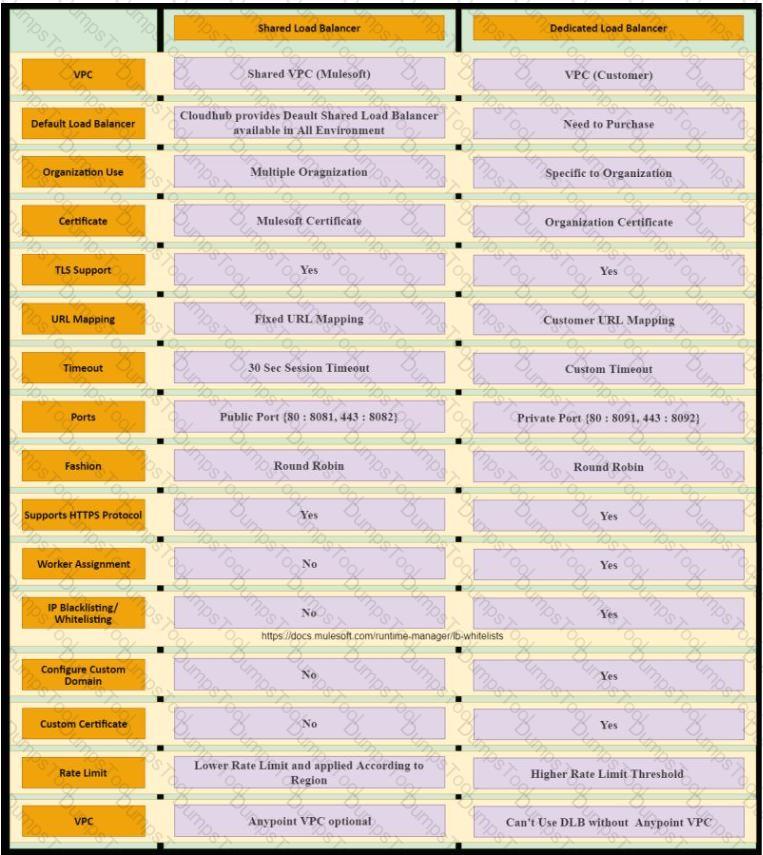
Question # 48

What comparison is true about a CloudHub Dedicated Load Balancer (DLB) vs. the CloudHub Shared Load Balancer (SLB)?

A.

Only a DLB allows the configuration of a custom TLS server certificate

B.

Only the SLB can forward HTTP traffic to the VPC-internal ports of the CloudHub workers

C.

Both a DLB and the SLB allow the configuration of access control via IP whitelists

D.

Both a DLB and the SLB implement load balancing by sending HTTP requests to workers with the lowest workloads

Full Access
Question # 49

In Anypoint Platform, a company wants to configure multiple identity providers (IdPs) for multiple lines of business (LOBs). Multiple business groups, teams, and environments have been defined for these LOBs.

What Anypoint Platform feature can use multiple IdPs across the company’s business groups, teams, and environments?

A.

MuleSoft-hosted (CloudHub) dedicated load balancers

B.

Client (application) management

C.

Virtual private clouds

D.

Permissions

Full Access
Question # 50

A new Mule application under development must implement extensive data transformation logic. Some of the data transformation functionality is already available as external transformation services that are mature and widely used across the organization; the rest is highly specific to the new Mule application.

The organization follows a rigorous testing approach, where every service and application must be extensively acceptance tested before it is allowed to go into production.

What is the best way to implement the data transformation logic for this new Mule application while minimizing the overall testing effort?

A.

Implement and expose all transformation logic as mlaoservices using DataWeave, so it can be reused by any application component that needs it, including the new Mule application

B.

Implement transformation logic in the new Mute application using DataWeave, replicating the transformation logic of existing transformation services

C.

Extend the existing transformation services with new transformation logic and Invoke them from the new Mule application

D.

Implement transformation logic in the new Mute application using DataWeave, invoking existing transformation services when possible

Full Access
Question # 51

An integration Mute application is being designed to process orders by submitting them to a backend system for offline processing. Each order will be received by the Mute application through an HTTPS POST and must be acknowledged immediately. Once acknowledged, the order will be submitted to a backend system. Orders that cannot be successfully submitted due to rejections from the backend system will need to be processed manually (outside the backend system).

The Mule application will be deployed to a customer-hosted runtime and is able to use an existing ActiveMQ broker if needed.

The backend system has a track record of unreliability both due to minor network connectivity issues and longer outages.

What idiomatic (used for their intended purposes) combination of Mule application components and ActiveMQ queues are required to ensure automatic submission of orders to the backend system, while minimizing manual order processing?

A.

An On Error scope Non-persistent VM ActiveMQ Dead Letter Queue for manual processing

B.

An On Error scope MuleSoft Object Store ActiveMQ Dead Letter Queue for manual processing

C.

Until Successful component MuleSoft Object Store ActiveMQ is NOT needed or used

D.

Until Successful component ActiveMQ long retry Queue ActiveMQ Dead Letter Queue for manual processing

Full Access
Question # 52

What is maximum vCores can be allocated to application deployed to CloudHub?

A.

1 vCores

B.

2 vCores

C.

4 vCores

D.

16 vCores

Full Access
Question # 53

Organization wants to achieve high availability goal for Mule applications in customer hosted runtime plane. Due to the complexity involved, data cannot be shared among of different instances of same Mule application. What option best suits to this requirement considering high availability is very much critical to the organization?

A.

The cluster can be configured

B.

Use third party product to implement load balancer

C.

High availability can be achieved only in CloudHub

D.

Use persistent object store

Full Access
Question # 54

An organization is migrating all its Mule applications to Runtime Fabric (RTF). None of the Mule applications use Mule domain projects.

Currently, all the Mule applications have been manually deployed to a server group among several customer hosted Mule runtimes.

Port conflicts between these Mule application deployments are currently managed by the DevOps team who carefully manage Mule application properties files.

When the Mule applications are migrated from the current customer-hosted server group to Runtime Fabric (RTF), fo the Mule applications need to be rewritten and what DevOps port configuration responsibilities change or stay the same?

A.

Yes, the Mule applications Must be rewrittenDevOps No Longer needs to manage port conflicts between the Mule applications

B.

Yes, the Mule applications Must be rewrittenDevOps Must Still Manage port conflicts.

C.

NO, The Mule applications do NOT need to be rewrittenDevOps MUST STILL manage port conflicts

D.

NO, the Mule applications do NO need to be rewrittenDevOps NO LONGER needs to manage port conflicts between the Mule applications.

Full Access
Question # 55

According to MuleSoft, which system integration term describes the method, format, and protocol used for communication between two system?

A.

Component

B.

interaction

C.

Message

D.

Interface

Full Access
Question # 56

An organization is choosing between API-led connectivity and other integration approaches.

According to MuleSoft, which business benefits is associated with an API-led connectivity approach using Anypoint Platform?

A.

improved security through adoption of monolithic architectures

B.

Increased developer productivity through sell-service of API assets

C.

Greater project predictability through tight coupling of systems

D.

Higher outcome repeatability through centralized development

Full Access
Question # 57

A MuteSoft developer must implement an API as a Mule application, run the application locally, and execute unit tests against the Running application.

Which Anypoint Platform component can the developer use to full all of these requirements?

A.

API Manager

B.

API Designer

C.

Anypoint CLI

D.

Anypoint Studio

Full Access
Question # 58

An organization heeds to procure an enterprise software system to increase cross-selling opportunities and better rack prospect data.

Which category of enterprise software has these core capabilities, when used for its typical and intended purpose?

A.

Supply Chain Management (SCM)

B.

IT Service Management (ITSM)

C.

Business-to-Business (A2B)

D.

Customer Relationship Management (CRM)

Full Access
Question # 59

A company is planning to migrate its deployment environment from on-premises cluster to a Runtime Fabric (RTF) cluster. It also has a requirement to enable Mule applications deployed to a Mule runtime instance to store and share data across application replicas and restarts.

How can these requirements be met?

A.

Anypoint object store V2 to share data between replicas in the RTF cluster

B.

Install the object store pod on one of the cluster nodes

C.

Configure Persistence Gateway in any of the servers using Mule Object Store

D.

Configure Persistent Gateway at the RTF

Full Access
Question # 60

An organization has deployed runtime fabric on an eight note cluster with performance profile. An API uses and non persistent object store for maintaining some of its state data. What will be the impact to the stale data if server crashes?

A.

State data is preserved

B.

State data is rolled back to a previously saved version

C.

State data is lost

D.

State data is preserved as long as more than one more is unaffected by the crash

Full Access
Question # 61

In a Mule Application, a flow contains two (2) JMS consume operations that are used to connect to a JMS broker and consume messages from two(2) JMS destination. The Mule application then joins the two JMS messages together.

The JMS broker does not implement high availability (HA) and periodically experiences scheduled outages of upto 10 mins for routine maintenance.

What is the most idiomatic (used for its intented purpose) way to build the mule flow so it can best recover from the expected outages?

A.

Configure a reconnection strategy for the JMS connector

B.

Enclose the two(2) JMS operation in an Until Successful scope

C.

Consider a transaction for the JMS connector

D.

Enclose the two(2) JMS operations in a Try scope with an Error Continue error handler

Full Access
Question # 62

An organization if struggling frequent plugin version upgrades and external plugin project dependencies. The team wants to minimize the impact on applications by creating best practices that will define a set of default dependencies across all new and in progress projects.

How can these best practices be achieved with the applications having the least amount of responsibility?

A.

Create a Mule plugin project with all the dependencies and add it as a dependency in each application's POM.xml file

B.

Create a mule domain project with all the dependencies define in its POM.xml file and add each application to the domain Project

C.

Add all dependencies in each application's POM.xml file

D.

Create a parent POM of all the required dependencies and reference each in each application's POM.xml file

Full Access
Question # 63

A marketing organization is designing a Mule application to process campaign data. The Mule application will periodically check for a file in a SFTP location and process the records in the file. The size of the file can vary from 10MB to 5GB. Due to the limited availabiltty of vCores, the Mule application is deployed to a single CloudHub worker configured with vCore size 0.2.

The application must transform and send different formats of this file to three different downstream SFTP locations.

What is the most idiomatic (used for its intended purpose) and performant way to configure the SFTP operations or event sources to process the large files to support these deployment requirements?

A.

Use an in-memory repeatable stream

B.

Use a file-stored non-repeatable stream

C.

Use an in-memory non-repeatable stream

D.

Use a file-stored repeatable stream

Full Access
Question # 64

An organization is designing an integration Mule application to process orders by submitting them to a back-end system for offline processing. Each order will be received by the Mule application through an HTTPS POST and must be acknowledged immediately. Once acknowledged, the order will be submitted to a back-end system. Orders that cannot be successfully submitted due to rejections from the back-end system will need to be processed manually (outside the back-end system).

The Mule application will be deployed to a customer-hosted runtime and is able to use an existing ActiveMQ broker if needed. The ActiveMQ broker is located inside the organization’s firewall. The back-end system has a track record of unreliability due to both minor network connectivity issues and longer outages.

What idiomatic (used for their intended purposes) combination of Mule application components and ActiveMQ queues are required to ensure automatic submission of orders to the back-end system while supporting but minimizing manual order processing?

A.

An Until Successful scope to call the back-end systemOne or more ActiveMQ long-retry queuesOne or more ActiveMQ dead-letter queues for manual processing

B.

One or more On Error scopes to assist calling the back-end systemAn Until Successful scope containing VM components for long retriesA persistent dead-letter VM queue configured in CloudHub

C.

One or more On Error scopes to assist calling the back-end systemOne or more ActiveMQ long-retry queuesA persistent dead-letter object store configured in the CloudHub Object Store service

D.

A Batch Job scope to call the back-end systemAn Until Successful scope containing Object Store components for long retriesA dead-letter object store configured in the Mule application

Full Access
Question # 65

What is true about the network connections when a Mule application uses a JMS connector to interact with a JMS provider (message broker)?

A.

To complete sending a JMS message, the JMS connector must establish a network connection with the JMS message recipient

B.

To receive messages into the Mule application, the JMS provider initiates a network connection to the JMS connector and pushes messages along this connection

C.

The JMS connector supports both sending and receiving of JMS messages over the protocol determined by the JMS provider

D.

The AMQP protocol can be used by the JMS connector to portably establish connections to various types of JMS providers

Full Access
Question # 66

What Mule application can have API policies applied by Anypoint Platform to the endpoint exposed by that Mule application?

A.

A Mule application that accepts requests over HTTP/1x

B.

A Mule application that accepts JSON requests over TCP but is NOT required to provide a response.

C.

A Mule application that accepts JSON requests over WebSocket

D.

A Mule application that accepts gRPC requests over HTTP/2

Full Access
Question # 67

An organization is in the process of building automated deployments using a CI/CD process. As a part of automated deployments, it wants to apply policies to API Instances.

What tool can the organization use to promote and deploy API Manager policies?

A.

Anypoint CLI

B.

MUnit Maven plugin

C.

Mule Maven plugin

D.

Runtime Manager agent

Full Access
Question # 68

A Mule application name Pub uses a persistence object store. The Pub Mule application is deployed to Cloudhub and it configured to use Object Store v2.

Another Mule application name sub is being developed to retrieve values from the Pub Mule application persistence object Store and will also be deployed to cloudhub.

What is the most direct way for the Sub Mule application to retrieve values from the Pub Mule application persistence object store with the least latency?

A.

Use an object store connector configured to access the Pub Mule application persistence object store

B.

Use a VM connector configured to directly access the persistence queue of the Pub Mule application persistence object store.

C.

Use an Anypoint MQ connector configured to directly access the Pub Mule application persistence object store

D.

Use the Object store v2 REST API configured to access the Pub Mule application persistence object store.

Full Access
Question # 69

When designing an upstream API and its implementation, the development team has been advised to not set timeouts when invoking downstream API. Because the downstream API has no SLA that can be relied upon. This is the only donwstream API dependency of that upstream API. Assume the downstream API runs uninterrupted without crashing. What is the impact of this advice?

A.

The invocation of the downstream API will run to completion without timing out.

B.

An SLA for the upstream API CANNOT be provided.

C.

A default timeout of 500 ms will automatically be applied by the Mule runtime in which the upstream API implementation executes.

D.

A load-dependent timeout of less than 1000 ms will be applied by the Mule runtime in which the downstream API implementation executes.

Full Access
Question # 70

The AnyAirline organization's passenger reservations center is designing an integration solution that combines invocations of three different System APIs (bookFlight, bookHotel, and bookCar) in a business transaction. Each System API makes calls to a single database.

The entire business transaction must be rolled back when at least one of the APIs fails.

What is the most idiomatic (used for its intended purpose) way to integrate these APIs in near real-time that provides the best balance of consistency, performance, and reliability?

A.

Implement eXtended Architecture (XA) transactions between the API implementationsCoordinate between the API implementations using a Saga patternImplement caching in each API implementation to improve performance

B.

Implement local transactions within each API implementationConfigure each API implementation to also participate in the same eXtended Architecture (XA) transactionImplement caching in each API implementation to improve performance

C.

Implement local transactions in each API implementationCoordinate between the API implementations using a Saga patternApply various compensating actions depending on where a failure occurs

D.

Implement an eXtended Architecture (XA) transaction manager in a Mule application using a Saga patternConnect each API implementation with the Mule application using XA transactionsApply various compensating actions depending on where a failure occurs

Full Access
Question # 71

An organization has various integrations implemented as Mule applications. Some of these Mule applications are deployed to custom hosted Mule runtimes (on-premises) while others execute in the MuleSoft-hosted runtime plane (CloudHub). To perform the Integra functionality, these Mule applications connect to various backend systems, with multiple applications typically needing to access the backend systems.

How can the organization most effectively avoid creating duplicates in each Mule application of the credentials required to access the backend systems?

A.

Create a Mule domain project that maintains the credentials as Mule domain-shared resources Deploy the Mule applications to the Mule domain, so the credentials are available to the Mule applications

B.

Store the credentials in properties files in a shared folder within the organization's data center Have the Mule applications load properties files from this shared location at startup

C.

Segregate the credentials for each backend system into environment-specific properties files Package these properties files in each Mule application, from where they are loaded at startup

D.

Configure or create a credentials service that returns the credentials for each backend system, and that is accessible from customer-hosted and MuleSoft-hosted Mule runtimes Have the Mule applications toad the properties at startup by invoking that credentials service

Full Access
Question # 72

An external API frequently invokes an Employees System API to fetch employee data from a MySQL database. The architect must design a caching strategy to query the database only when there Is an update to the Employees table or else return a cached response in order to minimize the number of redundant transactions being handled by the database.

A.

Use an On Table Row operation configured with the Employees table, call invalidate cache, and hardcode the new Employees data to cache. Use an object-store-caching-strategy and set the expiration interval to 1 hour.

B.

Use an On Table Row operation configured with the Employees table and cail invalidate cache. Use an object-store-caching-strategy and the default expiration interval.

C.

Use a Scheduler with a fixed frequency set to every hour to trigger an invalidate cache flow. Use an object-store-caching-strategy and the default expiration interval.

D.

Use a Scheduler with a fixed frequency set to every hour, triggering an invalidate cache flow. Use an object-store-caching-strategy and set the expiration interval to 1 hour.

Full Access
Question # 73

Which Salesforce API is invoked to deploy, retrieve, create, update, or delete customization information, such as custom object definitions using Mule Salesforce Connectors in a Mule application?

A.

sObject Platform Action API

B.

User Interface API

C.

Metadata API

D.

Process Rules API

Full Access
Question # 74

The company's FTPS server login username and password

A.

TLS context trust store containing a public certificate for the company. The company's PGP public key that was used to sign the files

B.

The partner's PGP public key used by the company to login to the FTPS server. A TLS context key store containing the private key for the companyThe partner's PGP private key that was used to sign the files

C.

The company's FTPS server login username and password. A TLS context trust store containing a public certificate for ftps.partner.comThe partner's PGP public key that was used to sign the files

D.

The partner's PGP public key used by the company to login to the FTPS server. A TLS context key store containing the private key for ftps.partner.comThe company's PGP private key that was used to sign the files

Full Access
Question # 75

In preparation for a digital transformation initiative, an organization is reviewing related IT integration projects that failed for various for reason.

According to MuleSoft’s surveys of global IT leaders, what is a common cause of IT project failure that this organization may likely discover in its assessment?

A.

Following an Agile delivery methodology

B.

Reliance on an Integration-Platform-as-a-Service (iPaaS)

C.

Spending too much time on enablement

D.

Lack of alignment around business outcomes

Full Access
Question # 76

An organization has several APIs that accept JSON data over HTTP POST. The APIs are all publicly available and are associated with several mobile applications and web applications. The organization does NOT want to use any authentication or compliance policies for these APIs, but at the same time, is worried that some bad actor could send payloads that could somehow compromise the applications or servers running the API implementations. What out-of-the-box Anypoint Platform policy can address exposure to this threat?

A.

Apply a Header injection and removal policy that detects the malicious data before it is used

B.

Apply an IP blacklist policy to all APIs; the blacklist will Include all bad actors

C.

Shut out bad actors by using HTTPS mutual authentication for all API invocations

D.

Apply a JSON threat protection policy to all APIs to detect potential threat vectors

Full Access
Question # 77

An API client is implemented as a Mule application that includes an HTTP Request operation using a default configuration. The HTTP Request operation invokes an external API that follows standard HTTP status code conventions, which causes the HTTP Request operation to return a 4xx status code.

What is a possible cause of this status code response?

A.

An error occurred inside the external API implementation when processing the HTTP request that was received from the outbound HTTP Request operation of the Mule application

B.

The external API reported that the API implementation has moved to a different external endpoint

C.

The HTTP response cannot be interpreted by the HTTP Request operation of the Mule application after it was received from the external API

D.

The external API reported an error with the HTTP request that was received from the outbound HTTP Request operation of the Mule application

Full Access
Question # 78

What is a core pillar of the MuleSoft Catalyst delivery approach?

A.

Business outcomes

B.

Technology centralization

C.

Process thinking

D.

Scope reduction

Full Access
Question # 79

An integration architect is designing an API that must accept requests from API clients for both XML and JSON content over HTTP/1.1 by default.

Which API architectural style, when used for its intended and typical purposes, should the architect choose to meet these requirements?

A.

SOAP

B.

GraphQL

C.

REST

D.

grRPC

Full Access
Question # 80

A Mule application is synchronizing customer data between two different database systems.

What is the main benefit of using eXtended Architecture (XA) transactions over local transactions to synchronize these two different database systems?

A.

An XA transaction synchronizes the database systems with the least amount of Mule configuration or coding

B.

An XA transaction handles the largest number of requests in the shortest time

C.

An XA transaction automatically rolls back operations against both database systems if any operation falls

D.

An XA transaction writes to both database systems as fast as possible

Full Access
Question # 81

A mule application is deployed to a Single Cloudhub worker and the public URL appears in Runtime Manager as the APP URL.

Requests are sent by external web clients over the public internet to the mule application App url. Each of these requests routed to the HTTPS Listener event source of the running Mule application.

Later, the DevOps team edits some properties of this running Mule application in Runtime Manager.

Immediately after the new property values are applied in runtime manager, how is the current Mule application deployment affected and how will future web client requests to the Mule application be handled?

A.

Cloudhub will redeploy the Mule application to the OLD Cloudhub workerNew web client requests will RETURN AN ERROR until the Mule application is redeployed to the OLD Cloudhub worker

B.

CloudHub will redeploy the Mule application to a NEW Cloudhub workerNew web client requests will RETURN AN ERROR until the NEW Cloudhub worker is available

C.

Cloudhub will redeploy the Mule application to a NEW Cloudhub workerNew web client requests are ROUTED to the OLD Cloudhub worker until the NEW Cloudhub worker is available.

D.

Cloudhub will redeploy the mule application to the OLD Cloudhub workerNew web client requests are ROUTED to the OLD Cloudhub worker BOTH before and after the Mule application is redeployed.

Full Access