dumpstool logo

You have an Azure Databricks workspace that is enabled for Unity Catalog and contains a Delta table named Orders.
You load the Orders table into an Apache Spark DataFrame named df.
You need to create a DataFrame that excludes rows where the order amount is null.
Solution: You run the following expression.
df.dropna(subset=[ " order_amount " ])
Does this meet the goal?
You have an Azure Databricks workspace that is enabled for Unity Catalog.
You need to share curated data with an external organization. The solution must meet the following requirements:
The organization will use its own compute platform to query the data.
Access to the data must be centrally governed by using Unity Catalog.
Administrative effort must be minimized.
What should you do?
You have an Azure Databricks account that contains workspaces enabled for Unity Catalog.
You need to implement audit logging to meet the following requirements:
• Capture audit logs for all the workspaces in the account.
• Retain the audit logs for 90 days.
• Minimize storage and ingestion costs.
The logs will be reviewed only during security investigations and will NOT be queried regularly.
To where should you send the audit logs?
You have an Azure Databricks workspace that is enabled for Unity Catalog.
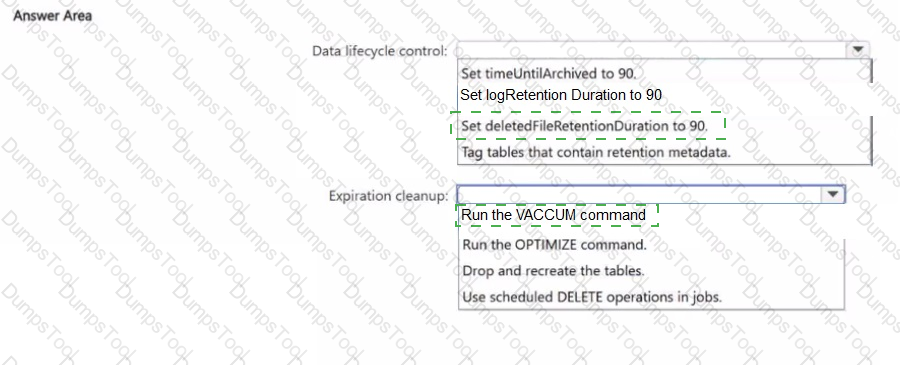
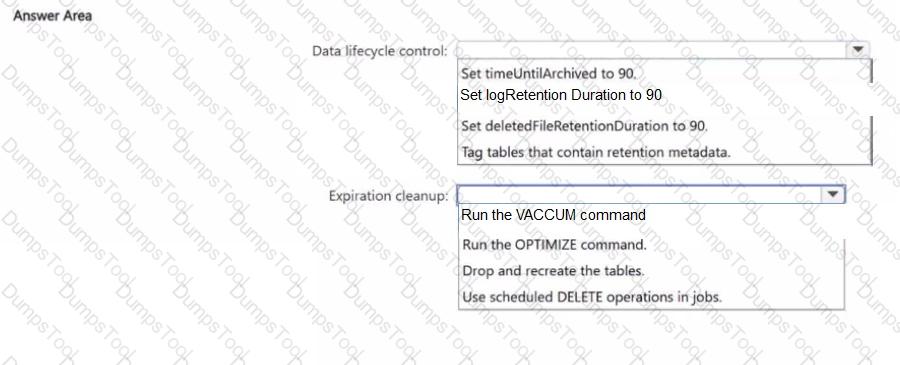
You need to implement a data lifecycle and expiration solution that meets the following requirements
• Transaction logs and deleted data files that are older than 90 days must be removed from Delta tables to reclaim storage.
• All the tables must remain available for querying during the cleanup process.
• Administrative effort must be minimized
What should you do for each requirement? To answer, select the appropriate options in the answer area.
NOTE: Each correct selection is worth one point.
You have an Azure Databricks workspace that is enabled for Unity Catalog and contains two managed Delta tables named sales.schema1.table1 and sales.schema1.table2.
sales.schema1.table1 contains sales data from the current year.
sales.schema1.table2 contains historical data.
You need to load all the rows from sales.schema1.table1 into sales.schema1.table2. The solution must preserve any existing data in sales.schema1.table2 and minimize processing effort.
Which command should you run?
You manage Declarative Automation Bundles by using the Databricks CLI.
You run the following command in a terminal window.
databricks bundle init
What occurs when you run the command?
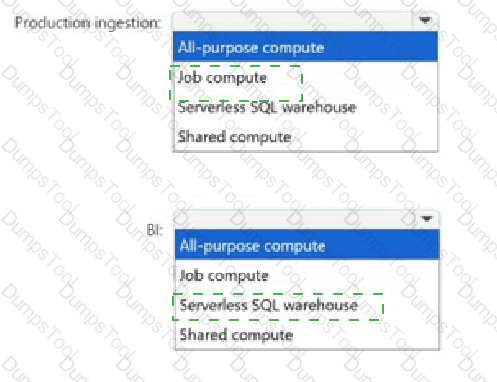
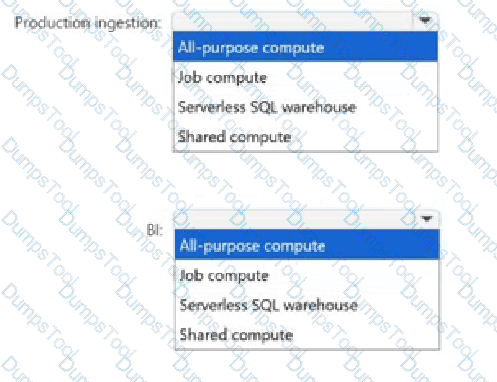
You need to recommend a compute type for the production ingestion workloads and BI workloads. The solution must meet the environment and compute requirements.
What should you recommend for each type of workload? To answer, select the appropriate options in the answer area.
NOTE: Each correct selection is worth one point.
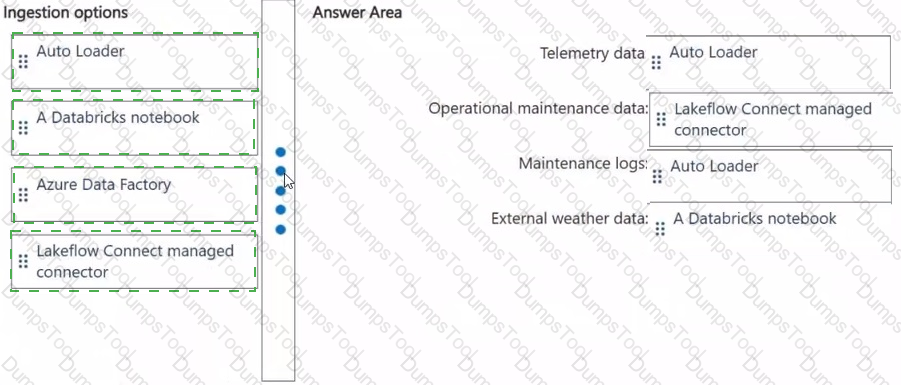
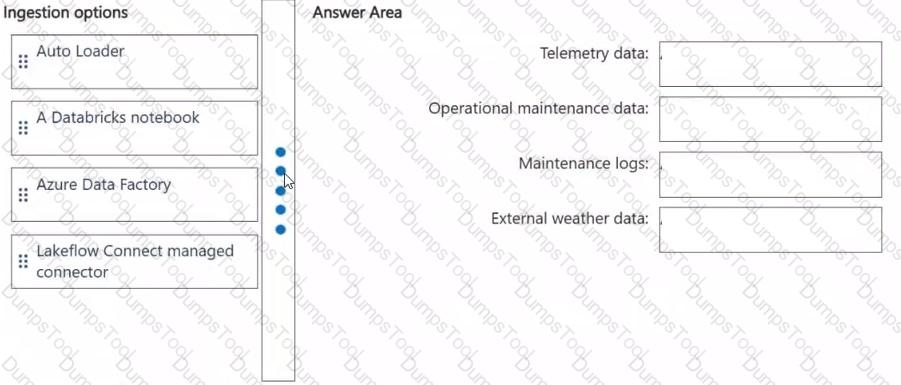
Which ingestion option should you recommend for each data source? To answer, drag the appropriate options to the correct data sources. Each option may be used once, more than once, or not at all. You may need to drag the split bar between panes or scroll to view content.
NOTE: Each correct selection is worth one point.
You need to configure compute for the ingestion of telemetry data. The solution must meet the data ingestion and processing requirements.
What should you do?

TESTED 19 Sep 2026