
Halloween Sale - Special 75% Discount Offer - Ends in 0d 00h 00m 00s - Coupon code: 75onlydt

NSE7_SSE_AR-26 Questions and Answers

Question # 6

You used the HUB IPsec_Recommended and the BRANCH IPsec_Recommended templates to define the overlay topology. Then, you used the SD-WAN template to define the SD-WAN members, rules, and performance SLAs. You applied the changes to the devices and want to use the FortiManager monitors menu to get a graphical view that shows the status of each SD-WAN member. Which statement best explains how to obtain this graphical view?

A.

Use the SD-WAN monitor template view to get a map view of the branches, hub, and tunnel status, including the SLA pass or missed status.

B.

Use the SD-WAN monitor table view to get a donut view and a table view that shows the status of each SD-WAN member, including the SLA pass or missed status.

C.

Use the VPN monitor map view to get a map view of the branches, hub, and tunnel status, including the SLA pass or missed status.

D.

Use the SD-WAN monitor asset view to get a donut view and a table view that shows the status of each device and the SLA status of each SD-WAN member.

Full Access
Question # 7

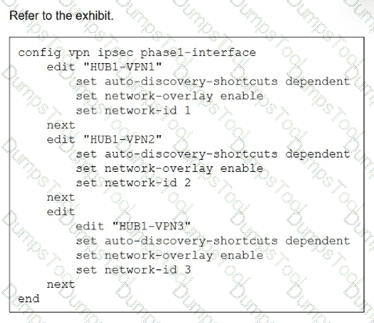
Refer to the exhibit. You update the spokes configuration of an existing auto-discovery VPN (ADVPN) topology by adding the parameters shown in the exhibit. Which is a valid objective of those settings? Choose one answer.
Question # 7

Exhibit 1

A.

Enable the tunnels as overlay links.

B.

Convert the configuration from ADVPN to ADVPN 2.0.

C.

Prevent cross-overlay shortcuts.

D.

Prevent multiple shortcuts from being established over the same overlay.

Full Access
Question # 8

Refer to the exhibit.

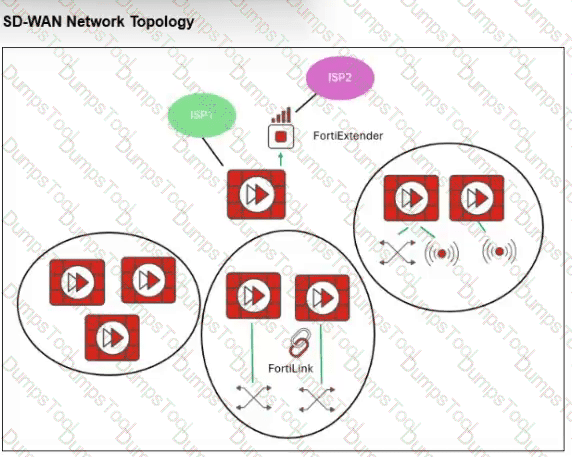
You want to configure SD-WAN on a network, as shown in the exhibit.

The network contains many FortiGate devices. Some are used as next-generation firewalls (NGFW), and some are installed with extensions such as FortiSwitch, FortiAP, or FortiExtender.

Which factors should you consider when planning your deployment?
Question # 8

Exhibit — SD-WAN network topology

A.

You should exclude the FortiGate devices with two types of extensions from the SD-WAN topology.

B.

You should build multiple SD-WAN topologies. Each topology should contain only one type of extension.

C.

You can build an SD-WAN topology that includes all devices. The hubs can be FortiGate devices with FortiExtender.

D.

You can build an SD-WAN topology that includes all devices. You must define multiple regions and group devices by extension type.

Full Access
Question # 9

When you deploy SD-WAN, you can choose from several common designs. Each design best applies to specific contexts. Which two statements correctly associate a common SD-WAN design with its main indication or constraint? Choose two answers.

A.

Use a cloud on-ramp topology to improve the performance of cloud applications.

B.

Use a standalone design for sites with only one WAN link to the cloud.

C.

Use remote breakout to centralize traffic inspection and limit local management requirements.

D.

Use a direct internet access (DIA) design to increase the traffic security and allow local devices with limited capabilities.

Full Access
Question # 10

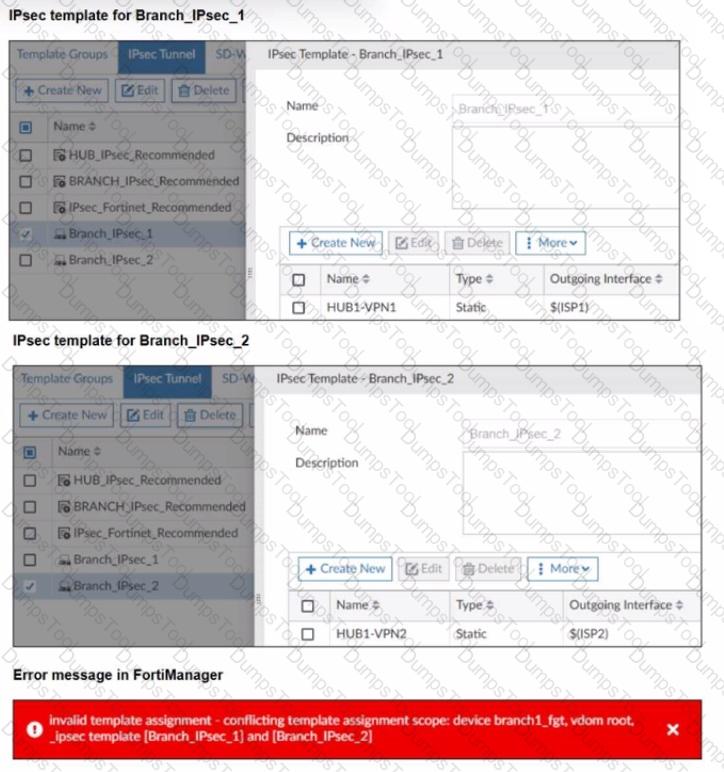
Refer to the exhibits. The exhibits show two IPsec templates to define Branch IPsec 1 and Branch_IPsec_2. Each template defines a VPN tunnel. The error message that FortiManager displayed when the administrator tried to assign the second template to the FortiGate device is also shown. Which statement best describes the cause of the issue?
Question # 10

Exhibit 1

A.

You can assign only one template with a tunnel type of static to each FortiGate device.

B.

You can assign only one IPsec template to each FortiGate device.

C.

You should review the branch1_fgt configuration for configured tunnels in the rootVDOM.

D.

You should use the same outgoing interface of both templates.

Full Access
Question # 11

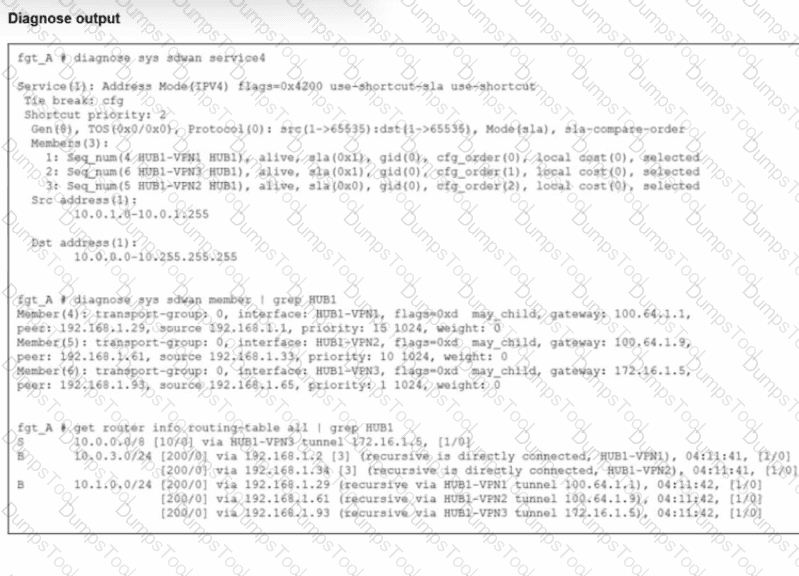
Refer to the exhibit. An administrator is troubleshooting SD-WAN on FortiGate. A device behind branch1_fgt generates traffic to the 10.0.0.0/8 network. The administrator expects the traffic to match SD-WAN rule ID 1 and be routed over HUB1-VPN1. However, the traffic is routed over HUB1-VPN3. Based on the output shown in the exhibit, which two reasons, individually or together, could explain the observed behavior? (Choose two.)
Question # 11

Exhibit 1

A.

HUB1-VPN3 has a higher member configuration priority than HUB1-VPN1.

B.

The traffic matches a regular policy route configured with HUB1-VPN3 as the outgoing device

C.

HUB1-VPN1 does not have a valid route to the destination

D.

HUB1-VPN3 has a lower route priority value (higher priority) than HUB1-VPN1.

Full Access
Question # 12

What is the benefit of branch on-ramp deployment with FortiSASE? (Choose one answer.)

A.

To secure internet traffic for small remote offices.

B.

To provide access to private applications using the bookmark portal.

C.

To manage branch location endpoints.

D.

To provide device compliance checks using zero trust network access (ZTNA) tags.

Full Access
Question # 13

What are three key routing principles of SD-WAN? (Choose three.)

A.

SD-WAN members are skipped if they do not have a valid route to the destination.

B.

Internet Service Database (ISDB) routes have precedence over SD-WAN rules.

C.

SD-WAN rules are skipped if the best route to the destination is not an SD-WAN member.

D.

SD-WAN rules are skipped if the best route to the destination is a static route.

E.

Routes to directly connected subnets have precedence over SD-WAN rules.

Full Access
Question # 14

You are using the FortiManager SD-WAN monitor menus to check the status of an SD-WAN topology. When you place the mouse next to branch1_fgt, you receive the output shown in the exhibit. Which two conclusions can you draw from the output shown in the exhibit? Choose two answers.
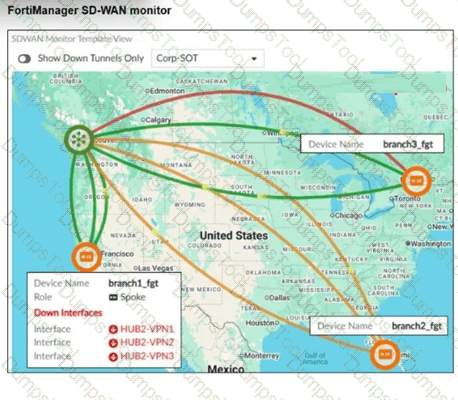
Question # 14

Exhibit 1

A.

Three spokes have tunnels that are out of SLA.

B.

The template Corp-SOT defines a dual-hub topology.

C.

branch3_fgt is configured with three SD-WAN overlay tunnels and one is down.

D.

branch1_fgt is configured with six SD-WAN overlay tunnels and three are down.

Full Access
Question # 15

Refer to the exhibit. The exhibit shows the details of a session and the index numbers of some relevant interfaces on a FortiGate device that supports hardware offloading. Based on the information shown in the exhibits, which two conclusions can you draw? (Choose two.)
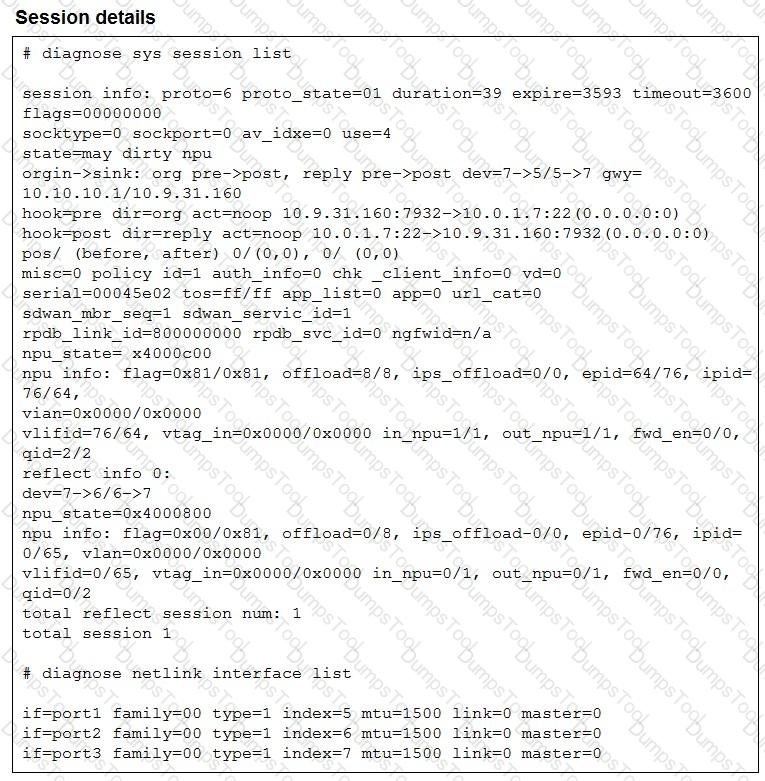
Question # 15

Exhibit 1

A.

By default, FortiGate offloads symmetric and asymmetric flows.

B.

The original direction of the symmetric traffic flows from port3 to port2.

C.

The reply direction of the asymmetric traffic flows from port2 to port3.

D.

The auxiliary session can be offloaded to hardware.

Full Access
Question # 16

Refer to the exhibits. You collected the output shown in the exhibits and want to know which interface TCP traffic will flow through from the user device 10.0.1.101 to the corporate file server 10.0.0.125. All SD-WAN links are stable. Which interface will FortiGate use to steer the traffic? Choose one answer.
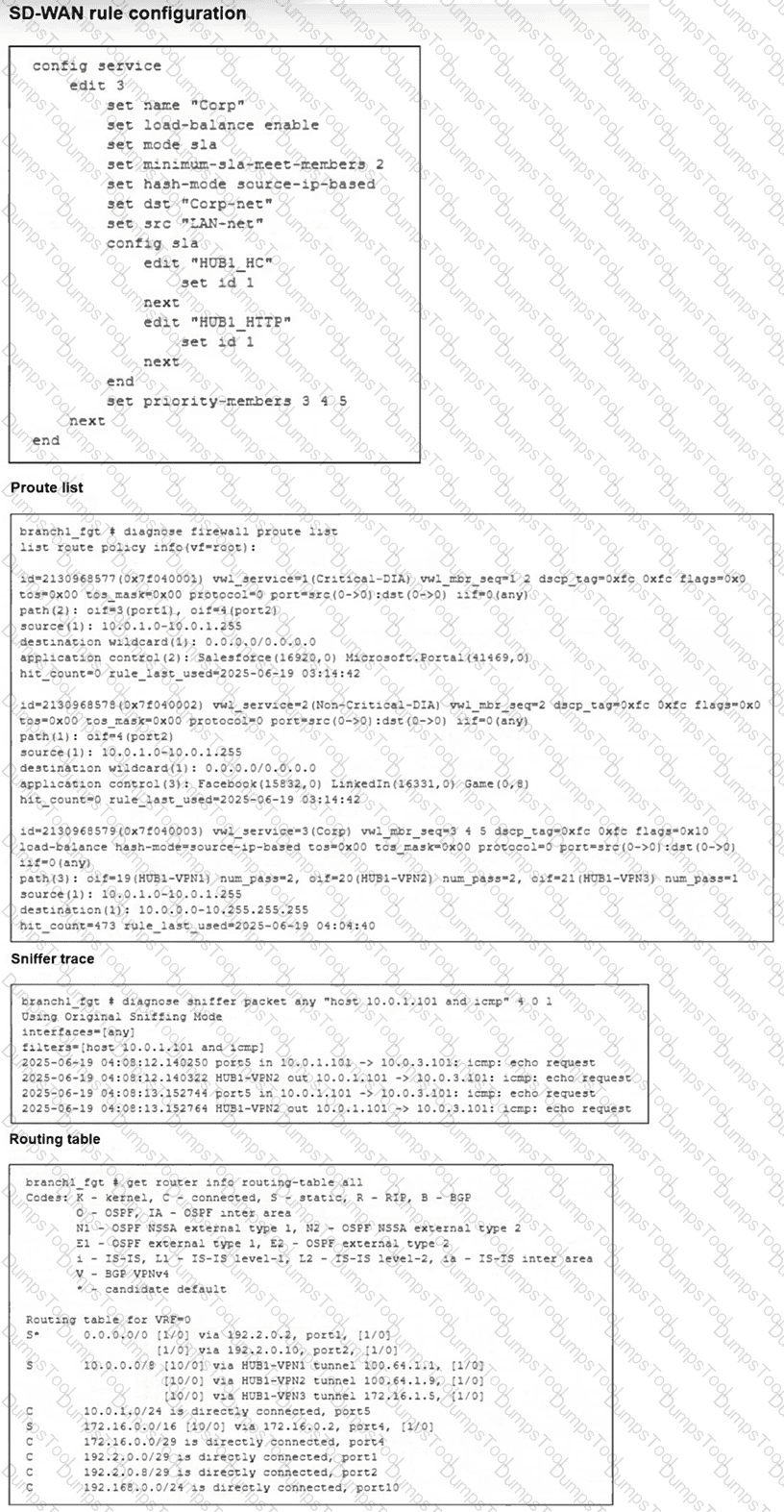
Question # 16

Exhibit 1

A.

Only HUB1-VPN1

B.

Either HUB1-VPN1 or HUB1-VPN2

C.

Only HUB1-VPN2

D.

Either HUB1-VPN1, HUB1-VPN2, or HUB1-VPN3

Full Access
Question # 17

Refer to the exhibit. You configure SD-WAN on a standalone FortiGate device. You want to create an SD-WAN rule that steers Facebook and Linkedin traffic through the less costly internet link. The FortiGate GUI page appears as shown in the exhibit. What should you do to set Facebook and LinkedIn as destinations?
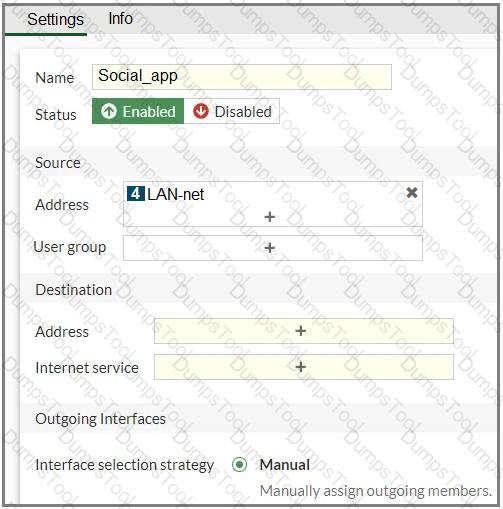
Question # 17

Exhibit 1

A.

Install a license to allow applications as destinations of SD-WAN rules.

B.

In the Internet service field, select Facebook and LinkedIn.

C.

Enable the applications as destinations of the SD-WAN rule feature visibility.

D.

You cannot configure applications as destinations of an SD-WAN rule on a standalone FortiGate device.

Full Access
Question # 18

Refer to the exhibit that shows event logs on FortiGate. Based on the output shown in the exhibit, what can you say about the tunnels on this device?
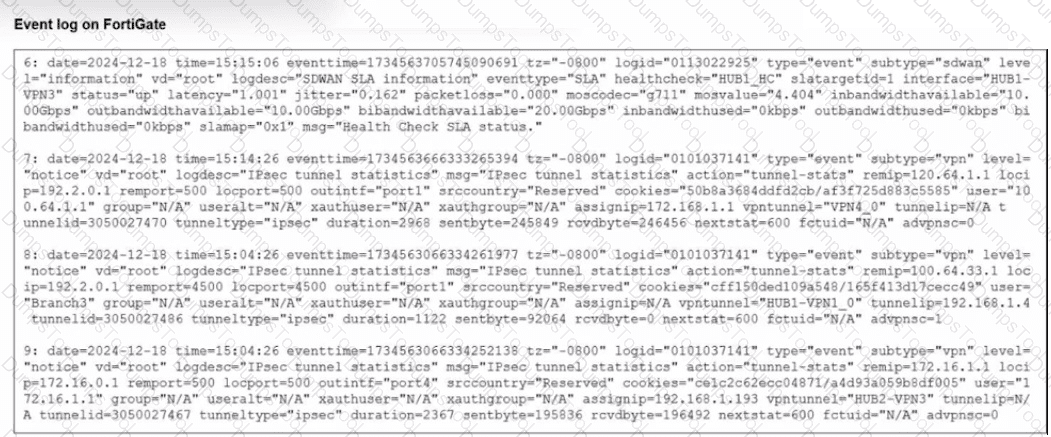
Question # 18

Exhibit 1

A.

The master tunnel HUB2-VPN3 cannot accept ADVPN shortcuts.

B.

The device steers voice traffic through the VPN tunnel HUB1-VPN3.

C.

The VPN tunnel HUB1-VPN1_0 is a shortcut tunnel.

D.

There is one shortcut tunnel built from master tunnel VPN4.

Full Access
Question # 19

Refer to the exhibit. An administrator configures SD-WAN rules for a DIA setup using the FortiGate GUI. The page to configure the source and destination part of the rule looks as shown in the exhibit. The GUI page shows no option to configure an application as the destination of the SD-WAN rule Why?
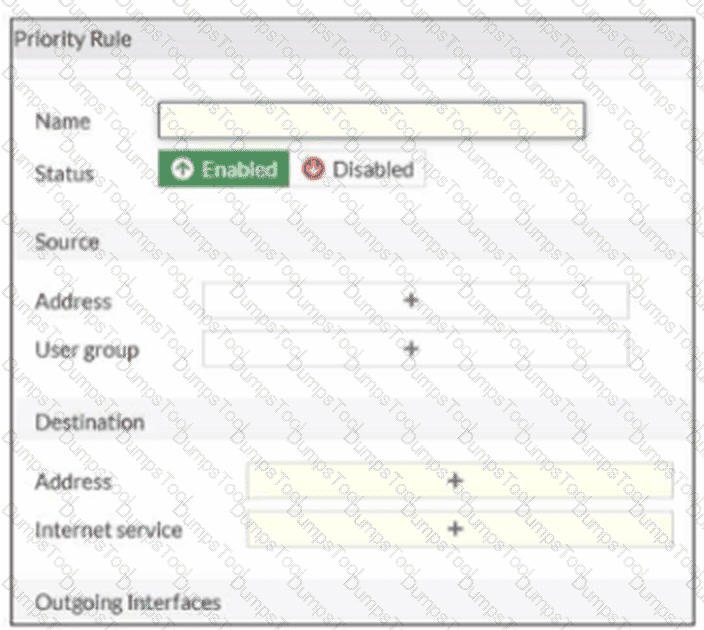
Question # 19

Exhibit 1

A.

You cannot use applications as the destination when FortiGate is used for a DIA setup.

B.

FortiGate allows the configuration of applications as the destination of SD-WAN rules only on the CLI.

C.

You must enable the feature on the CLI.

D.

You must enable the feature first using the GUI menu System > Feature Visibility.

Full Access
Question # 20

Refer to the exhibit.

Which SD-WAN rule and interface uses FortiGate to steer the traffic from the LAN subnet 10.0.1.0/24 to the corporate server 10.2.5.254?
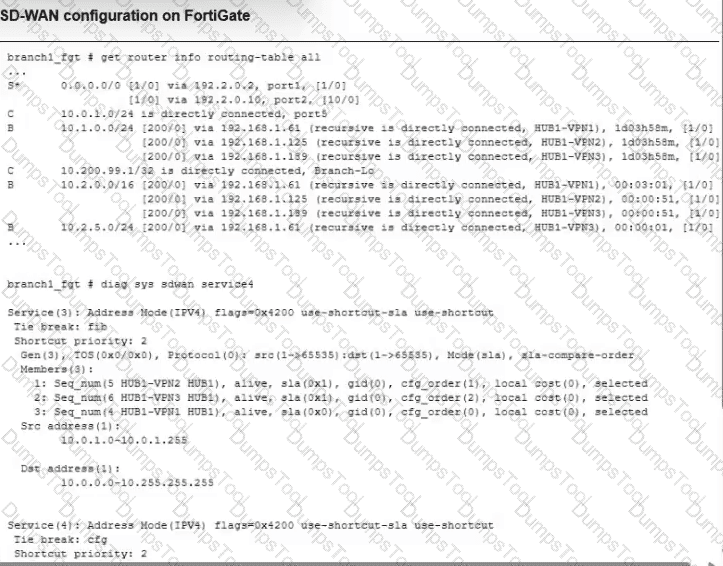
Question # 20

Exhibit — SD-WAN rule and routing outputs

A.

SD-WAN service rule 3 and interface HUB1-VPN3.

B.

SD-WAN service rule 3 and interface HUB1-VPN2.

C.

SD-WAN service rule 4 and interface port2.

D.

SD-WAN service rule 4 and port1 or port2.

Full Access
Question # 21

Refer to the exhibit. The administrator configured the SD-WAN rule ID 4 with two members (port1 and port2) and strategy lowest cost (SLA). What are the two characteristics of the session shown in the exhibit? (Choose two.)
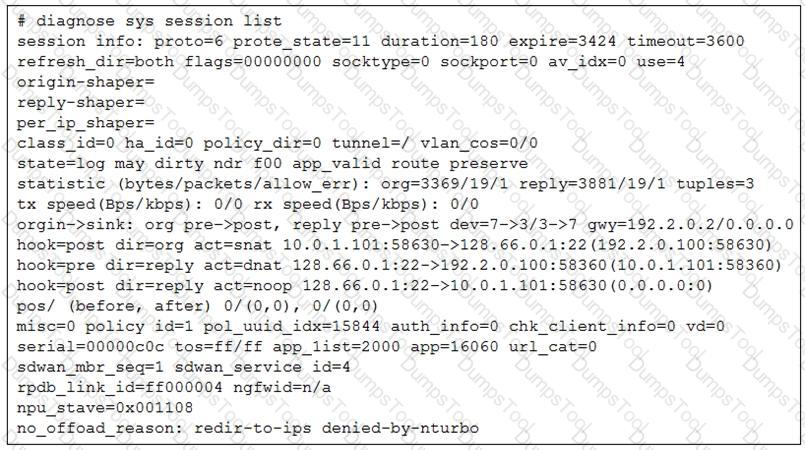
Question # 21

Exhibit 1

A.

FortiGate steered this flow according to an SD-WAN rule 4.

B.

FortiGate will never re-evaluate this session.

C.

FortiGate steered this flow according to the application detected and the outgoing interface is port3.

D.

FortiGate will re-evaluate this session if the outgoing interface goes down.

Full Access
Question # 22

An administrator is assessing FortiSASE deployment components and comparing a proxy-based agentless model with a deployment that integrates FortiClient. As part of this evaluation, the administrator wants to determine which additional capabilities become available when endpoints use FortiClient instead of relying solely on an agentless proxy approach.

Which two enhanced features are provided through FortiClient integration? (Choose two.)

A.

SSL inspection

B.

Device posture check

C.

Vulnerability management

D.

Inline-CASB protection

Full Access
Question # 23

You want to configure two static routes. One that references a zone and the second one that references an SD-WAN member that belongs to that zone.

Which statement about this scenario is true?

A.

You cannot create static routes that reference an SD-WAN zone.

B.

The destination subnets must be different.

C.

You cannot create static routes for individual SD-WAN members.

D.

The destination subnet of routes defined for the zone must overlap the subnet of the route defined for the member.

Full Access
Question # 24

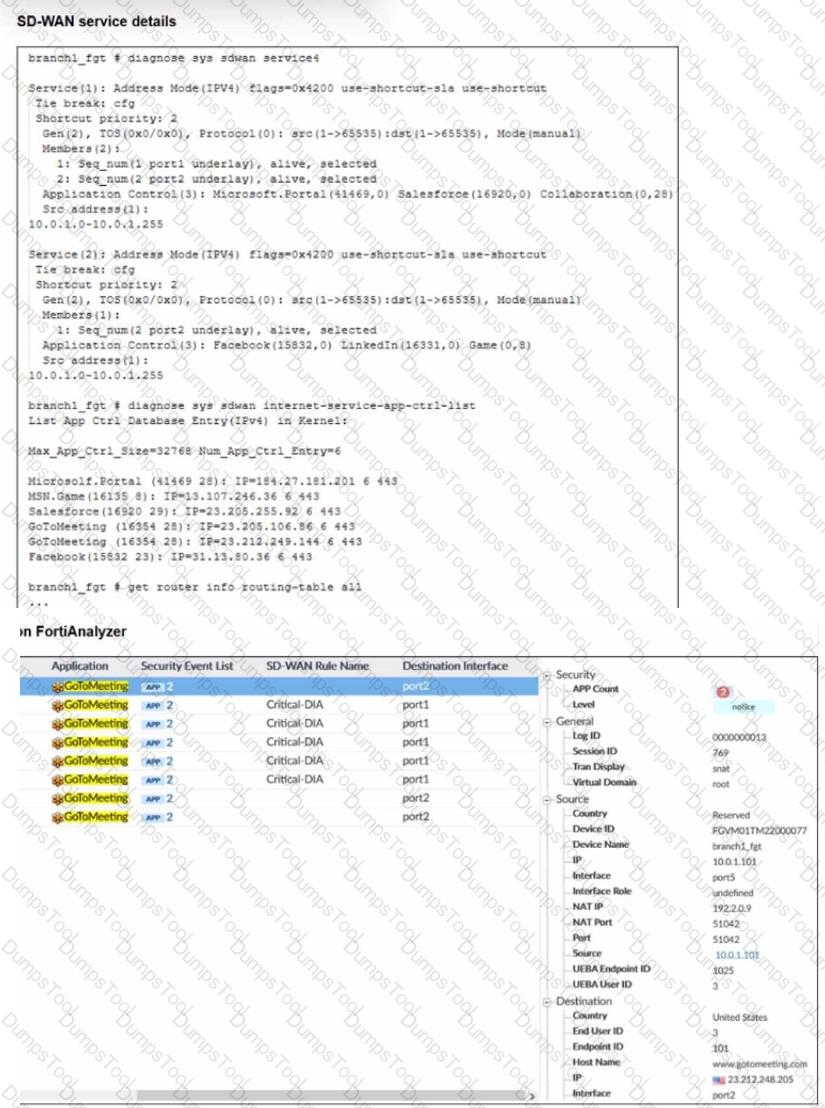
Refer to the exhibits. An administrator is testing application steering in SD-WAN. Before generating test traffic, the administrator collected the information shown in the first exhibit. After generating GoToMeeting test traffic, the administrator examined the corresponding traffic log on FortiAnalyzer, which is shown in the second exhibit. The administrator noticed that the traffic matched the implicit SD-WAN rule, but they expected the traffic to match rule ID 1. Which two reasons explain why some log messages show that the traffic matched the implicit SD-WAN rule? (Choose two.)
Question # 24

Exhibit 1

A.

Full SSL inspection is not enabled on the matching firewall policy.

B.

The session 3-tuple did not match any of the existing entries in the ISDB application cache.

C.

FortiGate could not refresh the routing information on the session after the application was detected.

D.

No configured SD-WAN rule matches the traffic related to the collaboration application GoToMeeting

Full Access
Question # 25

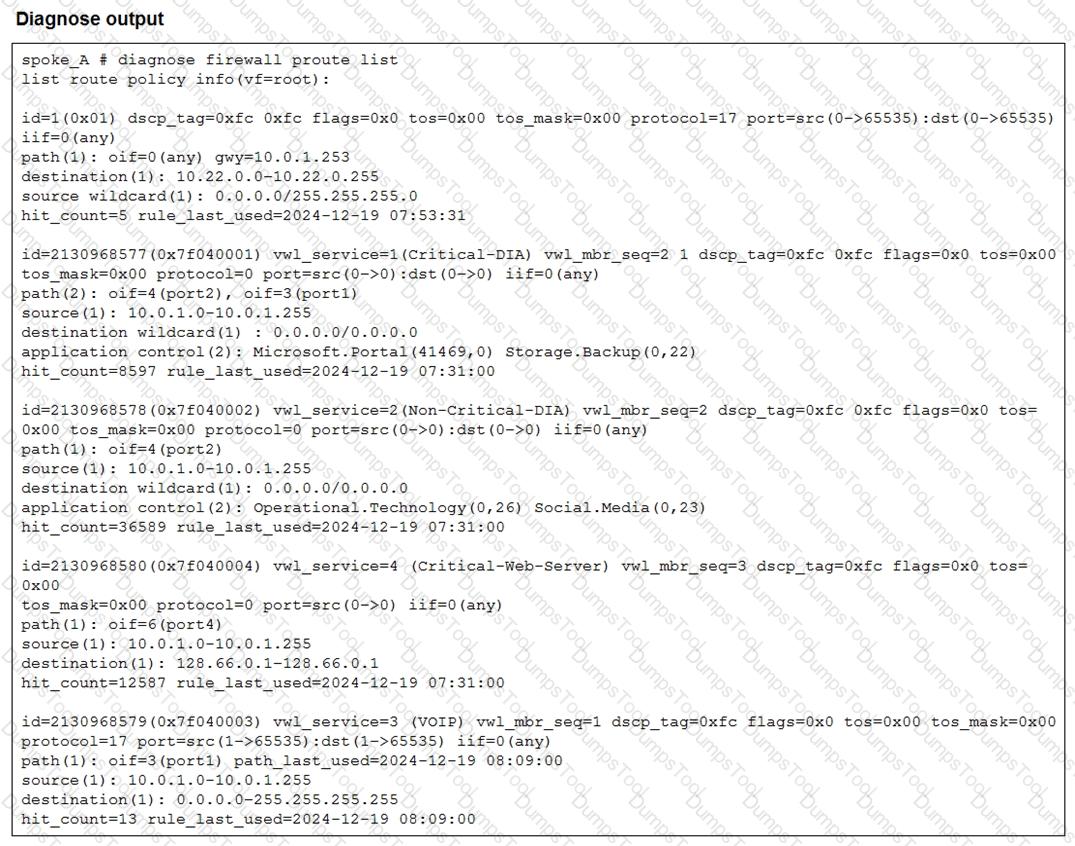
Refer to the exhibit. Which two conclusions can you draw from the output shown? (Choose two.)
Question # 25

Exhibit 1

A.

One SD-WAN rule is defined with application categories as the destination.

B.

UDP traffic destined to the subnet 10.22.0.0/24 matches a manual SD-WAN rule.

C.

One SD-WAN rule allows traffic load balancing.

D.

UDP traffic destined to the subnet 10.22.0.0/24 matches a policy route.

Full Access
Question # 26

In an enterprise deployment of FortiSASE, single sign-on (SSO) is used to streamline user authentication across security services.

Which statement correctly describes an SSO capability on FortiSASE?

A.

It requires users to authenticate separately for each security service for improved segmentation.

B.

It bypasses identity verification when users access trusted networks.

C.

It allows authentication to be delegated to an external identity provider such as Azure AD or SAML-based identity providers (IdPs).

D.

It stores user credentials locally on FortiSASE to reduce dependency on external systems.

Full Access
Question # 27

Refer to the exhibit.

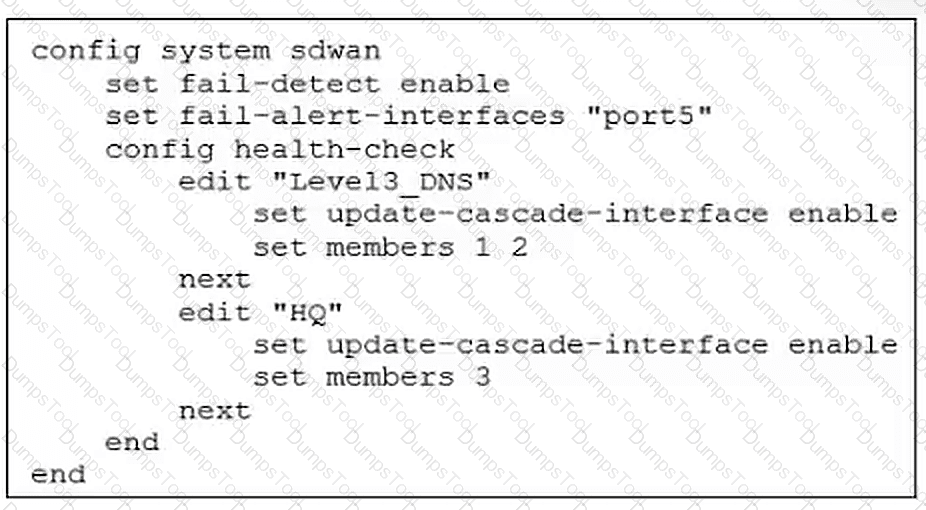
Which action will FortiGate take if it detects SD-WAN members as dead?
Question # 27

Exhibit — SD-WAN failure detection and cascade interface

A.

FortiGate sends alert messages through port5 when it detects any SD-WAN member as dead.

B.

FortiGate brings up port5 after it detects one SD-WAN member as alive.

C.

FortiGate brings up port5 when it detects all SD-WAN members as dead.

D.

FortiGate sends alert messages through port5 when it detects all SD-WAN members as dead.

Full Access
Question # 28

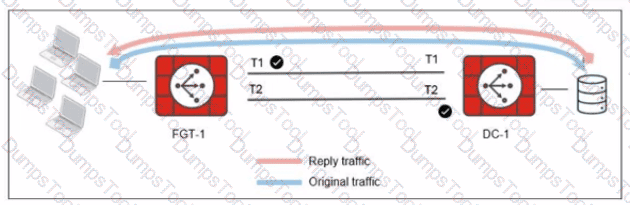
Refer to the exhibit. The administrator analyzed the traffic between a branch FortiGate and the server located in the data center, and noticed the behavior shown in the diagram. When the LAN clients located behind FGT1 establish a session to a server behind DC-1, the administrator observes that, on DC-1, the reply traffic is routed overT2. even though T1 is the preferred member in the matching SD-WAN rule. What can the administrator do to instruct DC-1 to route the reply traffic through the member with the best performance?
Question # 28

Exhibit 1

A.

Enable snat-route-change under config system global.

B.

Enable reply-session under config system sdwan.

C.

Enable auxiliary-session under config system settings.

D.

FortiGate route lookup for reply traffic only considers routes over the original ingress interface.

Full Access
Question # 29

Which two components are part of onboarding a proxy-based endpoint for secure internet access (SIA)? (Choose two.)

A.

Proxy auto-configuration (PAC) file

B.

FortiSASE certificate authority (CA) certificate

C.

FortiClient software

D.

Tunnel policy

Full Access
Question # 30

Which two statements correctly describe what happens when traffic matches the implicit SD-WAN rule? (Choose two.)

A.

The session information output displays no SD-WAN service id.

B.

Traffic is load balanced using the algorithm set for the v4-ecmp-mode setting.

C.

The traffic is distributed, regardless of weight, through all available static routes.

D.

Traffic does not match any of the entries in the policy route table.

E.

FortiGate flags the session with may_dirty and vwl_def ault.

Full Access
Question # 31

You are tasked with configuring ADVPN 2.0 on an SD-WAN topology already configured for ADVPN. What should you do to implement ADVPN 2.0 in this scenario?

A.

Update the IPsec tunnel configurations on the hub.

B.

Update the SD-WAN configuration on the branches.

C.

Update the IPsec tunnel configuration on the branches.

D.

Delete the existing ADVPN configuration and configure ADVPN 2.0.

Full Access
Question # 32

Refer to the exhibits. Two SD-WAN event logs, the member status, the SD-WAN rule configuration, and the health-check configuration for a FortiGate device are shown. Immediately after the log messages are displayed, how will the FortiGate steer the traffic based on the information shown in the exhibits? Choose one answer.
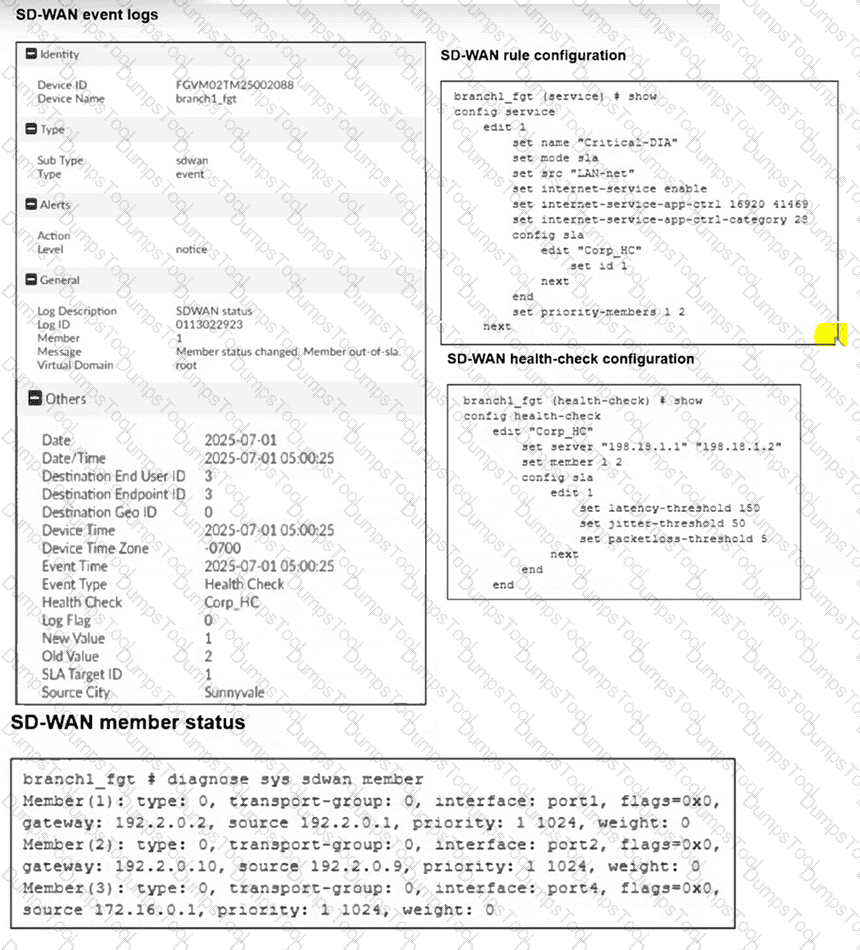
Question # 32

Exhibit 1

A.

FortiGate skips SD-WAN rule ID 1.

B.

FortiGate uses port2 to steer the traffic for SD-WAN rule ID 1.

C.

FortiGate uses port1 to steer the traffic for SD-WAN rule ID 1.

D.

FortiGate uses port1 or port2 to steer the traffic for SD-WAN rule ID 1.

Full Access
Question # 33

Refer to the exhibit. For your ZTP deployment, you review the CSV file shown in exhibit and note that it is missing important information. Which two elements must you change before you can import it into FortiManager? (Choose two.)

Question # 33

Exhibit 1

A.

You must associate a device blueprint with each device

B.

You must define a name for each device

C.

You must define a value for each device and each metadata variable that defines an IP address.

D.

You must define a value for each device and each user-defined metadata variable.

Full Access