New Year Sale - Special 70% Discount Offer - Ends in 0d 00h 00m 00s - Coupon code: 70dumps

FCSS_SDW_AR-7.6 Questions and Answers

Question # 6

Exhibit.

Two hub-and-spoke groups are connected through redundant site-to-site IPsec VPNs between Hub 1 and Hub 2

Which two configuration settings are required for the spoke A1 to establish an ADVPN shortcut with the spoke B2? (Choose two.)

A.

On hubs, auto-discovery-forwarder must be enabled on the IPsec VPNs to hubs.

B.

On hubs, auto-discovery-receiver must be enabled on the IPsec VPNs to spokes.

C.

On hubs, auto-discovery-forwarder must be enabled on the IPsec VPNs to spokes.

D.

On hubs, auto-diacovery-sender must be enabled on the IPsec VPNs to spokes

Full Access
Question # 7

You are planning a new SD-WAN deployment with the following criteria:

- Two regions

- Most of the traffic is expected to remain within its region

- No requirement for inter-region ADVPN

To remain within the recommended best practices, which routing protocol should you select for the overlays?

A.

OSPF for the routing within each region and EBGP between the regions.

B.

IBGP with BGP on loopback within each region and EBGP between the regions.

C.

IBGP with BGP per overlays within each region and IBGP with BGP on loopback between the regions.

D.

IBGP within each region and between the regions.

Full Access
Question # 8

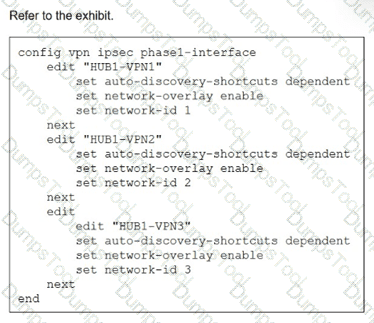
(Refer to the exhibit.

You update the spokes configuration of an existing auto-discovery VPN (ADVPN) topology by adding the parameters shown in the exhibit.

Which is a valid objective of those settings? Choose one answer.)

A.

Enable the tunnels as overlay links.

B.

Convert the configuration from ADVPN to ADVPN 2.0.

C.

Prevent cross-overlay shortcuts.

D.

Prevent multiple shortcuts from being established over the same overlay.

Full Access
Question # 9

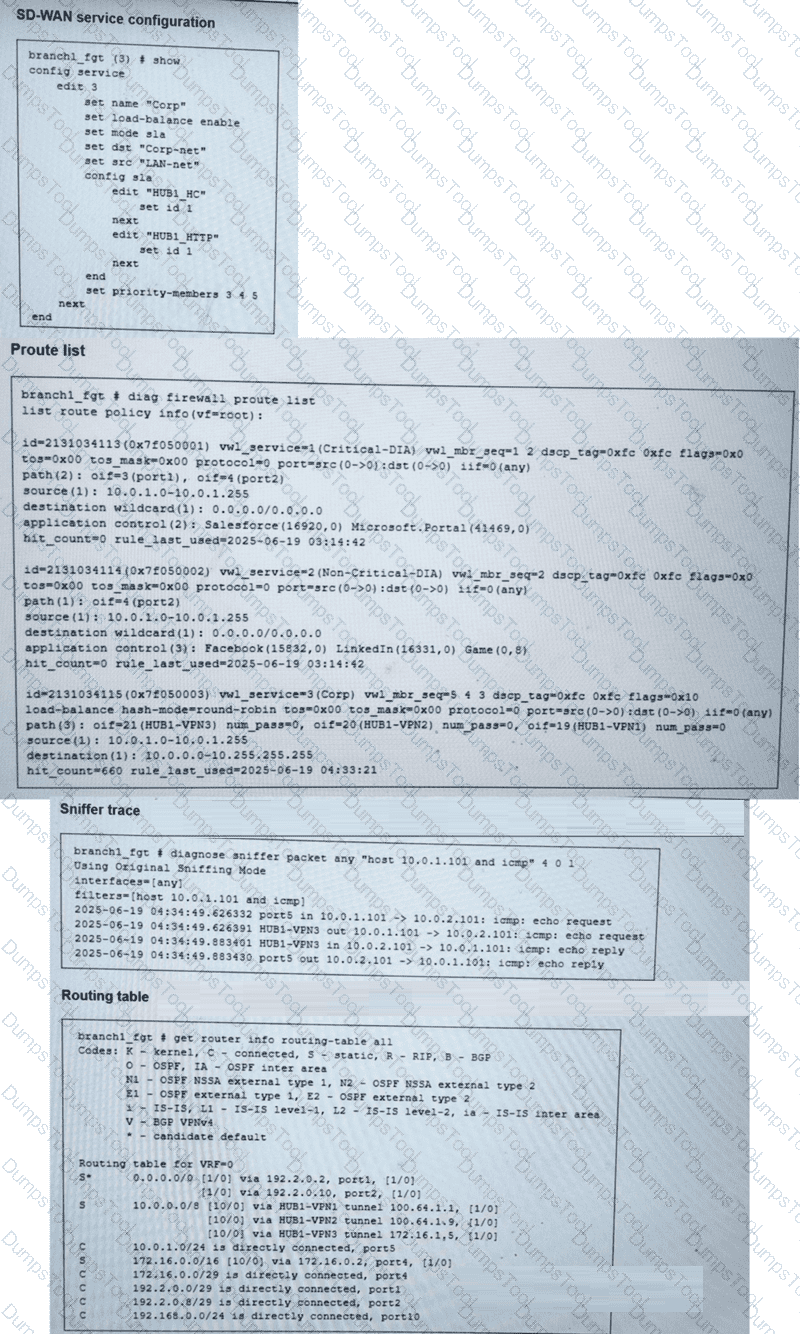
(Refer to the exhibits.

You collected the output shown in the exhibits and want to know which interface HTTP traffic will flow through from the user device 10.0.1.101 to the corporate web server 10.0.0.126. All SD-WAN links are stable.

Which interface will FortiGate use to steer the traffic? Choose one answer.)

A.

Only HUB1-VPN3

B.

Only HUB1-VPN2

C.

Either HUB1-VPN2 or HUB1-VPN3

D.

Either HUB1-VPN1, HUB1-VPN2, or HUB1-VPN3

Full Access
Question # 10

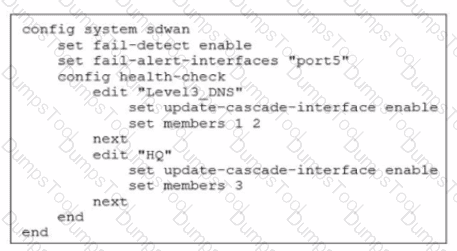
Exhibit.

Which action will FortiGate take if it detects SD-WAN members as dead?

A.

FoftiGate bounces port5 after it detects all SD-WAN members as dead.

B.

FortiGate fails over to the secondary device after it detects port5 as dead.

C.

FortiGate sends alert messages through poft5 when it detects all SD-WAN members as dead

D.

FortiGate brings down port5 after it detects all SD-WAN members as dead.

Full Access
Question # 11

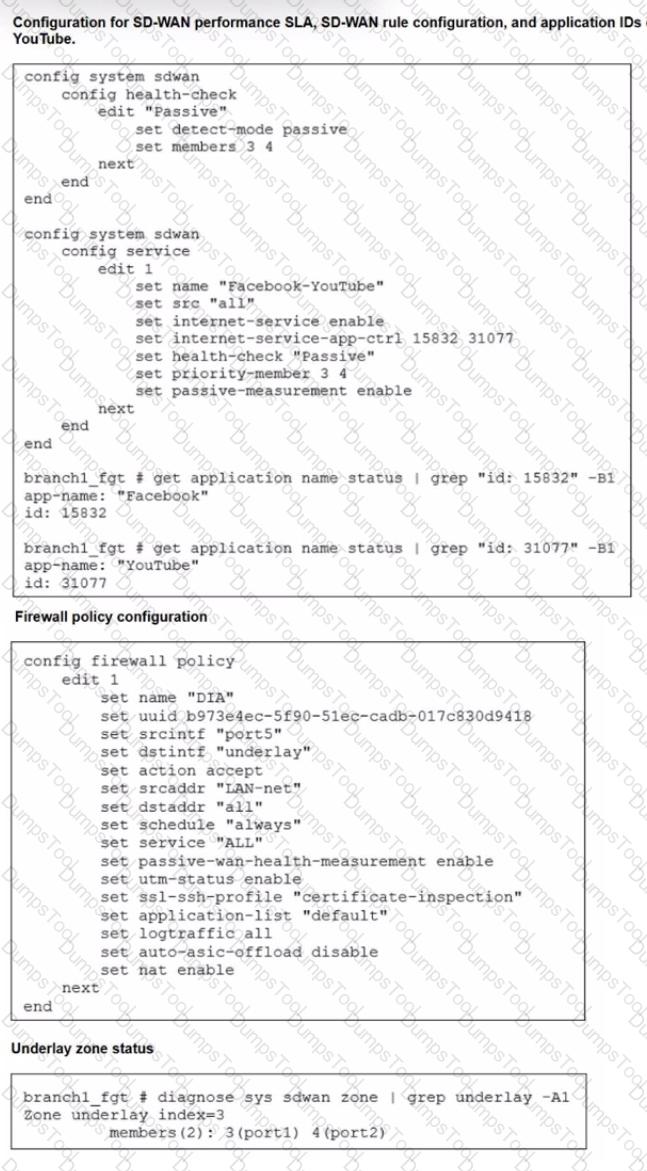
Refer to the exhibits.

The exhibits show the configuration for SD-WAN performance. SD-WAN rule, the application IDs of Facebook and YouTube along with the firewall policy configuration and the underlay zone status.

Which two statements are true about the health and performance of SD-WAN members 3 and 4? (Choose two.)

A.

Only related TCP traffic is used for performance measurement.

B.

The performance is an average of the metrics measured for Facebook and YouTube traffic passing through the member.

C.

Encrypted traffic is not used for the performance measurement.

D.

FortiGate identifies the member as dead when there is no Facebook and YouTube traffic passing through the member.

Full Access
Question # 12

(You want FortiGate to use SD-WAN rules to steer ping local-out traffic.

Which two constraints should you consider? Choose two answers.)

A.

You can steer local-out traffic only with SD-WAN rules that use the manual strategy.

B.

By default, FortiGate uses SD-WAN rules only for local-out traffic that corresponds to ping and traceroute.

C.

By default, local-out traffic does not use SD-WAN.

D.

You must configure each local-out feature individually to use SD-WAN.

Full Access
Question # 13

Refer to the exhibits.

You connect to a device behind a branch FortiGate device and initiate a ping test. The device is part of the LAN subnet and its IP address is 10.0.1.101.

Based on the exhibits, which interface uses branch 1_fgt to steer the test traffic?

A.

port4

B.

HUB1-VPN1

C.

port1

D.

port2

Full Access
Question # 14

(Refer to the exhibit.

You configure SD-WAN on a standalone FortiGate device.

You want to create an SD-WAN rule that steers traffic related to Facebook and LinkedIn through the less costly internet link.

What must you do to set Facebook and LinkedIn applications as destinations from the GUI? Choose one answer.)

A.

Enable the visibility of the applications field as destinations of the SD-WAN rule.

B.

In the Internet service field, select Facebook and LinkedIn.

C.

You cannot configure applications as destinations of an SD-WAN rule on a standalone FortiGate device.

D.

Install a license to allow applications as destinations of SD-WAN rules.

Full Access
Question # 15

You used the HUB IPsec_Recommended and the BRANCH IPsec_Recommended templates to define the overlay topology. Then, you used the SD-WAN template to define the SD- WAN members, rules, and performance SLAs.

You applied the changes to the devices and want to use the FortiManager monitors menu to get a graphical view that shows the status of each SD-WAN member.

Which statement best explains how to obtain this graphical view?

A.

Use the SD-WAN monitor template view to get a map view of the branches, hub, and tunnel status, including the SLA pass or missed status.

B.

Use the SD-WAN monitor table view to get a donut view and a table view that shows the status of each SD-WAN member, including the SLA pass or missed status.

C.

Use the VPN monitor map view to get a map view of the branches, hub, and tunnel status, including the SLA pass or missed status.

D.

Use the SD-WAN monitor asset view to get a donut view and a table view that shows the status of each device and the SLA status of each SD-WAN member.

Full Access
Question # 16

Which three factors about SLA targets and SD-WAN rules should you consider when configuring SD-WAN rules? (Choose three.)

A.

Member metrics are measured only if a rule uses the SLA target.

B.

SLA targets are used only by SD-WAN rules that are configured with a Lowest Cost (SLA) strategy.

C.

SD-WAN rules can use SLA targets to check whether the preferred members meet the SLA requirements.

D.

When configuring an SD-WAN rule, you can select multiple SLA targets if they are from the same performance SLA.

E.

When configuring an SD-WAN rule, you can select multiple SLA targets from different performance SLAs.

Full Access
Question # 17

Refer to the exhibits.

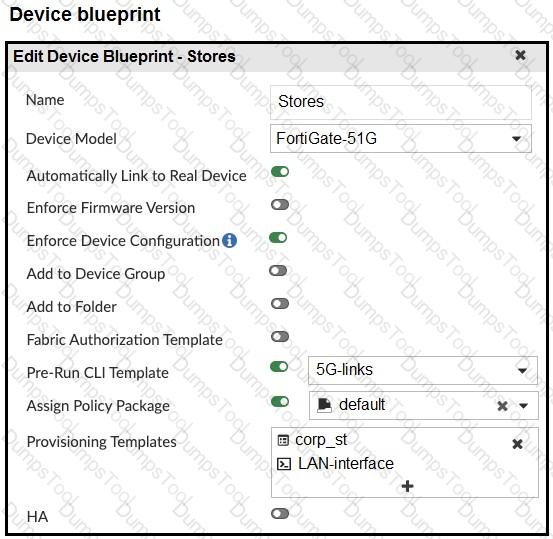
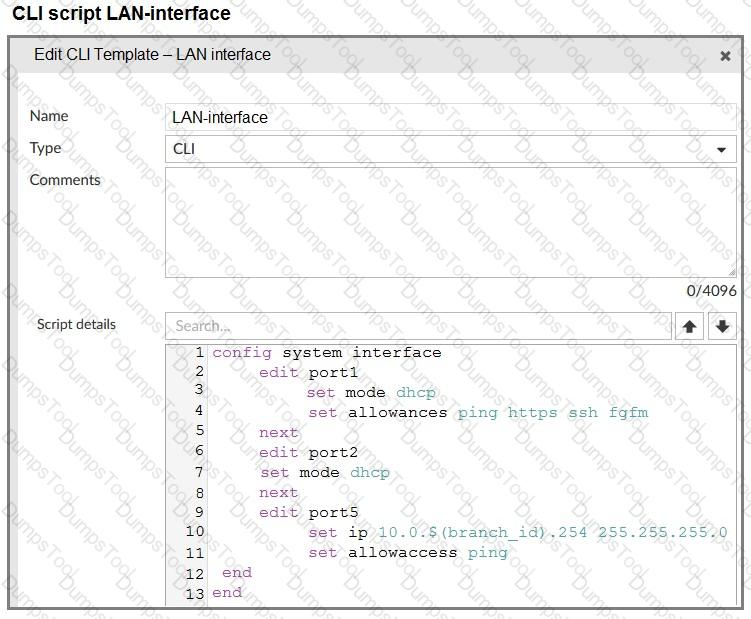
The administrator configured a device blueprint and CLI scripts as shown in the exhibits, to prepare for onboarding FortiGate devices in the company’s stores. Later, a technician prepares a FortiGate 51G with a basic configuration and connects it to the network. The basic configuration contains the port1 configuration and the minimal configuration required to allow the device to connect to FortiManager.

After the device first connects to FortiManager, FortiManager updates the device configuration.

Based on the exhibits, which actions does FortiManager perform?

A.

FortiManager updates the device configuration according to the selected templates. It applies the corp_st template first.

B.

FortiManager does not update the port1 configuration because FortiManager does not change the configuration of interfaces with fgfm access.

C.

FortiManager updates access rights only for port1. FortiManager cannot update the IP address because it was already set manually.

D.

FortiManager updates the configuration of port1, port2, and port5. The three ports might get new IP addresses.

Full Access
Question # 18

When a customer delegate the installation and management of its SD-WAN infrastructure to an MSSP, the MSSP usually keeps the hub within its infrastructure for ease of management and to share costly resources.

In which two situations will the MSSP install the hub in customer premises? (Choose two.)

A.

The customer requires SIA with centralized breakout.

B.

The administrator expects a large volume of traffic between the branches.

C.

The customer expects a large amount of VoIP traffic.

D.

The majority of the branch traffic is directed to a corporate data center.

Full Access
Question # 19

When you use the command diagnose sys session list, how do you identify the sessions that correspond to traffic steered according to SD-WAN rules?

A.

You identify sessions steered according to SD-WAN rules with the flag vwl.

B.

You cannot identify SD-WAN sessions. You must use the sdwar. session filter.

C.

You identify sessions steered according to SD-WAN rules with the data vwl_mbr_seq.

D.

You identify sessions steered according to SD-WAN rules with the data 3dwan_service_id.

Full Access
Question # 20

As an IT manager for a healthcare company, you want to delegate the installation and management of your SD-WAN deployment to a managed security service provider (MSSP). Each site must maintain direct internet access and ensure that it is secure. You expected significant traffic flow between the sites and want to delegate as much of the network administration and management as possible to the MSSP.

Which two MSSP deployment blueprints best address the customer’s requirements? (Choose two.)

A.

Use a shared hub at the MSSP premises with a dedicated VDOM for the new customer, and install the spokes at the customer premises.

B.

Use a shared hub at the MSSP premises and a dedicated hub at the customer premises and install the spokes at the customer premises.

C.

Install a dedicated hub at the MSSP premises for the new customer, and install the spokes at the customer premises.

D.

Install the hub and spokes at the customer premises and enable the MSSP to manage the SD-WAN deployment using FortiManager with a dedicated ADOM.

Full Access
Question # 21

Refer to the exhibits.

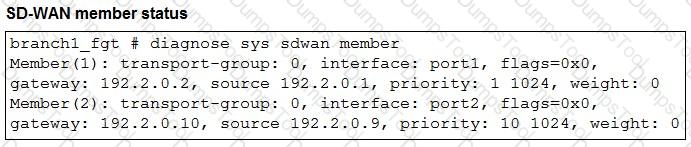
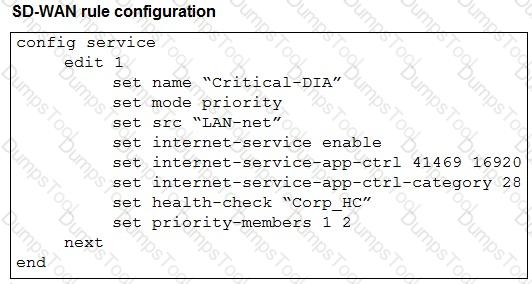
The exhibits show an SD-WAN event log, the member status, and the SD-WAN rule configuration.

Which two conclusions can you draw from the information shown? (Choose two.)

A.

The administrator configured the service ID 1 with the highest priority member for port2.

B.

Port2 has a lower latency than port1.

C.

FortiGate updated the outgoing interface list on the rule so it prefers port2.

D.

The administrator configured the SD-WAN rule ID 1 with the default strategy mode.

Full Access
Question # 22

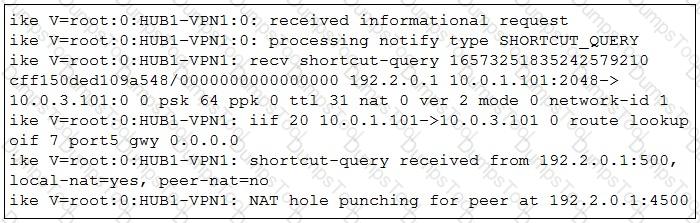
Refer to the exhibit.

Which statement best describe the role of the ADVPN device in handling traffic?

A.

This is a spoke that has received a direct shortcut query from a remote spoke.

B.

This is a hub, and two spokes, 192.2.0.1 and 10.0.3.101, establish a shortcut.

C.

This is a hub that has received a shortcut query from a spoke and has forwarded it to another spoke.

D.

This is a spoke that has received a shortcut query from a remote hub.

Full Access
Question # 23

SD-WAN interacts with many other FortiGate features. Some of them are required to allow SD-WAN to steer the traffic.

Which three configuration elements that you must configure before FortiGate can steer traffic according to SD-WAN rules? (Choose three.)

A.

Firewall policies

B.

Interfaces

C.

Security profiles

D.

Traffic shaping

E.

Routing

Full Access
Question # 24

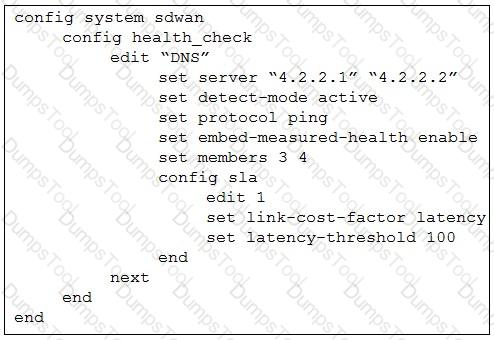
Refer to the exhibit.

The exhibit shows the health-check configuration on a FortiGate device used as a spoke. You notice that the hub FortiGate doesn’t prioritize the traffic as expected.

Which two configuration elements should you check on the hub? (Choose two.)

A.

The performance SLA has the parameter priority-out-sla configured.

B.

This performance SLA uses the same members.

C.

The performance SLA uses the same criteria.

D.

The performance SLA is configured with set embedded-measure accept.

Full Access
Question # 25

(Refer to the exhibit. You noticed that one SD-WAN member went down and you immediately collected the session output shown in the exhibit. What can you conclude from this output? Choose one answer.)
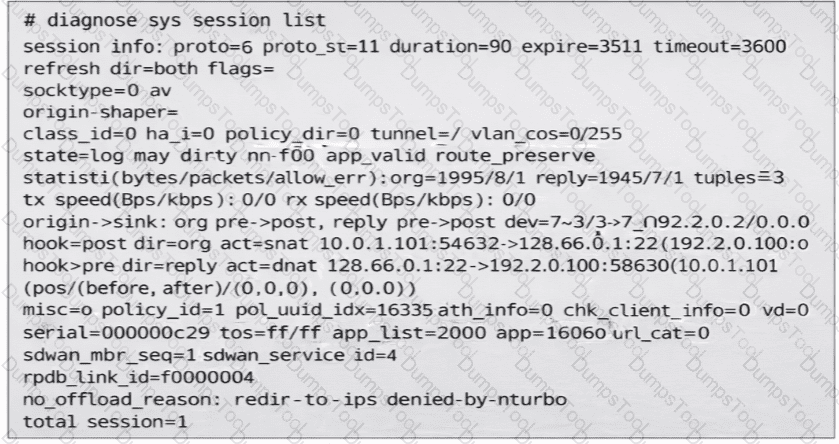
A.

FortiGate didn’t receive any traffic related to this session after the interface went down.

B.

FortiGate flushed the gateway for the session.

C.

FortiGate cannot reevaluate the session.

D.

FortiGate already reevaluated this session.

Full Access
Question # 26

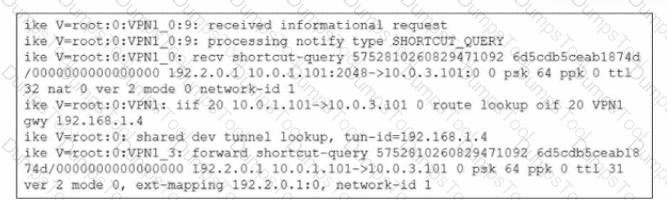
Refer to the exhibit.

Which statement best describe the role of the ADVPN device in handling traffic?

A.

This is a hub that has received a query from a spoke and has forwarded it to another spoke.

B.

This is a hub in a dual-region topology. The remote hub tunnel ID is 10.0.2.101.

C.

This is a spoke that has received a shortcut query from another spoke and has forwarded the response to its hub.

D.

This is a spoke. The kernel received a shortcut request and forwards the query to another spoke.

Full Access
Question # 27

An SD-WAN member is no longer used to steer SD-WAN traffic. The administrator updated the SD-WAN configuration and deleted the unused member. After the configuration update, users report that some destinations are unreachable. You confirm that the affected flow does not match an SD-WAN rule.

What could be a possible cause of the traffic interruption?

A.

FortiGate, with SD-WAN enabled, cannot route traffic through interfaces that are not SD-WAN members.

B.

FortiGate can remove some static routes associated with an interface when the member is removed from SD-WAN.

C.

FortiGate removes the layer 3 settings for interfaces that are removed from the SD-WAN configuration.

D.

FortiGate administratively brings down interfaces when they are removed from the SD-WAN configuration.

Full Access
Question # 28

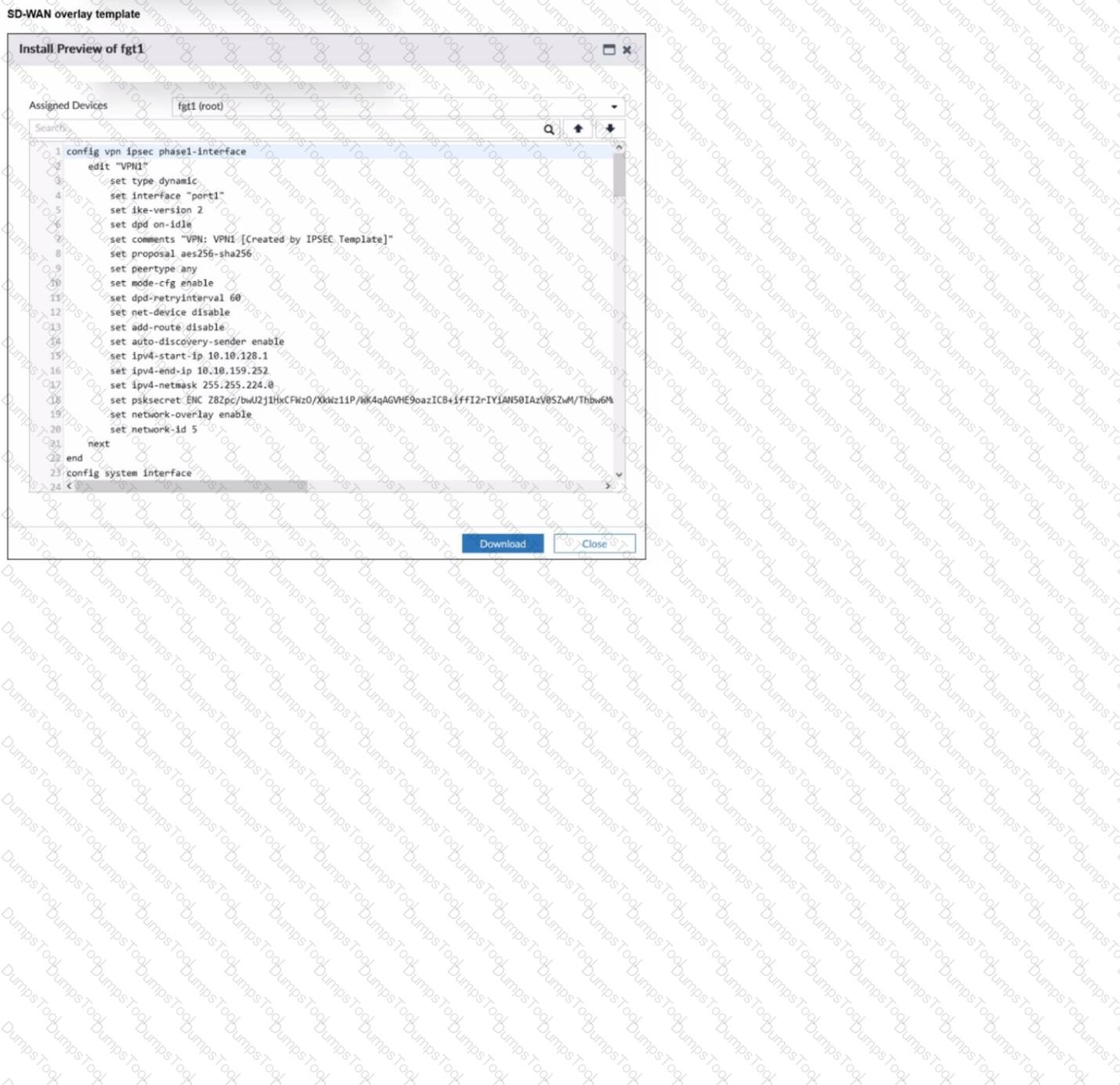
Refer to the exhibit.

The administrator used the SD-WAN overlay template to prepare an IPsec tunnels configuration for a hub-and-spoke SD-WAN topology. The exhibit shows the FortiManager installation preview for one FortiGate device.

Based on the exhibit, which statement best describes the configuration applied to the FortiGate device?

A.

It is a spoke device that establishes dynamic IPsec tunnels to the hub. The local subnet range is 10.10.128.0/23.

B.

It is a hub device. It can send ADVPN shortcut offers.

C.

It is a hub device. It will automatically discover the spoke devices and add them to the SD-WAN topology.

D.

It is a spoke device that establishes dynamic IPsec tunnels to the hub It can send ADVPN shortcut requests.

Full Access