dumpstool logo

A web server administrator informs the BIG-IP Administrator that web servers currently load-balanced require encrypted traffic. Starting next month, the web server administrator will offload SSL. Starting next month, the BIG-IP device will terminate SSL to reduce web server load. The BIG-IP device is already using Client SSL, Client port, and iRules on HTTP traffic. What actions should the BIG-IP Administrator take to achieve the desired configuration? (Choose one answer)
How can a BIG-IP Administrator identify a configuration object that has been configured within an iApp?
Users are unable to reach an application. The Virtual Server shows a red diamond status in the Configuration Utility.
What is the cause?
In the BIG-IP Configuration Utility, a user requests a single screen view to determine the status of all Virtual Servers and associated pool members, as well as any iRules in use. Where should the BIG-IP Administrator instruct the user to find this view?
The BIG-IP Administrator has to provide encrypted communication between the users and the virtual server they access. Multiple hostnames are configured in DNS with the same IP address. Which profile type and setting in the profile should be used?
All pool members are online. All other virtual server settings are at default.
What might alter the load balancing behavior? (Choose one answer)
A BIG-IP Administrator creates an HTTP Virtual Server using an iApp template. After the Virtual Server is created, the user requests to change the destination IP addresses. The BIG-IP Administrator tries to change the destination IP address from 10.1.1.1 to 10.2.1.1 in Virtual Server settings, but receives the following error: " The application service must be updated using an application management interface. " What is causing this error?
A BIG-IP Administrator creates a new Virtual Server to load balance SSH traffic. Users are unable to log on to the servers.
What should the BIG-IP Administrator do to resolve the issue?
A BIG-IP Administrator configures a node with a standard icmp Health Monitor. The Node shows as DOWN although the Backend Server is configured to answer ICMP requests. Which step should the administrator take next to find the root cause of this issue?
In a pool there are 2 pool members (older servers) that can handle fewer connections than the other 3 newer servers.
Which load balancing method would allow more traffic to be directed to the newer servers? (Choose one answer)
An organization is reporting slow performance accessing their Intranet website. All employees use a single Proxy Server with a public IP.
What should the BIG-IP Administrator do to fix this issue?
Refer to the exhibit.
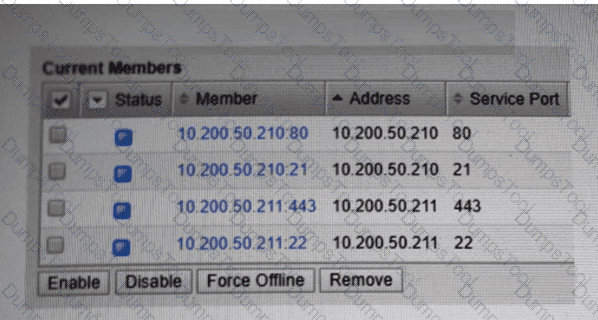
A BIG-IP Administrator needs to configure health monitors for a newly configured server pool named Pool_B.
Which health monitor settings will ensure that all pool members will be accurately marked as available or unavailable? (Choose one answer)
The BIG-IP Administrator is investigating whether better TCP performance is possible for a virtual server.
Which built-in profile should be tried first? (Choose one answer)
A BIG-IP Administrator adds new pool members into an existing, highly utilized pool. Soon after, there are reports that the application is failing to load for some users.
What pool-level setting should the BIG-IP Administrator check?
A Standard Virtual Server for a web application is configured with Automap for the Source Address Translation option. The original source address of the client must be known by the backend servers. What should the BIG-IP Administrator configure to meet this requirement?
A BIG-IP Administrator finds the following log entry after a report of user issues connecting to a virtual server:
01010201: Intercept exhaustion on 10.70.110.112 to 192.28.123.250:80 (proto 6)
How should the BIG-IP Administrator modify the SNAT pool that is associated with the virtual server? (Choose one answer)
The BIG-IP Administrator is investigating if better TCP performance is possible for a virtual server. Which built-in profile should be tried first?
Local Traffic Network Map: VS_HTTP → POOL_WEB → 192.168.212.30:80 Pool Member | Parent Node 192.168.212.30 Port 80
Why is the virtual server unresponsive to incoming connections?

TESTED 25 Sep 2026