
Pre-Summer Sale - Special 70% Discount Offer - Ends in 0d 00h 00m 00s - Coupon code: 70dumps

CCPSC Questions and Answers

Question # 6

Which of the following are Hazard Identification and Risk Analysis methods? (Select all that apply)

A.

Root Cause Analysis

B.

Layer of Protection Analysis

C.

Bow-Tie Analysis

D.

What-If

E.

Fish Bone Analysis

F.

FMEA

Full Access
Question # 7

Which of the following are evidence that good workforce involvement exists at a facility? (Select all that apply)

A.

Operators are always included on PHA teams

B.

Operators are disciplined for not following procedures

C.

Operators are expected to report minor process safety incidents

D.

Operators participate on incident investigation teams

E.

Operators are consulted on the content of training programs

Full Access
Question # 8

Which of the following statements apply to the purpose of an incident investigation? (Select all that apply)

A.

To help continually improve the process safety management efforts

B.

To determine who should be disciplined for causing the event

C.

To prevent reoccurrence of the same or similar process safety incidents

D.

To document all injuries as process safety incidents

Full Access
Question # 9

During a Risk Based Process Safety audit, one operator states that refresher training should be provided more frequently. What actions should the auditor take? (Select all that apply)

A.

The auditor should classify this as a finding. No additional information is required

B.

The auditor should record this input, but not classify this as a finding based on a single observation

C.

The auditor should not classify this as a finding because the operator should not have been interviewed

D.

The auditor should interview additional operators before deciding whether to classify the observation as a finding

Full Access
Question # 10

Which of the following conditions could indicate performance problems in a plant’s Asset Integrity program? (select all that apply)

A.

An operator can identify each piece of equipment on the maintenance schedule and explain what is planned

B.

The metrics report related to Asset Integrity performance is 9 months out of date

C.

The rotating equipment is vibrating excessively

D.

Piping handling hazardous material within a containment area is not on the inspection list

Full Access
Question # 11

Which of the following would be most effective as a leading metric for a Management of Change program?

A.

Percentage of procedures revalidated per schedule/plan/period

B.

Percentage of work orders/requests which were misclassified as replacement-in-kind

C.

Number (or percent) of overdue inspection, testing, and preventative maintenance tasks

D.

Number of metrics for which data are collected

Full Access
Question # 12

Which of the following is not a leading metric for emergency management?

A.

Number of actual process safety incidents in past year

B.

Number of trained emergency response team members on each shift

C.

Number of revisions to emergency response plans in past year

D.

Number of realistic emergency response drills in past year

Full Access
Question # 13

Contractors were installing a heating coil in a small tank. When the job was nearly complete, the workers went on break, but one of them stayed behind and entered the tank alone. It is believed that while doing so, he inadvertently bumped open the nitrogen supply line lever-operated valve. He was later found dead inside the tank. Based only on the information provided in this brief description, which of the RBPS (Risk Based Process Safety) elements most directly apply to this event? (Select all that apply)

A.

Safe Work Practices

B.

Contractor Management

C.

Measurement and Metrics

D.

Management Review and Continuous Improvement

E.

Auditing

F.

Emergency Management

Full Access
Question # 14

For a vapor explosion in an unconfined and uncongested area, the amount of thermodynamic energy that ends up in the overpressure is approximately:

A.

100%

B.

50–75%

C.

10–15%

D.

2–5%

E.

0%

Full Access
Question # 15

Which of the following statements is correct pertaining to Process Safety Audits? (Select all that apply)

A.

An audit is a systematic, independent review to verify conformance with established guidelines, standards, regulatory requirements, or self-imposed requirements of the organization.

B.

2nd and 3rd party audit teams may include access to a representative of the facility being audited.

C.

Findings and recommendations usually are the same thing in a process safety audit.

D.

It is always appropriate for a facility to staff the audit team with only site personnel.

Full Access
Question # 16

For a vapor explosion that occurs in a closed vessel, the amount of thermodynamic energy that ends up in the overpressure is approximately:

A.

2%

B.

50%

C.

17.5%

D.

0%

Full Access
Question # 17

A principal rule of HAZOP is: “The more participants in the room, the more effective the exercise will be”. True or false?

A.

True

B.

False

Full Access
Question # 18

A contractor has been hired to apply a proprietary coating in an unoccupied process area. The coating has hazardous properties. What documentation should the contractor provide to the site owner before starting work? (Select all that apply)
A.

The contractor’s procedure for handling and applying the coating

B.

The site owner is responsible for protecting the site employees, so no contractor documentation needs to be provided

C.

No documentation is required since the contractor’s technology is proprietary

D.

A plan on how the contractor will protect all site employees from exposure

E.

A Safety Data Sheet (SDS) for the coating materials

Full Access
Question # 19

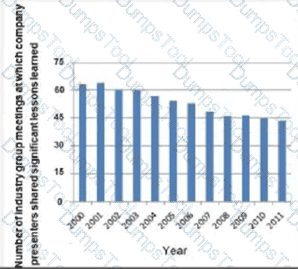
The X/Y/Z Corporation decides to track an activity as shown in the diagram. They interpret the results to indicate a possible deteriorating performance in one of their process safety management elements.

The chart shows a declining trend in the number of industry group meetings at which company presenters shared significant lessons learned over several years.

Which of the following RBPS elements is MOST directly reflected by this activity?

A.

Compliance with Standards

B.

Process Safety Competence

C.

Stakeholder Outreach

D.

Workforce Involvement

E.

Measurement and Metrics

Full Access
Question # 20

The following groups may provide information required for the Process Knowledge Management element (select all that apply)

A.

Process equipment vendors

B.

External engineering firms

C.

Corporate research and development function

D.

Local emergency responders

Full Access
Question # 21

A toxic release occurs. Which conditions are more likely to result in the highest downwind concentration at a given distance?

A.

1.5 m/s wind speed, Pasquill Class F stability

B.

5 m/s wind speed, Pasquill Class D stability

C.

3 m/s wind speed, Pasquill Class F stability

D.

3 m/s wind speed, Pasquill Class D stability

Full Access
Question # 22

Process Safety Competency is not involved with succession planning. True or False?

A.

True

B.

False

Full Access
Question # 23

What is it called when a process operates outside of documented standard operating limits?

A.

Consequences of Deviation

B.

Emergency Response

C.

Abnormal Operations

D.

Transient Operation

Full Access
Question # 24

Individuals presenting information on a Risk Based Process Safety element during a Management Review are expected to: (select all that apply)

A.

Identify accident root causes

B.

Offer potential improvement opportunities for the element, where warranted

C.

Answer questions about the implementation of the element

D.

Present performance metrics for the element

E.

Conduct annual certification of operating procedures

Full Access
Question # 25

Development and documentation of information about the equipment and chemicals is most closely related to which risk based process safety element?

A.

Hazard Identification and Risk Analysis

B.

Process Knowledge Management

C.

Process Safety Competence

D.

Compliance with Standards

Full Access
Question # 26

A contract company that has never worked at your site is the only contract company technically capable of performing a critical task at your site. The contract company’s safety record is well below your company’s safety performance criteria. What activities do you take while they are working on-site? (select all that apply)

A.

Participate in job pre-plan activities daily with the contract company workers to understand the work they will be performing and their plan to do it safely

B.

Meet with the management of the contract company after the completion of the project to discuss their safety performance onsite

C.

If significant safety issues occur, stop all of the contract company work at the site and discuss/retrain as needed

D.

Conduct frequent observations of the worksite and stop any unsafe work, then provide timely feedback to the contract company on the observed safety issues

E.

Investigate and document any safety issues with the contract company activities

Full Access
Question # 27

A material had been oxidized many times, without incident, under an oxygen atmosphere in a small pilot plant vessel. While scaling up to a larger vessel, the plant engineers decided they could improve gas/liquid contact by using a more efficient feed dispersing system. This dispersing system filled the reactor ' s vapor space with a fine combustible mist. Several hours after startup, the vessel was ruptured by an internal mist explosion. The source of ignition was a small amount of catalyst left over from an earlier set of experiments. This was a phenomenon that the engineers had not considered. Which of the following risk based process safety elements could have helped prevent this incident? (Select all that apply)

A.

Measurement and Metrics

B.

Management of Change

C.

Contractor Management

D.

Process Knowledge Management

E.

Emergency Management

Full Access
Question # 28

Applicable codes and standards can be issued by (Select all that apply)

A.

The company

B.

Regulatory agencies

C.

The business unit or site

D.

National or international standards organizations

Full Access
Question # 29

Which of the following typically require piping wall thickness inspections? (Select all that apply)
A.

Process piping that is protected by insulation

B.

Piping that contains drinking water

C.

Piping that contains nitrogen

D.

Buried process piping at the point where the piping exits the ground

E.

Piping that could contain stagnant liquid

Full Access
Question # 30

Management of Change review should be done: (select all that apply)

A.

For process related changes

B.

Throughout the process lifecycle

C.

For replacement in kind

D.

To confirm operational readiness

E.

To evaluate compliance with safe work practices

Full Access
Question # 31

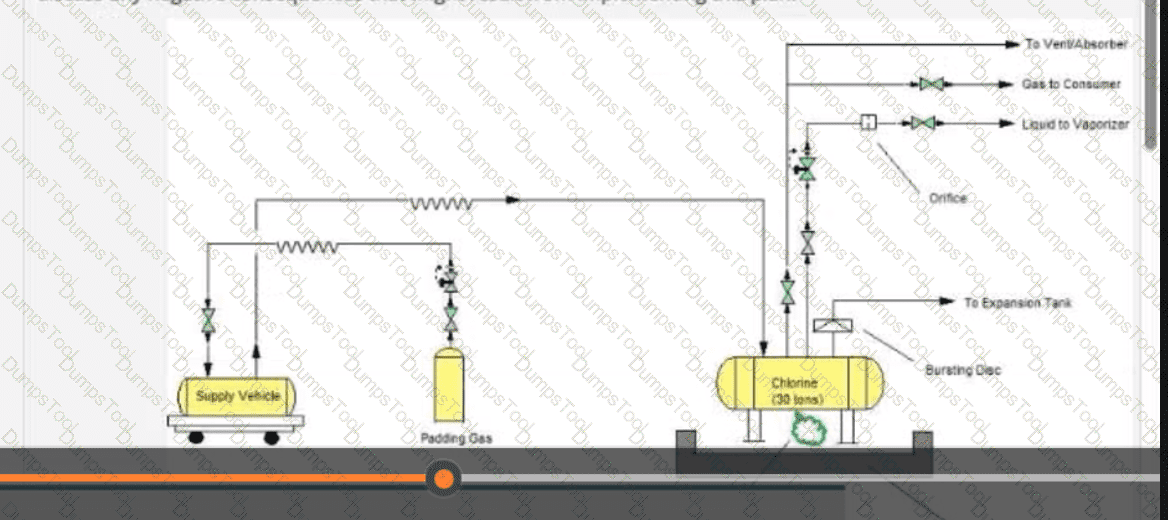
A chemical processor has a chlorine unloading facility shown in the sketch. The area has an ambient chlorine detector with audible alarm and a chemical operator is continually in attendance during the unloading operation. In the event of a leak, the action plan is to spray water on the leak and the contained spill to effect some dilution. Identify and discuss any negative consequences that might result from implementing this plan.

A.

Water spray always neutralizes chlorine safely with no risks

B.

Water spray may increase hazard by forming toxic/corrosive byproducts, spreading contamination, and increasing exposure risk

C.

The plan eliminates the need for detection systems

D.

There are no significant consequences if an operator is present

Full Access
Question # 32

The Management of Change element: (select all that apply)

A.

Helps maintain safe process operations

B.

Makes the evaluation of the safety impact of a small change optional

C.

Helps avoid inaccuracies in process safety information

D.

Requires communicating approved changes to affected contractors

Full Access
Question # 33

The XYZ Corporation decides to track an activity as shown in the diagram. They interpret the results to indicate a possible deteriorating performance in one of their process safety management elements.

Full Access